
Determine the necessary mass, volume, or concentration for preparing a solution.
| Activity Type | Activity Value -log(M) | Mechanism of Action | Activity Reference | Publications (PubMed IDs) |
|---|
Moligand™, 10mM in DMSO Moligand™ for sensitive chromatographic and analytical workflows requiring minimal baseline interference.
Store at -80°C Ships Dry ice packs + Cold packs Check lot-specific COA for exact specifications.
SDS, COA, datasheet, and spec sheet available for download. Lot-specific COA accessible via lot number lookup.
Cited in 0 peer-reviewed publications across chromatography, organic synthesis, and cross-coupling reactions.
Information
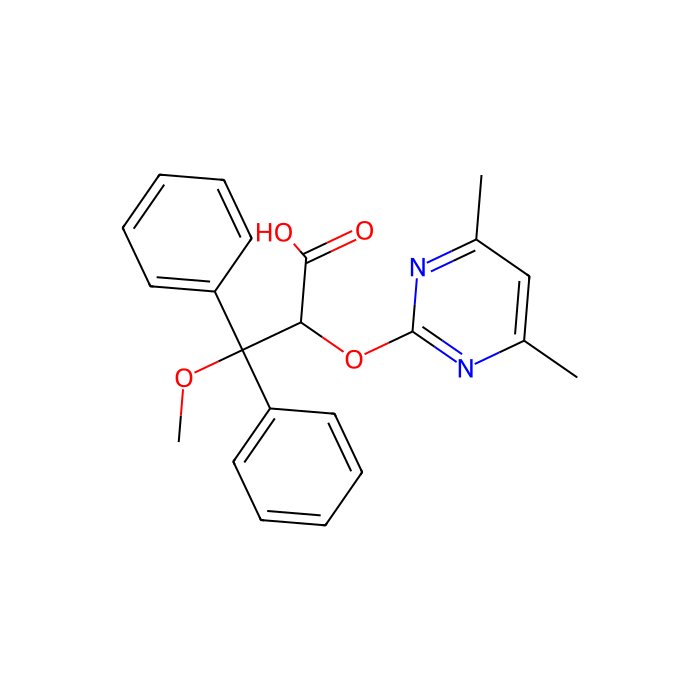
Ambrisentan Ambrisentan (LU-208075, BSF-208075) is a highly selective antagonist of the endothelin-1 type A receptor , used in the treatment of pulmonary arterial hypertension (PAH).
In vitro
Ambrisentan only increases intracellular calcein fluorescence in P388/dx cells at concentrations above 100 μM and in L-MDR1 cells not at all indicating negligible P-gp inhibition. Ambrisentan inhibits specific [(125)I]ET-1 binding in these tissues in a concentration-dependent manner. Ambrisentan undergoes oxidative metabolism mainly by cytochrome P450 (CYP) 3A4 and to a lesser extent by CYP3A5 and CYP2C19. Ambrisentan is not only a strong inducer of CYP3A4, but also of ABCB1 and ABCG2. Ambrisentan also has a concentration-dependent effect on PXR activity, but because plateau effects are not reached, an EC50-value could not be calculated. Ambrisentan inhibits specific [(125)I]ET-1 binding in a concentration-dependent manner at nanomolar ranges of IC50. Ambrisentan significantly increases the dissociation constant for bladder [(125)I]ET-1 binding without affecting maximal number of binding sites (Bmax). Ambrisentan seem to bind to bladder ET-1 receptor in a competitive and reversible manner. Ambrisentan is an effective and safe treatment which is a valuable addition to the armamentarium against PAH. Ambrisentan offers a relative lack of drug interactions, once daily dosing and reassuring liver safety, offering safety and convenience advantages over bosentan.
In vivo
Cell Data
cell lines:
Concentrations:
Incubation Time:
Powder Purity:≥99%
| ALogP | 3.8 |
|---|
| Isómeros SMILES | CC1=CC(=NC(=N1)O[C@H](C(=O)O)C(C2=CC=CC=C2)(C3=CC=CC=C3)OC)C |
|---|---|
| RTECS | UA2459660 |
| Peso molecular | 378.42 |
| Reaxy-Rn | 7549073 |
| Reaxys-RN_link_address | https://www.reaxys.com/reaxys/secured/hopinto.do?context=S&query=IDE.XRN=7549073&ln= |
Comprehensive hazard, handling, storage, and regulatory compliance document.
Download SDS →Lot-specific quality data. Enter your lot number to retrieve the exact COA.
Look up COA →Full quality attributes and acceptance criteria for this grade.
View spec sheet →| Activity Type | Activity Value -log(M) | Mechanism of Action | Activity Reference | Publications (PubMed IDs) |
|---|
| Activity Type | Activity Value -log(M) | Mechanism of Action | Activity Reference | Publications (PubMed IDs) |
|---|
| Rotación específica [α] | 173° (C=0.5,MeOH) |
|---|---|
| Punto de fusión (°C) | 178 °C(dec.) |
Our grade selection guide covers purity, stabilizer status, and application suitability for all variants in our catalog.
View Moligand™ grade guide →