2mM in DMSO for sensitive chromatographic and analytical workflows requiring minimal baseline interference.
🌡
Storage & shipping
Store at -80°C Ships Dry ice packs + Cold packs Check lot-specific COA for exact specifications.
📋
Quality documents
SDS, COA, datasheet, and spec sheet available for download. Lot-specific COA accessible via lot number lookup.
📚
Literature proof
Cited in 5 peer-reviewed publications across chromatography, organic synthesis, and cross-coupling reactions.
Descripción general
Information
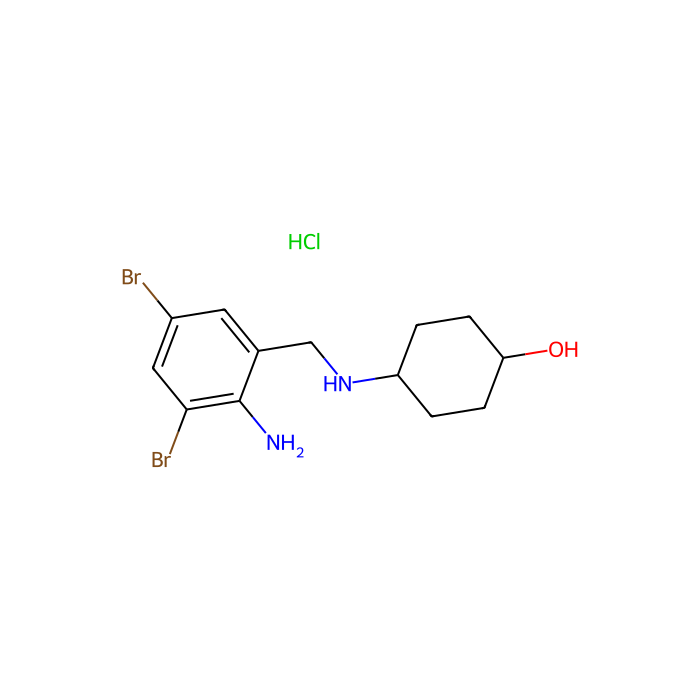
Ambroxol HCl AmbroxolHCl is a potent inhibitor of the neuronal Na+ channels , inhibits TTX-resistant Na+ currents with IC50 of 35.2 μM and 22.5 μM for tonic and phasic block, inhibits TTX-sensitive Na+ currents with IC50 of 100 μM. Phase 3. In vitro
Ambroxol inhibits Na+ channels in sensory neurons. The potency for tonic block of TTX-r channels is relatively high. Ambroxol affects the Na+ current kinetics of TTX-r and TTX-s channels differently. In CNaIIA cells, the compound behaves like a charged local anesthetic: the block is dependent on stimulus number and increases with higher frequencies in a train of depolarizing stimuli. In CNaIIA cells, ambroxol inhibits inactivated channels 5.5-fold more potently than resting channels. The corresponding factor for TTX-r channels is only 3.3. Ambroxol inhibits the release of histamine, leukotrienes and cytokines from human leukocytes and mast cells.
In vivo
Ambroxol inhibited histamine release by more than 50% from human adenoidal mast cells (1000 microM ambroxol) and skin mast cells (100 microM ambroxol) stimulated by Con A and compound 48/80, respectively. Ambroxol (100 microM) strikingly inhibited anti-IgE induced release of both histamine, LTC4, IL-4 and IL-13 from basophils and reduced both histamine and LTB4 release induced by C5a or Zymosan in monocytes. The drug also reduced LTB4 and superoxide anion production in granulocytes stimulated by zymosan or fMLP. Cell Data
AmbroxolHCl is a potent inhibitor of the neuronal Na+ channels, inhibits TTX-resistant Na+ currents with IC50 of 35.2 μM and 22.5 μM for tonic and phasic block, inhibits TTX-sensitive Na+ currents with IC50 of 100 μM. Phase 3.
Condiciones de almacenamiento de almacenamiento
Store at -80°C
Enviado en
Dry ice packs + Cold packs
Este producto requiere envío en cadena de frío. Los servicios terrestres y otros servicios económicos no están disponibles.
1.Yushi Ding, Suyun Yu, Zhonghong Wei, Rui Deng, Peng Chen, Yifan Sun, Qi Jia, Xiaoman Li, Yuanyuan Wu, Wenxing Chen, Kurt S. Zanker, Aiyun Wang, Yin Lu. (2020) Relieving Sore Throat Formula Exerts a Therapeutic Effect on Pharyngitis through Immunoregulation and NF-κB Pathway. MEDIATORS OF INFLAMMATION, [PMID:32508523][10.1155/2020/2929163]
2.Sovichea Lay, Hai-ning Yu, Bao-xiang Hu, Sheng-rong Shen. (2016) Molecularly imprinted polymers as the extracted sorbents of clenbuterol ahead of liquid chromatographic determination. Journal of Zhejiang University-SCIENCE B, [PMID:27256680][10.1631/jzus.B1500225]
3.Binbin Shao, Chenkai Hu, Hainan Zhao, Chengcheng Xiao, Erdeng Du, Anhong Cai, Jing Deng. (2024) Degradation of ambroxol by UV/chloramine process: Kinetics, degradation pathway, and control of the risk of highly toxic disinfection by-products. ENVIRONMENTAL POLLUTION, [PMID:39393762][10.1016/j.envpol.2024.125091]
4.Fan Zhang, Yajie Ma, Jie Mei, Xinrong Xie, Xiaoyan Wang, Yuanyuan Zhang, Boyang Yu. (2026) Complementary Roles and Synergy of the Ephedra-Glycyrrhiza Herb Pair Across Murine Models of Respiratory Symptoms and Poly(I:C)-Induced Pneumonia. PHYTOMEDICINE, [PMID:41539102][10.1016/j.phymed.2026.157795]
5.Zheng Xiong, Niu Qiuqi, Cui Zihan, Sun Chuanzhi, Long Min, Wu Yang, Chen Yinguang. (2026) Functional Groups
in Pharmaceutical Contaminants Reshape
Sludge Fermentation Pathways: Substrate Selectivity and Microbial
Stress Responses. ENVIRONMENTAL SCIENCE & TECHNOLOGY, [PMID:][10.1021/acs.est.6c01101]
Calculadoras de soluciones
Molarity Calculator
Determine the necessary mass, volume, or concentration for preparing a solution.
Dilution Calculator
Determine the dilution needed to prepare a stock solution.
We use cookies to ensure the website functions properly and, where permitted, to improve your experience. You can manage your preferences at any time in Settings. Learn more in our Cookie Policy.
Shall we send you a message when we have discounts available?
Remind me later
Thank you! Please check your email inbox to confirm.
Products are supplied to verified businesses, institutions, and qualified professionals for research and development use only. Not for use in humans, animals, diagnosis, or therapy.