Determine the necessary mass, volume, or concentration for preparing a solution.
≥98% for sensitive chromatographic and analytical workflows requiring minimal baseline interference.
Store at -20°C Ships Ice chest + Ice pads Check lot-specific COA for exact specifications.
SDS, COA, datasheet, and spec sheet available for download. Lot-specific COA accessible via lot number lookup.
Cited in 3 peer-reviewed publications across chromatography, organic synthesis, and cross-coupling reactions.
Information
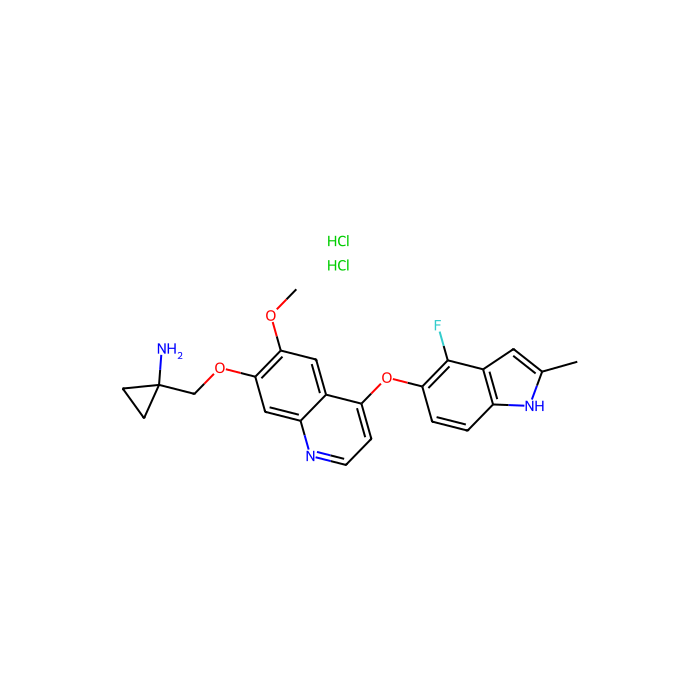
Anlotinib (AL3818) is a highly potent and selectiveVEGFR2inhibitor with IC50 less than 1 nM. It has broad-spectrum antitumor potential in clinical trials.Please use saline solution rather than PBS for dilutions. PBS may cause precipitation.
Targets
VEGFR2 (Cell-free assay); VEGFR3 (Cell-free assay); c-Kit (Cell-free assay); c-Kit (Cell-free assay); c-Kit (Cell-free assay) 0.2 nM; 0.7 nM; 14.8 nM; 14.8 nM; 14.8 nM
In vitro
Anlotinib occupies the ATP-binding pocket of VEGFR2 tyrosine kinase and shows high selectivity and inhibitory potency (IC 50 <1 nmol/L) for VEGFR2 relative to other tyrosine kinases. Anlotinib inhibits VEGFR2 and VEGFR3 with IC50 values of 0.2 and 0.7 nmol/L, respectively. The inhibitory potency of anlotinib against VEGFR1 is lower, with an IC50 value of 26.9 nmol/L. The IC50 values of anlotinib for inhibition of the PDGFR-related kinases c-Kit and PDGFRβ are 14.8 and 115.0 nmol/L, respectively. Anlotinib has little effect on the activity of other kinases, including c-Met, c-Src, EGFR and HER2, even at a concentration of 2000 nmol/L. Anlotinib inhibits VEGF-induced signaling and cell proliferation in HUVEC with picomolar IC50 values. However, micromolar concentrations of anlotinib are required to inhibit tumor cell proliferation directly in vitro. Anlotinib significantly inhibits HUVEC migration and tube formation; it also inhibits microvessel growth from explants of rat aorta in vitro.
In vivo
Anlotinib decreases vascular density in tumor tissue in vivo. Compared with the well-known tyrosine kinase inhibitor sunitinib, once-daily oral dose of anlotinib shows broader and stronger in vivo antitumor efficacy and, in some models, causes tumor regression in nude mice. It is well-tolerated in mice. Anlotinib is efficacious at doses (1.5‐6 mg/kg daily) that are significantly lower than effective doses of other TKI, which require doses of 20‐100 mg/kg to achieve significant inhibition of tumor growth in mice. anlotinib has showed broad activity against human tumor xenograft models of the colon (SW-620), ovarian (SK-OV-3), liver (SMMC-7721), renal (Caki-1), glioma (U87MG), and non-small cell lung (Calu-3) during dosing period. In Sprague-Dawley rats and beagle dogs, anlotinib is rapidly absorbed from the gastrointestinal tracks after oral administration. The oral bioavailability is 23-45 % in rats and 47-74 % in dogs. Anlotinib exhibits large volume of distribution in both species. In rats, primary tissues, such as the lung, kidneys, liver, and heart, exhibit significant higher exposure levels to anlotinib compared with that in plasma. The exposure level in the brain is comparable with the corresponding plasma level. In tumor-bearing mice, anlotinib concentrates 2.4-2.6 times in tumor tissue than in plasma. In human, anlotinib exhibits a quite long t1/2 (96 ± 17 h), which appeared to be dose-independent. The terminal half-life of anlotinib in dogs (22.8±11.0 h) is longer than that in rats (5.1±1.6 h). This difference appeares to be mainly associated with an interspecies difference in total plasma clearance (rats, 5.35±1.31 L/h/kg; dogs, 0.40±0.06 L/h/kg). In human plasma, anlotinib is predominantly bound to albumin and lipoproteins, rather than to α1-acid glycoprotein or γ-globulins.
Cell Research(from reference)
Cell lines:HUVEC, Mo7e, U-87MG and A431 cells
Concentrations:0-10 μM
Incubation Time:1.5 h
| Sonrisas canónicas | CC1=CC2=C(N1)C=CC(=C2F)OC3=C4C=C(C(=CC4=NC=C3)OCC5(CC5)N)OC.Cl.Cl |
|---|---|
| IUPAC Name | 1-[[4-[(4-fluoro-2-methyl-1H-indol-5-yl)oxy]-6-methoxyquinolin-7-yl]oxymethyl]cyclopropan-1-amine;dihydrochloride |
| InChIKey | UUAKQNIPIXQZFN-UHFFFAOYSA-N |
| INCHI | 1S/C23H22FN3O3.2ClH/c1-13-9-15-16(27-13)3-4-19(22(15)24)30-18-5-8-26-17-11-21(20(28-2)10-14(17)18)29-12-23(25)6-7-23;;/h3-5,8-11,27H,6-7,12,25H2,1-2H3;2*1H |
| Isómeros SMILES | CC1=CC2=C(N1)C=CC(=C2F)OC3=C4C=C(C(=CC4=NC=C3)OCC5(CC5)N)OC.Cl.Cl |
| PubChem CID | 57380530 |
| Peso molecular | 480.4 |
Comprehensive hazard, handling, storage, and regulatory compliance document.
Download SDS →Lot-specific quality data. Enter your lot number to retrieve the exact COA.
Look up COA →Full quality attributes and acceptance criteria for this grade.
View spec sheet →Taxonomy Tree
| Kingdom | Organic compounds |
|---|---|
| Superclass | Organic oxygen compounds |
| Clase | Organooxygen compounds |
| Subclass | Ethers |
| Intermediate Tree Nodes | Not available |
| Direct Parent | Diarylethers |
| Alternative Parents | Quinolines and derivatives Indoles Anisoles Alkyl aryl ethers Substituted pyrroles Pyridines and derivatives Aryl fluorides Heteroaromatic compounds Azacyclic compounds Organofluorides Monoalkylamines Hydrochlorides Hydrocarbon derivatives |
| Molecular Framework | Aromatic heteropolycyclic compounds |
| Substituents | Diaryl ether - Quinoline - Indole - Indole or derivatives - Anisole - Phenol ether - Alkyl aryl ether - Benzenoid - Aryl fluoride - Aryl halide - Pyridine - Substituted pyrrole - Heteroaromatic compound - Pyrrole - Azacycle - Organoheterocyclic compound - Amine - Organonitrogen compound - Organofluoride - Organohalogen compound - Primary aliphatic amine - Hydrocarbon derivative - Organic nitrogen compound - Hydrochloride - Primary amine - Aromatic heteropolycyclic compound |
| Descripción | This compound belongs to the class of organic compounds known as diarylethers. These are organic compounds containing the dialkyl ether functional group, with the formula ROR', where R and R' are aryl groups. |
| External Descriptors | Not available |
Find and download the COA for your product by matching the lot number on the packaging.
| Lot Number | Certificate Type | Fecha | Articulo |
|---|---|---|---|
| Certificate of Analysis | Jun 09, 2026 | A414137 | |
| Certificate of Analysis | Aug 07, 2025 | A414137 | |
| Certificate of Analysis | Aug 07, 2025 | A414137 | |
| Certificate of Analysis | Mar 29, 2024 | A414137 | |
| Certificate of Analysis | Mar 29, 2024 | A414137 | |
| Certificate of Analysis | Mar 29, 2024 | A414137 | |
| Certificate of Analysis | Mar 29, 2024 | A414137 | |
| Certificate of Analysis | Oct 30, 2023 | A414137 | |
| Certificate of Analysis | Oct 30, 2023 | A414137 | |
| Certificate of Analysis | Oct 30, 2023 | A414137 | |
| Certificate of Analysis | Oct 30, 2023 | A414137 | |
| Certificate of Analysis | Oct 30, 2023 | A414137 | |
| Certificate of Analysis | Oct 30, 2023 | A414137 | |
| Certificate of Analysis | Oct 30, 2023 | A414137 | |
| Certificate of Analysis | Oct 30, 2023 | A414137 | |
| Certificate of Analysis | Sep 24, 2022 | A414137 | |
| Certificate of Analysis | Sep 24, 2022 | A414137 | |
| Certificate of Analysis | Sep 24, 2022 | A414137 |
| Solubilidad | Solubility (25°C) In vitro Water: 96 mg/mL (199.85 mM); DMSO: 48 mg/mL (99.92 mM); Ethanol: Insoluble; |
|---|---|
| Peso molecular | 480.400 g/mol |
| XLogP3 | |
| Hydrogen Bond Donor Count | 4 |
| Hydrogen Bond Acceptor Count | 6 |
| Rotatable Bond Count | 6 |
| Exact Mass | 479.118 Da |
| Monoisotopic Mass | 479.118 Da |
| Topological Polar Surface Area | 82.400 Ų |
| Heavy Atom Count | 32 |
| Formal Charge | 0 |
| Complexity | 606.000 |
| Isotope Atom Count | 0 |
| Defined Atom Stereocenter Count | 0 |
| Undefined Atom Stereocenter Count | 0 |
| Defined Bond Stereocenter Count | 0 |
| Undefined Bond Stereocenter Count | 0 |
| The total count of all stereochemical bonds | 0 |
| Covalently-Bonded Unit Count | 3 |
| 1. Li Wenchao, Chen SaiSai, Lu Jian, Mao Weipu, Zheng Shiya, Zhang Minhao, Wu Tiange, Chen Yurui, Lu Kai, Chu Chunyan, Shu Chuanjun, Hou Yue, Yang Xue, Shi Naipeng, Chen Zhijun, Zhang Lihua, Zhang Lei, Na Rong, Chen Ming, Ju Shenghong, Zhang Dingxiao, Ma Yi, Xu Bin. (2025) YY1 enhances HIF-1α stability in tumor-associated macrophages to suppress anti-tumor immunity of prostate cancer in mice. Nature Communications, 16 (1): (1-19). [PMID:40623999] [10.1038/s41467-025-61560-0] |
| 2. Chao Fang, Daihan Xie, Fanlei Kong, Xin Yu, Jingting Yin, Yu Huo, Chunxia Su. (2026) Lipid-Engineered Small-Sized Metal-Organic Frameworks for Targeted Delivery of Anlotinib in Lung Cancer Treatment. International Journal of Nanomedicine, [PMID:] [10.2147/IJN.S566873] |
| 3. Minzhang Guo, Lei Xue, Jun Li, Mengni Zhu, Hang Long, Jiangzhou Peng. (2026) Heterogeneous inorganic nanomedicine delivery system loaded with anlotinib for enhanced treatment of non-small cell lung cancer (NSCLC). COLLOIDS AND SURFACES B-BIOINTERFACES, [PMID:] [10.1016/j.colsurfb.2026.115586] |