Determine the necessary mass, volume, or concentration for preparing a solution.
Dilution Calculator
Determine the dilution needed to prepare a stock solution.
Reconstitution Calculator
Reseñas
Reseñas de cliente
Application Protocols
Manufacturer-tested applications
Not specified for this item; refer to CoA/Spec Sheet.
General protocols for small-molecule negative controls (guidance, not item-specific)
Stock preparation: Dissolve in dry DMSO to a convenient concentration (e.g., 10–50 mM). Vortex and, if needed, briefly sonicate. Filter sterilize (0.22 μm PTFE) for cell-based assays if sterility is required.
Assay setup: Add to assay plates to match the active probe’s final concentration and vehicle percentage. Include vehicle-only wells. Mix thoroughly to prevent edge effects or precipitation.
Data interpretation: Any signal produced by the negative control indicates non-specific or assay-interference effects; adjust assay design (e.g., wash steps, detergents, readout wavelength) accordingly.
Documentation
Record lot number, preparation date, solvent, and concentration. Where possible, verify concentration by quantitative NMR or LC–AUC if the extinction coefficient is unknown.
Biological Roles
Item-specific biological function
No target, pathway, or mechanism information is provided for ARCC 4 negative control in the Product Data. As a “negative control,” it is intended to lack the primary biological activity of the corresponding active probe (ARCC 4), enabling interpretation of specificity and off-target effects.
General context (literature/practice)
Negative controls are essential in target validation: they mirror the physicochemical properties of the active probe while lacking the key interaction features (e.g., H-bond triad, basic center orientation) required for binding/modulation of the intended target. This allows:
Distinguishing true on-target phenotypes from scaffold-related background effects
Benchmarking cytotoxicity unrelated to target engagement
Use guidance
Employ at the same nominal concentration and dosing schedule as the active probe.
Confirm lack of target engagement with orthogonal assays where feasible (e.g., biophysical binding, CETSA, target-proximal biomarkers) before drawing conclusions in complex systems.
Note: Absent a disclosed structure or target, do not assign or infer biological pathways to this item. Consult any available probe documentation for ARCC 4 to design appropriate controls.
Buffer Applications
This product is a small-molecule negative control rather than a buffering agent. As such, it is not used to establish or maintain pH.
Practical notes for assay buffers (general guidance)
Vehicle control: Match the buffer and vehicle (e.g., 0.1% DMSO in PBS/HEPES) used for the active probe; include a vehicle-only well to deconvolute solvent effects.
Protein-binding considerations: Include carrier protein (e.g., 0.1–0.5% BSA) if nonspecific adsorption leads to compound loss; verify compatibility with readout.
pH stability: If the control or probe is acid/base-sensitive (unknown here), maintain a consistent buffer pH (commonly 7.2–7.5 for cell-based, tailored to enzyme optimum for biochemical assays) and minimize CO2 exposure for bicarbonate systems.
Item-specific buffer recipes are not applicable because no structure, pKa, or solubility data are provided for this compound.
Green Alternatives
Because this product functions as a control compound rather than a process solvent or reagent, “green alternatives” primarily concern solvent choices for stock preparation and assay compatibility.
General solvent greenness comparison (literature-based; not item-specific)
DMSO: High solvency, low volatility, good worker exposure profile; environmental persistence and high energy for removal are drawbacks.
Ethanol/Water mixtures: Renewable and low-toxicity; limited solubility for many hydrophobic scaffolds.
2-MeTHF or CPME: Greener alternatives to THF/ethers for synthetic steps; seldom relevant for biological stock solutions.
Minimal-impact practices
Use the lowest effective DMSO percentage in assays (often ≤0.1–0.5% v/v) while maintaining solubility.
Favor ethanol or aqueous vehicles when compatible with compound solubility and assay biology.
Prepare concentrated master stocks to reduce solvent volume, aliquot to minimize freeze–thaw waste, and dispose according to institutional protocols.
Table (overview)
Option: DMSO | Pros: Broad solubility, assay standard | Tradeoffs: Persistence, disposal energy
This product is supplied strictly for research use only (as stated). It is not intended for human or veterinary use, not for diagnostic or therapeutic applications.
Relevance to pharmaceutical R&D (general)
In early discovery, negative-control small molecules are used in mechanistic and selectivity studies, DMPK screens (e.g., permeability, plasma protein binding), and interference testing in bioanalytical methods, to contextualize data from active probes.
They may be formulated into DMSO or ethanol stock solutions for in vitro assays; when used in in vivo research (outside the scope of this listing), rigorous safety and quality vetting would be required.
Standards and documentation
No pharmacopeial monograph is expected for a bespoke negative-control probe. For regulated contexts, request full analytical characterization (purity, identity, residual solvents) and stability data from the CoA.
Item-specific claims
None provided beyond “For research use only.” Do not extrapolate to clinical or manufacturing use.
Physical Properties
Item-specific data
Appearance: Not specified for this item; refer to CoA/Spec Sheet.
Melting point: Not specified for this item; refer to CoA/Spec Sheet.
Boiling point: Not specified for this item; refer to CoA/Spec Sheet.
Density: Not specified for this item; refer to CoA/Spec Sheet.
Solubility: Not specified for this item; refer to CoA/Spec Sheet.
LogP/logD: Not specified for this item; refer to CoA/Spec Sheet.
pKa: Not specified for this item; refer to CoA/Spec Sheet.
Refractive index/UV cutoff: Not specified for this item; refer to CoA/Spec Sheet.
General guidance (literature/practice, not item-specific)
Negative-control probe candidates are commonly supplied as solids and formulated for stock solutions in DMSO (10–50 mM). If the structure includes ionizable groups, aqueous stocks can be prepared in buffered media following pKa-dependent protonation; absent such data, titration to solubility is recommended.
If hygroscopic or photosensitive behavior is suspected (common for heteroaromatic scaffolds), handle under low humidity, amber light protection, and inert atmosphere as appropriate. Confirm requirements on the item’s CoA/SDS.
Quality and Grades
Item-specific grade/purity
Grade/Purity: Not specified for this item; refer to CoA/Spec Sheet.
How to interpret the listing (general guidance)
For screening-library control compounds, vendors typically provide an identity confirmation (1H NMR/LC-MS) and a purity benchmark (often ≥95% by HPLC/LC–UV). In absence of stated values here, consult the CoA/SDS for:
Analytical purity method and percentage (HPLC/UPLC, UV vs MS detection)
Identity data (NMR, HRMS, LC retention time)
Residual solvent and water content (e.g., KF)
Salt form or solvate state
Considerations for assay reproducibility
Negative controls should be matched to the active probe in formulation (solvent, concentration) and in batch purity to ensure that observed differences are due to biology rather than impurity profiles. If you require low-UV or endotoxin-tested material for specialized readouts, confirm availability prior to use.
Reaction and Applications
Not a synthetic reagent context
ARCC 4 negative control is supplied as a research tool compound for assay control rather than as a building block or reagent. It is generally not applied to drive or catalyze chemical reactions.
Applications in discovery workflows (general best practice)
Specificity control: Run in parallel with the active ARCC 4 probe to discriminate true target-mediated effects from off-target, polypharmacology, or assay-interference signals.
Phenotypic screens: Include at equivalent molarity to the active probe to estimate baseline response attributable to the scaffold/background.
Counter-screens: Use orthogonal assay formats (e.g., biochemical vs cell-based, reporter vs binding) with the negative control to identify readout artifacts (fluorescence quenching, redox cycling, aggregation).
Matched parameters: Keep vehicle, final DMSO %, and incubation times identical to the active probe.
Practical tips
Prepare matched stocks (e.g., 10 mM in DMSO) and verify concentration by AUC or quantitative NMR if extinction coefficients are unknown.
If precipitation is observed upon dilution, pre-warm or use stepwise dilution into assay media. Sonication can assist but verify no degradation by LC–MS.
Note: No manufacturer-provided application claims were listed for this item; adapt the above to your specific assay design.
Reaction Conditions
Not applicable as a reagent
ARCC 4 negative control is not intended for use as a catalyst, substrate, or reagent in chemical synthesis.
Assay usage conditions (general guidance)
Stock solutions: Commonly 10–50 mM in DMSO; exact solubility for this item is not specified—verify empirically.
Working concentrations: Match the active ARCC 4 probe across serial dilutions (e.g., 3–10 point curves spanning sub- to supra-EC50/IC50 ranges of the active). The negative control should remain inactive across the same range; any response suggests assay artifacts or off-target biology.
Incubation: Mirror the probe’s contact time and temperature. Include pre-incubation if the active requires it.
Controls: Include vehicle-only, positive control (if applicable), and assay interference controls (e.g., redox, fluorescence) where relevant.
All numerical values above are general/literature practice and not specifications for this item.
Safety and Handling
Item-specific hazard data
GHS classification: Not specified for this item; refer to SDS.
Signal word / H-statements / pictograms: Not specified for this item; refer to SDS.
General laboratory precautions (professional guidance; defer to SDS for authority)
Wear suitable PPE: lab coat, safety glasses, and appropriate chemical-resistant gloves (e.g., nitrile). Use in a fume hood to avoid inhalation of dusts or solvent vapors during stock preparation.
Avoid contact with skin/eyes; wash thoroughly after handling. Prevent release to the environment.
Storage incompatibilities: Until structure is confirmed, segregate from strong oxidizers and acids/bases; avoid moisture and light exposure unless data indicate stability. Keep caps tightly closed to minimize DMSO absorption and water uptake.
First aid (general): In case of skin contact, wash with soap and water; eye contact, rinse cautiously with water for several minutes and seek medical attention; inhalation, move to fresh air; ingestion, rinse mouth and seek medical attention. Provide SDS to responders.
Notes specific to negative-control small molecules
Treat as you would any research chemical of unknown detailed hazard profile: minimize quantity handled, label secondary containers clearly, and document disposal per institutional procedures and local regulations.
Solvent Selection
Item-specific solubility data are not provided. The following is general best practice for small-molecule probe/control reconstitution (not item-specific specifications):
Primary solvent: DMSO is the first-line solvent for most discovery probes due to broad solubilizing power and assay compatibility up to 0.1–1% v/v in many formats.
Secondary solvents: Ethanol, methanol, acetonitrile, and DMF can assist where DMSO solubility is limited. For aqueous work, co-solvent systems (DMSO or EtOH 2–10% + buffer) or minimal amounts of non-ionic surfactant (e.g., 0.01% Tween-80) can help once compatibility is verified.
Buffering: If the compound is ionizable, dissolving in a small volume of suitable buffer at pH ±1 of the pKa can enhance solubility; absent pKa data, begin with neutral buffer (PBS, HEPES) and adjust empirically.
Filtration: After dissolution, 0.22 μm PTFE filters are recommended for organic-rich solutions; for aqueous media, PES or PVDF filters are typical.
Comparison pointers (general)
DMSO vs MeOH: DMSO affords higher solubility for many heteroaromatics; MeOH is more volatile and may be preferred for rapid evaporation steps.
ACN vs DMF: ACN is more volatile/less hygroscopic; DMF offers stronger solvation but adds toxicity and removal challenges.
Always validate solvent effects on your assay readout using this negative control alongside the active compound.
Storage and Reconstitution
Item-specific instructions
Storage conditions: Store at -20°C (from Product Data).
General best practices (not item-specific specifications)
Keep container tightly closed, ideally under inert gas with desiccant if the compound is moisture/oxygen sensitive (status not specified here). Protect from light until stability is known.
Aliquot upon first opening to minimize freeze–thaw and headspace moisture. For DMSO stocks, store at ≤ -20°C; for aqueous stocks, short-term storage at 2–8°C may be acceptable, but verify stability by LC–MS/HPLC.
Thawing: Bring frozen aliquots to room temperature before opening to avoid condensation ingress; vortex to ensure homogeneity.
Reconstitution guidance
Solvent: Begin with anhydrous DMSO to prepare a concentrated master stock; adjust to assay vehicle by serial dilution into compatible buffer/media while maintaining constant final solvent percentage across control and active probe.
Documentation: Note the final concentration, solvent, and preparation date on each aliquot; discard solutions showing precipitation, discoloration, or degradation by analytical check.
Research Use Only
For research use only. Not for use in humans or diagnostics.
Structure and Identity
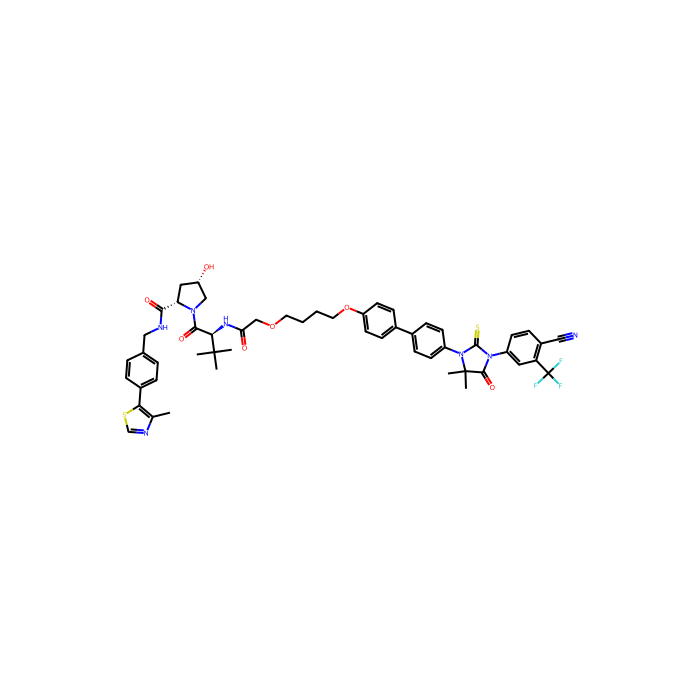
Product name: ARCC 4 negative control (SKU: A287126)
CAS: 2156588-26-8
PubChem CID: 145746289
InChIKey: 73276 (as provided in Product Data; appears non-standard length)
SMILES: Not specified for this item; refer to CoA/Spec Sheet.
Molecular formula: Not specified for this item; refer to CoA/Spec Sheet.
Molecular weight: Not specified for this item; refer to CoA/Spec Sheet.
Item-specific context
This listing is described as a “negative control” small molecule within a compound library category (小分子和化合物库). Negative controls are typically close structural analogs of an active probe but engineered or selected to lack target activity; they are used to benchmark assay specificity and detect off-target or assay-artifact signals.
General notes (chemistry/literature)
In chemical probe practice, a negative control often preserves core scaffold features (ring system count, heteroatom pattern) while disrupting key pharmacophores (e.g., H-bond donor/acceptor geometry, planarity, basicity), enabling matched physical properties with minimal biological activity. Without a disclosed structure for this item, those features cannot be summarized here.
2D structural description
Not available: no structural formula/SMILES was supplied for this item. Please consult the CoA/structure file for ring systems, functional groups, and stereochemistry if needed.
Synthetic Utility
This item is a finished small-molecule control compound and is not positioned as a synthetic building block. Without a disclosed structure, its reactivity and transformation scope cannot be summarized.
General note (chemistry perspective)
Control compounds can inform structure–activity relationship (SAR) exploration by indicating which scaffold features abrogate activity; however, that is a design consideration rather than a use case for this specific material.
If synthetic derivatization is desired
Obtain the full structure, functional group map, and protecting-group compatibility from the CoA/structure file before attempting any chemistry. Evaluate liability motifs (e.g., anilides, aldehydes, Michael acceptors) for stability under planned conditions.
Conclusion
Treat ARCC 4 negative control as an assay tool, not as a reagent or intermediate. No item-specific synthetic transformations can be recommended based on the provided data.
Target Specificity
Item-specific data
No target, pathway, species selectivity, or binding data are provided for ARCC 4 negative control in the Product Data.
General role of a negative control
Intended to lack activity at the primary target of the corresponding active probe while closely matching physicochemical properties. Use it to detect off-target or non-specific effects and to validate that observed phenotypes stem from on-target modulation by the active compound.
Actionable advice
If a target is known for the active ARCC 4 probe in your program, confirm the negative control’s inactivity using orthogonal measurements (e.g., biophysical binding, CETSA/thermal shift, target-proximal markers) before relying on phenotypic comparisons.
Utilizamos cookies para garantizar el correcto funcionamiento del sitio web y, cuando esté permitido, para mejorar su experiencia. Puede gestionar sus preferencias en cualquier momento en Configuración. Más información en nuestra Política de Cookies.
¿Quieres que te enviemos un mensaje cuando tengamos descuentos disponibles?
Recordármelo más tarde
¡Gracias! Por favor, revisa tu bandeja de entrada de correo electrónico para confirmar.
Products are supplied to verified businesses, institutions, and qualified professionals for research and development use only. Not for use in humans, animals, diagnosis, or therapy.