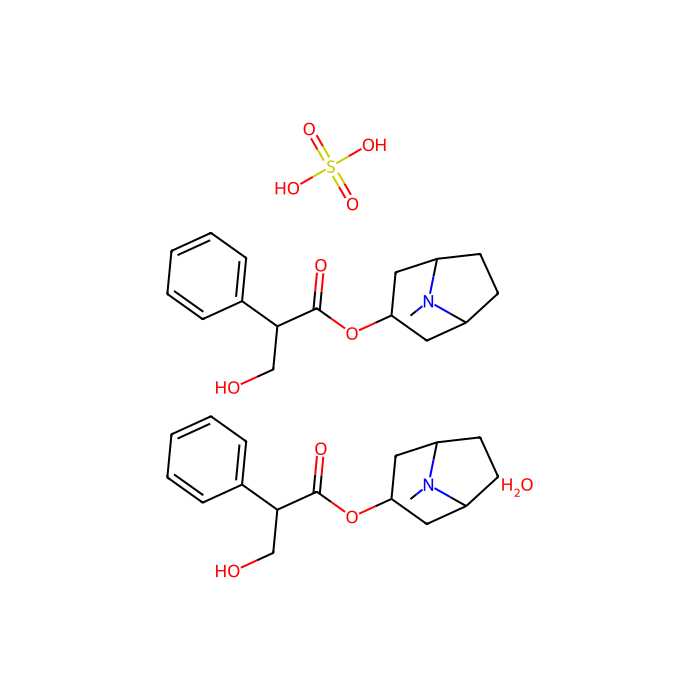
10mM in DMSO for sensitive chromatographic and analytical workflows requiring minimal baseline interference.
🌡
Storage & shipping
Store at -80°C Ships Dry ice packs + Cold packs Check lot-specific COA for exact specifications.
📋
Quality documents
SDS, COA, datasheet, and spec sheet available for download. Lot-specific COA accessible via lot number lookup.
📚
Literature proof
Cited in 5 peer-reviewed publications across chromatography, organic synthesis, and cross-coupling reactions.
Descripción general
Information
Atropine sulfate monohydrate is a competitive antagonist for themuscarinic acetylcholine receptor, used to decrease the production of saliva and secretions of the airway prior to surgery. In vitro
Atropine increases the release of the neurotransmitter dopamine into the superfusate in vitro at 100-500 mM and into the vitreous in vivo at 250 mg. Atropine induces spreading depression (SD) in the in vitro preparation. Atropine reduces the ERG b- and d-wave, leads to damped oscillations of RPE potentials, and reverses the ERG c-wave. Atropine suppresses myopia only at doses at which severe nonspecific side effects are observed in the retina.
In vivo
Atropine (1.0 mg/kg, i.p.), but not methylatropine (1.0 mg/kg, i.p.), prevents the enhancement of retention induced by both doses of the anticholinesterase when given immediately after training in mice. Atropine administration effectively prevents bradycardia and second-degree heart block but induces pulsus alternans and hypertension in dogs. Atropine has no effect on handling-induced acetylcholine output in the presence of 10 nM neostigmine, but causes greater and longer increases in the presence of 100 nM and 1000 nM neostigmine in rats. Atropine not only blocks the rapid eye movement (REM) sleep increases induced by CGS but it also tends to decrease REM sleep compared to atropine preceding saline in rats. Atropine decreases the time to exhaustion by 67% in intact rats and by 96.2% in adrenodemedullated (ADM) and also reduces the exercise-induced pituitary prolactin (PRL) release in both intact (50%) and ADM rats (90%). Cell Data
Atropine sulfate monohydrate is a competitive antagonist for the muscarinic acetylcholine receptor, used to decrease the production of saliva and secretions of the airway prior to surgery.
Condiciones de almacenamiento de almacenamiento
Store at -80°C
Enviado en
Dry ice packs + Cold packs
Este producto requiere envío en cadena de frío. Los servicios terrestres y otros servicios económicos no están disponibles.
1.Yi Xiao, Haomin Yi, Jingzhi Zhu, Suhua Chen, Guofang Wang, Yilong Liao, Yuanyuan Lei, Liyin Chen, Xingcai Zhang, Fangfu Ye. (2022) Evaluation of DNA adduct damage using G-quadruplex-based DNAzyme. Bioactive Materials, [PMID:36406255][10.1016/j.bioactmat.2022.10.002]
2.Yazhou Qin, Yuanzhao Wu, Binjie Wang, Jiye Wang, Xingsen Zong, Weixuan Yao. (2021) Controllable preparation of sea urchin-like Au NPs as a SERS substrate for highly sensitive detection of the toxic atropine. RSC Advances, 11 (32):(19813-19818). [PMID:35479250][10.1039/D1RA03223B]
3.Lisiqi Xie, Xiao Huang, Bin Su. (2017) Portable Sensor for the Detection of Choline and Its Derivatives Based on Silica Isoporous Membrane and Gellified Nanointerfaces. ACS Sensors, [PMID:28723110][10.1021/acssensors.7b00166]
4.Jian-Jun Meng, Jia-Wei Shen, Guang Li, Chang-Jie Ouyang, Jia-Xi Hu, Zi-Shuo Li, Hang Zhao, Yi-Ming Shi, Mei Zhang, Rong Liu, Ju-Tao Chen, Yu-Qian Ma, Huan Zhao, Tian Xue. (2023) Light modulates glucose metabolism by a retina-hypothalamus-brown adipose tissue axis. CELL, [PMID:36669474][10.1016/j.cell.2022.12.024]
5.Ying Miao, Huan Zhao, Yu-Fei Li, Yan-Ping Sun, Rui Bi, Hongli Li, Xin Fang, Zi-Shuo Li, Yu-Hua Ma, Long-Bao Lv, Kai An, Jian-Jun Meng, Yong-Gang Yao, Tian Xue. (2025) Light at night negatively affects mood in diurnal primate-like tree shrews via a visual pathway related to the perihabenular nucleus. PROCEEDINGS OF THE NATIONAL ACADEMY OF SCIENCES OF THE UNITED STATES OF AMERICA, 122 (23):(e2411280122). [PMID:40478874][10.1073/pnas.2411280122]
Calculadoras de soluciones
Molarity Calculator
Determine the necessary mass, volume, or concentration for preparing a solution.
Dilution Calculator
Determine the dilution needed to prepare a stock solution.
We use cookies to ensure the website functions properly and, where permitted, to improve your experience. You can manage your preferences at any time in Settings. Learn more in our Cookie Policy.
Shall we send you a message when we have discounts available?
Remind me later
Thank you! Please check your email inbox to confirm.
Products are supplied to verified businesses, institutions, and qualified professionals for research and development use only. Not for use in humans, animals, diagnosis, or therapy.