GRADE & PURITYMoligand™?Moligand™ — Aladdin's line of ligands and bioactive small molecules. Use for receptor, pathway, and binding studies needing defined small-molecule tools.10mM in DMSO
Moligand™, 10mM in DMSO Moligand™ for sensitive chromatographic and analytical workflows requiring minimal baseline interference.
🌡
Storage & shipping
Store at -80°C Ships Dry ice packs + Cold packs Check lot-specific COA for exact specifications.
📋
Quality documents
SDS, COA, datasheet, and spec sheet available for download. Lot-specific COA accessible via lot number lookup.
📚
Literature proof
Cited in 0 peer-reviewed publications across chromatography, organic synthesis, and cross-coupling reactions.
Descripción general
Information
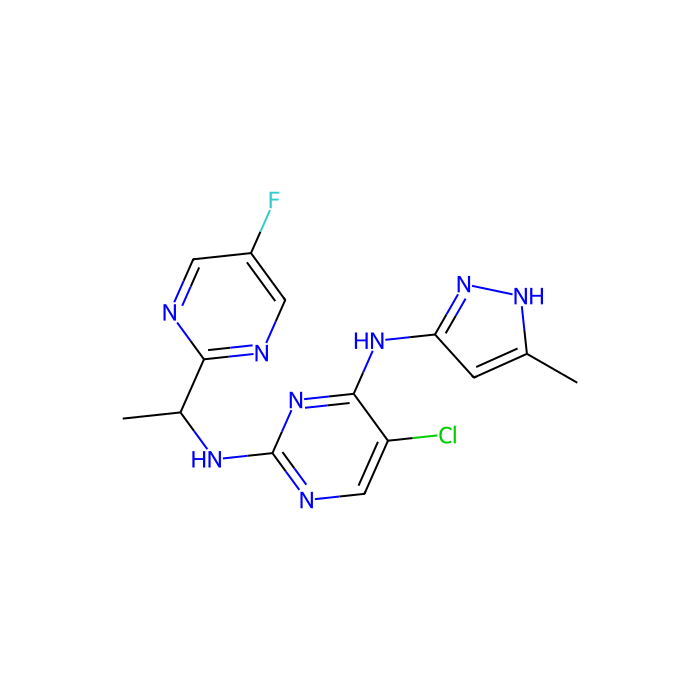
AZD1480 is a novel ATP-competitiveJAK2inhibitor withIC50of 0.26 nM in a cell-free assay, selectivity against JAK3 and Tyk2, and to a smaller extent against JAK1. Phase 1. In vitro
5μM AZD1480 induces G2/M arrest and cell death by inhibiting Aurora kinases. AZD1480 is a potent JAK2 inhibitor that can suppress growth, survival, as well as FGFR3 and STAT3 signaling and downstream targets including Cyclin D2 in human multiple myeloma cells. At low micromolar concentrations, AZD1480 blocks cell proliferation and induces apoptosis of myeloma cell lines. AZD1480 effectively blocks constitutive and stimulus-induced JAK1, JAK2, and STAT-3 phosphorylation in both human and murine glioma cells, and leads to a decrease in cell proliferation and induction of apoptosis. AZD1480 is a potent, competitive small-molecule inhibitor of JAK1/2 kinase, and that it is capable of inhibiting STAT3 phosphorylation and tumor growth in a STAT3-dependent manner. AZD1480 inhibits tumor angiogenesis and metastasis in part by affecting the tumor microenvironment.
In vivo
AZD1480 inhibits the STAT3 phosphorylation in an xenograft model of human solid tumors and multiple myeloma. In vivo, AZD1480 inhibits the growth of subcutaneous tumors and increases survival of mice bearing intracranial glioblastoma (GBM) tumors by inhibiting STAT-3 activity, indicating that pharmacologic inhibition of the JAK/STAT-3 pathway by AZD1480 should be considered for study in the treatment of patients with GBM tumors. AZD1480 blocks lung infiltration of myeloid cells and formation of pulmonary metastases in both mouse syngeneic experimental and spontaneous metastatic models. Furthermore, AZD1480 reduces angiogenesis and metastasis in a human xenograft tumor model. The Jak2 inhibitor, AZD1480, suppresses the growth of human solid tumor xenografts harboring persistent Stat3 activity. Cell Data
AZD1480 is a novel ATP-competitive JAK2 inhibitor with IC50 of 0.26 nM in a cell-free assay, selectivity against JAK3 and Tyk2, and to a smaller extent against JAK1. Phase 1.
Condiciones de almacenamiento de almacenamiento
Store at -80°C
Enviado en
Dry ice packs + Cold packs
Este producto requiere envío en cadena de frío. Los servicios terrestres y otros servicios económicos no están disponibles.
Determine the necessary mass, volume, or concentration for preparing a solution.
Dilution Calculator
Determine the dilution needed to prepare a stock solution.
Reconstitution Calculator
Reseñas
Reseñas de cliente
Application Protocols
Only product-validated protocols from the Product Data may be listed here.
Tested applications, recommended dilutions, and positive controls: Not specified for this item.
General recommendation
Develop application-specific protocols based on your assay platform. Validate concentration ranges, solvent percentages, and incubation times empirically. For detailed, lot-specific guidance, consult the CoA or contact Technical Support.
Biological Roles
Item-specific biological mechanism is not provided in the Product Data.
Literature context (general; not a product specification):
AZD1480 is widely reported in the scientific literature as a small-molecule inhibitor used to interrogate the JAK/STAT signaling pathway in biochemical and cellular models. Such compounds are used as chemical probes to modulate kinase activity and study downstream transcriptional responses.
Typical use-cases include pathway validation, target engagement studies, and establishing structure–activity relationships (SAR) in kinase-focused chemical biology.
Good practices for biological studies (general):
Establish concentration–response curves and include appropriate vehicle controls to account for solvent effects (e.g., DMSO).
Confirm on-target activity with orthogonal assays (e.g., enzymatic readouts, phosphorylation state measurements) and check for off-target interactions where feasible.
Assess compound stability in the relevant biological matrix (buffer, media, lysate) and consider protein binding and adsorption to plastics.
Reminder
This product is labeled: For research use only. No medical, diagnostic, or therapeutic uses are claimed or supported.
Buffer Applications
Not a buffering reagent. AZD1480 itself does not constitute a buffer system.
Practical guidance for preparing working solutions (general):
Prepare a concentrated stock in anhydrous DMSO, then dilute into assay buffer such as HEPES (pH 7.2–7.6), PBS (pH ~7.4), or Tris (pH 7.4–8.0) with rapid mixing to minimize local supersaturation.
Keep final DMSO fraction within the validated tolerance of your assay (commonly ≤0.1–1% v/v). If precipitation occurs, add a small amount of nonionic surfactant (e.g., 0.01% Tween-20) or adjust ionic strength.
Filter or centrifuge diluted solutions to remove any particulates before use in optical or microfluidic readouts.
Item-specific buffer compatibility and pKa values are not provided; optimize empirically for your assay.
Green Alternatives
Because AZD1480 is a discrete small-molecule probe rather than a bulk process solvent or reagent, “green alternatives” focus on handling practices and solvent choices for stock preparation and assay execution.
Greener handling strategies (general):
Prefer minimal DMSO fractions in working solutions (e.g., ≤0.1–0.5% v/v) consistent with assay tolerance to reduce solvent burden.
Use acetonitrile or ethanol as co-solvents where scientifically acceptable to reduce reliance on high-boiling, persistent aprotics (DMF, NMP). Validate solubility and assay performance.
Implement microplate miniaturization and low-dead-volume liquid handling to reduce compound and solvent usage.
Reuse and properly segregate solvent waste streams to facilitate solvent recovery.
Comparison (general, not item-specific):
DMSO: High solvency; low volatility; excellent for stocks; environmental persistence manageable but requires proper waste handling.
Ethanol: Renewable routes available; higher biocompatibility; may not dissolve hydrophobic heteroaromatics at high concentration.
Acetonitrile: Volatile and recyclable via distillation; moderate solvency; consider occupational exposure limits.
Note: Given the small masses used for screening compounds, the dominant “green” leverage comes from reducing solvent volumes, preventing failed runs (quality-by-design), and consolidating analytical steps rather than substituting the compound itself.
Pharmaceutical Uses
No pharmacopeial or excipient status is provided in the Product Data. This product is supplied strictly for research use only.
Relevant research/formulation contexts (general; not item-specific):
As a reference standard for in vitro ADME profiling (e.g., metabolic stability, microsomal clearance, plasma protein binding) and for building QSAR models.
As a spiking compound to develop and qualify LC–MS/MS analytical methods (retention, ionization behavior, matrix effects) in discovery-stage workflows.
As a tool compound in pre-formulation screenings to study solvent effects, precipitation kinetics, and compatibility with assay diluents.
Regulatory note
This material is not manufactured to GMP and is not intended for human or veterinary use. No clinical, diagnostic, or therapeutic claims are made. For regulated applications or lot-specific impurity profiles, contact Technical Support regarding available documentation.
Physical Properties
Item-specific specifications are not provided in the Product Data for AZD1480.
Physical state/appearance: Not specified for this item; refer to CoA/Spec Sheet.
Melting point, boiling point, density, refractive index: Not specified for this item; refer to CoA/Spec Sheet.
Solubility (item-specific): Not specified for this item; refer to CoA/Spec Sheet.
General guidance for small-molecule screening ligands (literature/practice, not item-specific):
Many kinase-directed heteroaromatics are sparingly soluble in water but dissolve well in polar aprotic solvents such as DMSO and DMF; partial solubility is often observed in ethanol or acetonitrile. Aqueous working solutions are commonly prepared by diluting a DMSO stock into assay buffer with vigorous mixing.
Typical analytical stocks are prepared at 10–50 mM in anhydrous DMSO and stored frozen; precipitation on aqueous dilution depends on buffer composition, temperature, and final DMSO fraction.
Hygroscopicity and polymorphism can influence handling and assay reproducibility; confirm by DSC/TGA and PXRD if material behavior is critical to your workflow.
Always confirm actual, lot-specific physicochemical parameters from the CoA and characterize as needed for your application.
Quality and Grades
Grade: Moligand™
About Moligand™ grade (Aladdin discovery chemistry line):
Intended for research use only in discovery, chemical biology, screening, and assay development. Moligand™ items emphasize identity and suitability as small-molecule ligands/chemical probes for in vitro work.
Documentation: Each lot is supported by a Certificate of Analysis (CoA) and/or Specification Sheet. Where applicable, documentation may include identity confirmation (e.g., HPLC/LC–MS, NMR), assay purity, and storage guidance specific to the lot.
UV cutoff, water/metal/peroxide limits, residual solvents, or stabilizers: Not specified for this item; refer to CoA/Spec Sheet.
What this means for your workflow:
Moligand™ materials are commonly used as reference standards, positive controls, and hit-validation reagents. If your application requires extended impurity profiling (e.g., trace metals, residual solvents), or compliance with pharmacopeial monographs, contact Technical Support for available data or a custom specification.
For bioassays, we recommend confirming lot identity/purity in-house (e.g., LC–MS single peak, expected mass) and recording the exact solvent system used to prepare stocks to ensure cross-study reproducibility.
Reaction and Applications
Primary use: AZD1480 is supplied as a discovery-chemistry ligand/chemical probe for research screening and assay development. No specific synthetic/manufacturing application is stated in the Product Data.
Laboratory applications (general; literature/practice, not item-specific):
As a reference compound in biochemical enzyme assays (e.g., kinase activity or binding assays) to benchmark assay performance and validate dynamic range.
In chemical biology studies to interrogate signaling pathways through small-molecule perturbation, typically using DMSO stocks diluted into buffered media.
For method development in LC–MS bioanalytical workflows (retention factor benchmarking, ionization behavior), provided appropriate standards are prepared.
Practical tips
Prepare concentrated, anhydrous DMSO stocks (e.g., 10–50 mM) to minimize freeze–thaw and aqueous exposure. Aliquot into low-bind tubes under inert gas if possible.
Verify identity/purity by LC–MS and single-peak HPLC prior to quantitative assays. Record extinction coefficients if UV/fluorescence detection will be used (determine experimentally if not in literature).
Control variables that commonly confound small-molecule assays: final solvent fraction, pH, ionic strength, protein binding (e.g., BSA or serum), and plastic adsorption (consider glass vials or low-bind plastics).
Note: If using in cells or complex matrices, run vehicle controls matched for solvent and include precipitation/solubility checks at working concentrations.
Reaction Conditions
This product is not primarily intended for use as a reagent in synthetic transformations; therefore, no item-specific reaction conditions are provided.
General guidance for preparing and using assay stocks (not item-specific):
Stock preparation: Dissolve at 10–50 mM in anhydrous DMSO. Sonication or brief warming (≤40°C) can assist dissolution; avoid prolonged heating. Verify clarity by visual inspection and, if critical, by 0.22 µm filtration.
Aliquoting: Dispense into single-use aliquots under dry, inert atmosphere where feasible to minimize water uptake and oxidative degradation. Label with concentration, solvent, and preparation date.
Working solutions: Dilute into assay buffer to the desired final concentration keeping final DMSO ≤0.1–1% v/v as tolerated. Mix immediately and thoroughly to avoid local supersaturation and precipitation.
Stability checks: Confirm stability by LC–MS or HPLC after typical assay windows (e.g., 1–24 h at room temperature or 37°C) and after freeze–thaw cycles.
Expected “yields” are not applicable. For any synthetic use or conjugation chemistry, obtain the exact structure and confirm functional group compatibility before designing conditions.
Safety and Handling
GHS/SDS information specific to this item is not provided in the Product Data.
GHS classification, signal word, hazard and precautionary statements, pictograms: Not specified for this item; refer to the SDS.
General laboratory safety guidance (not item-specific; follow your institutional EHS):
Handle in a fume hood; avoid inhalation of dusts/aerosols and contact with skin or eyes. Use appropriate PPE: lab coat, nitrile gloves (change regularly), and safety glasses. When making DMSO stocks, note that DMSO can enhance dermal absorption of solutes—avoid skin contact.
Prevent cross-contamination of screening libraries by dedicating tools/tips and working at low temperature where feasible. Cap vials promptly to minimize atmospheric moisture uptake.
Incompatibilities: As a general precaution for organic solids, avoid strong oxidizers and strong acids/bases unless required by a validated procedure. Keep away from ignition sources and static discharge when handling powders/organic solvents.
First aid (overview; consult SDS for details): rinse eyes/skin with water for at least 15 minutes upon contact, remove contaminated clothing, and seek medical attention if irritation persists. If inhaled, move to fresh air; if swallowed, rinse mouth and seek medical advice.
Always consult the official SDS provided with your shipment for authoritative safety and regulatory information.
Solvent Selection
This product is a small-molecule screening ligand. Item-specific solubility is not provided; select solvents based on common practice for kinase-chemistry scaffolds and verify empirically.
Polarity class: Typically handled as a moderately polar organic compound; dissolve first in DMSO (most common), DMF, or acetonitrile; partial solubility may occur in ethanol.
Aqueous use: Prepare a concentrated DMSO stock and dilute into assay buffers (e.g., HEPES, PBS) with vigorous mixing. Keep final DMSO ≤0.1–1% v/v to protect biomolecular assays (general guidance; optimize per assay).
Additives: If precipitation occurs on dilution, include 0.01–0.05% nonionic surfactant (e.g., Tween-20, Pluronic F-68) or raise ionic strength/temperature slightly.
Quick comparison (general):
DMSO: Maximum solubilizing power; miscible with water; can affect cells/enzymes above ~0.5% v/v.
DMF: Strong solvent but less preferred in bioassays; harder to remove; higher toxicity profile.
Acetonitrile: Useful co-solvent; volatile; lower solvating power for some heteroaromatics.
Ethanol: Biocompatible at low %; moderate solvating ability.
Tips
Filter 0.22 µm or centrifuge stock before critical assays to remove particulates.
Record solvent lot and water content (Karl Fischer) for reproducibility when possible.
Storage and Reconstitution
Storage conditions (from Product Data): Store at −80°C.
Shipping (from Product Data): Shipped on dry ice packs + cold packs to maintain low temperature.
Additional best practices (general; not item-specific):
Upon receipt, keep frozen. Allow containers to equilibrate in a desiccator to avoid condensation before opening. Reseal promptly under dry atmosphere.
For reconstitution, prepare concentrated stocks in anhydrous DMSO (e.g., 10–50 mM). Mix until fully dissolved; if needed, sonicate briefly or warm to room temperature. Record exact concentration and solvent.
Aliquot stocks into low-bind, airtight vials to minimize freeze–thaw cycles. Store aliquots at −80°C protected from light. Avoid frost-free freezers that cycle temperatures.
Thaw on ice or at room temperature just before use. After dilution into aqueous buffers, use promptly or validate short-term stability at the intended temperature (e.g., 1–24 h).
Item-specific stability in solution, hygroscopicity, and light sensitivity: Not specified for this item; refer to CoA/Spec Sheet and SDS. Always discard solutions that show precipitation, discoloration, or unexpected chromatographic changes.
Structure and Identity
Item name: AZD1480 (SKU: A409220)
CAS: 935666-88-9 (catalog identifier)
PubChem CID: 16659841 (literature identifier)
Molecular formula: Not specified for this item; refer to CoA/Spec Sheet.
Molecular weight: Not specified for this item; refer to CoA/Spec Sheet.
SMILES: Not specified for this item; refer to CoA/Spec Sheet.
InChIKey: Not specified for this item; refer to CoA/Spec Sheet.
AZD1480 is a small-molecule heteroaromatic kinase-chemistry scaffold reported in the literature as a tool compound for interrogating the JAK/STAT pathway. Specific ring systems and stereochemistry are not provided in the product data and may vary by supplier description; consult the CoA/SDS for definitive structural data.
Notes
This listing is supplied under Aladdin’s Moligand™ line for discovery chemistry screening. For exact identifiers used in your registration system (SMILES/InChIKey), please verify against your internal reference or request the current CoA.
Synthetic Utility
AZD1480 is offered as a finalized small-molecule probe rather than a versatile synthetic building block.
As such, it is typically used as a reference compound or assay control, not as a starting material for further synthesis.
If derivative preparation or immobilization is desired for target engagement studies (e.g., affinity matrices), users commonly explore bioorthogonal handles via separate synthetic routes or purchase analogs designed with linkers. No such handles or reactive functional groups are specified for this item; consult the CoA or consider custom synthesis.
Analytical/bench chemistry uses (general):
Standard for developing chromatographic methods (gradient scouting, stationary phase selection) in kinase-chemistry space.
Benchmark compound for stability-indicating methods (stress testing under light, heat, oxidative, and hydrolytic conditions) to build platform knowledge.
Item-specific functional groups, pKa, and reactivity are not provided; avoid assuming suitability for named reactions or conjugations without structural confirmation.
Target Specificity
Only information from Product Data may be listed here.
Target, pathway, and binding data: Not specified for this item; refer to CoA/Spec Sheet.
Clone/isotype/species reactivity: Not applicable.
Note: Literature often discusses AZD1480 in the context of kinase pathway interrogation; however, no target-specific claims are made for this catalog item.
Need help choosing the grade?
Our grade selection guide covers purity, stabilizer status, and application suitability for all variants in our catalog.
We use cookies to ensure the website functions properly and, where permitted, to improve your experience. You can manage your preferences at any time in Settings. Learn more in our Cookie Policy.
Shall we send you a message when we have discounts available?
Remind me later
Thank you! Please check your email inbox to confirm.
Products are supplied to verified businesses, institutions, and qualified professionals for research and development use only. Not for use in humans, animals, diagnosis, or therapy.

 F2414010