
Determine the necessary mass, volume, or concentration for preparing a solution.
| Activity Type | Activity Value -log(M) | Mechanism of Action | Activity Reference | Publications (PubMed IDs) |
|---|
Moligand™, 10mM in DMSO Moligand™ for sensitive chromatographic and analytical workflows requiring minimal baseline interference.
Store at -80°C Ships Dry ice packs + Cold packs Check lot-specific COA for exact specifications.
SDS, COA, datasheet, and spec sheet available for download. Lot-specific COA accessible via lot number lookup.
Cited in 0 peer-reviewed publications across chromatography, organic synthesis, and cross-coupling reactions.
Information
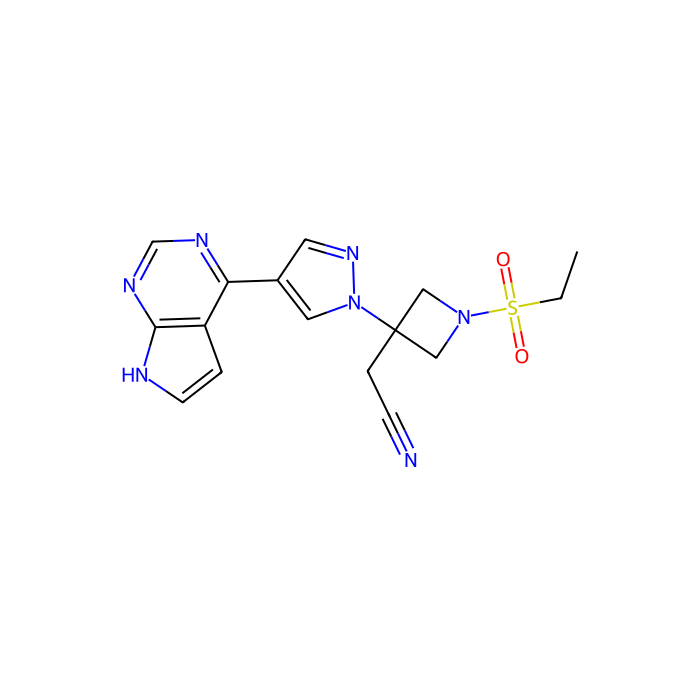
Baricitinib (LY3009104, INCB028050) is a selectiveJAK1andJAK2inhibitor withIC50of 5.9 nM and 5.7 nM in cell-free assays, ~70 and ~10-fold selective versus JAK3 and Tyk2, no inhibition to c-Met and Chk2. Baricitinib is found to reduce or interrupt the pass
In vitro
Baricitinib inhibits IL-6–stimulated phosphorylation of the canonical substrate STAT3 (pSTAT3) and subsequent production of the chemokine MCP-1 with IC50 values of 44 nM and 40 nM, respectively, in PBMCs. Baricitinib also inhibits pSTAT3 stimulated by IL-23 with IC50 od 20 nM in isolated naive T-cells.
In vivo
Baricitinib inhibits IL-6–stimulated phosphorylation of STAT3 in whole blood with an IC50 of 128 nM. Baricitinib (10 mg/kg p.o.) is expected to inhibit JAK1/2 signaling (by ≥50%) in rats for about 8 hours. Baricitinib (10 mg/mL, p.o.) inhibits disease scores in dose-dependent manner in rats with established disease in the adjuvant arthritis model. Baricitinib treatment, compared with vehicle, inhibits the increase in hind paw volumes during the 2 weeks of treatment by 50% at a dose of 1 mg/kg and >95% at doses of 3 mg/kg or 10 mg/kg. Baricitinib treatment, compared with vehicle, also inhibits composite score of immune infiltrate, edema, and periarticular tissue appearance by 27% at a dose of 1 mg/kg, 64% at doses of 3 mg/kg and 82% at doses of 10 mg/kg in rats with established disease in the adjuvant arthritis model. Baricitinib reduces bone resorption by 15%, 61%, and 67% with increasing dose level (1, 3, and 10 mg/kg) in rats with established disease in the adjuvant arthritis model. Baricitinib (10 mg/kg, daily for 2 wk, p.o.) results in radiographic improvements with restoration of the normal architecture and appearance to the ankle and tarsals in rats with established disease in the adjuvant arthritis model. Baricitinib reduces levels of pSTAT3 in a dose- and time-dependent manner in the peripheral blood of rAIA animals. Baricitinib (10 mg/mL, p.o.) improves a composite score of joint damage by 47% in the murine CIA model. Baricitinib (10 mg/kg) reduces pannus (74%) and bone damage (78%) and improves cartilage damage (43%) and signs of inflammation (33%), resulting in a 53% improvement in an aggregate score of disease in the collagen Ab-induced arthritis (CAIA) murine model. Baricitinib (10 mg/kg) inhibits the delayed-type hypersensitivity response by 48% in both the CIA and CAIA models. Baricitinib is efficacious in active rheumatoid arthritis patients refractory to disease modifying drugs and biologics. Baricitinib preferentially inhibits JAK1 and JAK2, with 10-fold selectivity over Tyk2 and 100-fold over JAK3. The observed effects of GLPG-0634 on the ACR20, albeit in a smaller study, appear to be at least as good as that seen with tofacitinib and superior to that of baricitinib, since baricitinib only moderately affect the ACR20 values in Phase IIa clinical studies. Baricitinib has the dose-limiting side-effect of inducing anaemia which has been attributed to its effects on JAK2 but has clearly shown efficacy.
Cell Data
cell lines:
Concentrations:
Incubation Time:
Powder Purity:≥99%
| ALogP | -0.5 |
|---|
| Isómeros SMILES | CCS(=O)(=O)N1CC(C1)(CC#N)N2C=C(C=N2)C3=C4C=CNC4=NC=N3 |
|---|---|
| Peso molecular | 371.42 |
| Reaxy-Rn | 19442770 |
| Reaxys-RN_link_address | https://www.reaxys.com/reaxys/secured/hopinto.do?context=S&query=IDE.XRN=19442770&ln= |
Comprehensive hazard, handling, storage, and regulatory compliance document.
Download SDS →Lot-specific quality data. Enter your lot number to retrieve the exact COA.
Look up COA →Full quality attributes and acceptance criteria for this grade.
View spec sheet →| Activity Type | Activity Value -log(M) | Mechanism of Action | Activity Reference | Publications (PubMed IDs) |
|---|
| Activity Type | Activity Value -log(M) | Mechanism of Action | Activity Reference | Publications (PubMed IDs) |
|---|
| Activity Type | Activity Value -log(M) | Mechanism of Action | Activity Reference | Publications (PubMed IDs) |
|---|
| Activity Type | Activity Value -log(M) | Mechanism of Action | Activity Reference | Publications (PubMed IDs) |
|---|
| Activity Type | Activity Value -log(M) | Mechanism of Action | Activity Reference | Publications (PubMed IDs) |
|---|
| Activity Type | Activity Value -log(M) | Mechanism of Action | Activity Reference | Publications (PubMed IDs) |
|---|
| Activity Type | Activity Value -log(M) | Mechanism of Action | Activity Reference | Publications (PubMed IDs) |
|---|
| Activity Type | Activity Value -log(M) | Mechanism of Action | Activity Reference | Publications (PubMed IDs) |
|---|
| Solubilidad | Solubility (25°C) In vitro DMSO: 6 mg/mL (26.64 mM); Water: Insoluble; Ethanol: Insoluble; |
|---|
Our grade selection guide covers purity, stabilizer status, and application suitability for all variants in our catalog.
View Moligand™ grade guide →