≥99% for sensitive chromatographic and analytical workflows requiring minimal baseline interference.
🌡
Storage & shipping
Store at 2-8°C,Desiccated Ships Wet ice Check lot-specific COA for exact specifications.
📋
Quality documents
SDS, COA, datasheet, and spec sheet available for download. Lot-specific COA accessible via lot number lookup.
📚
Literature proof
Cited in 0 peer-reviewed publications across chromatography, organic synthesis, and cross-coupling reactions.
Descripción general
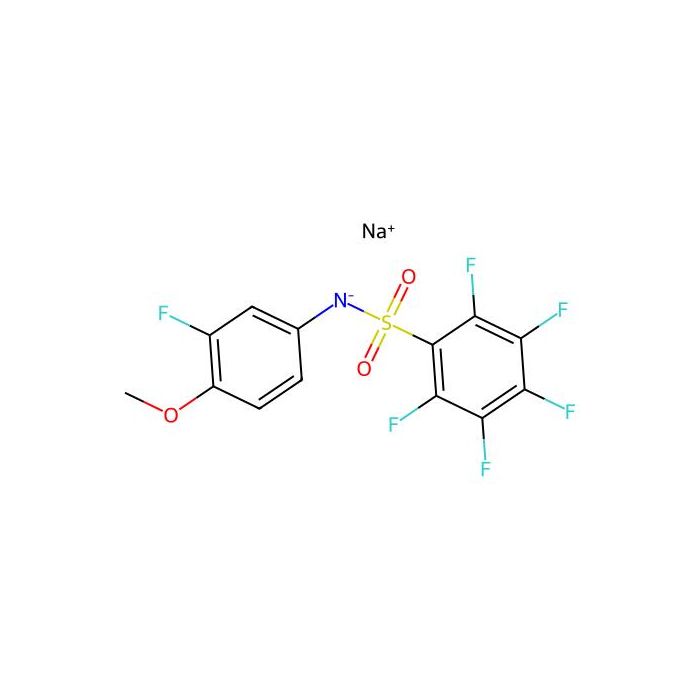
Batabulin sodium (T138067 sodium) is an antitumor agent, which binds covalently and selectively to a subset of the β-tubulin isotypes , thereby disrupting microtubule polymerization. Batabulin sodium affects cell morphology and leads to cell-cycle arrest ultimately induces apoptotic cell death
In Vitro
Batabulin (T138067; 30-300 nM; 24 hours; MCF7 cells) treatment shows approximately 25-30% tetraploid (4n) DNA content in cells, indicating an arrest at the G2/M cell-cycle boundary. Batabulin (T138067; 30-300 nM; 24-48 hours; MCF7 cells) treatment shows 25-30% apoptosis. After a 48-hr exposure to 100 nM Batabulin, approximately 50-80% of the cell population is undergoing apoptosis. Batabulin (T138067) binds covalently and selectively to a subset of the β-tubulin isotypes, thereby disrupting microtubule polymerization. Covalent modification occurs at a conserved Cys-239 shared by the β1, β2, and β4 tubulin isotypes. Cells exposed to Batabulin become altered in shape, indicating a collapse of the cytoskeleton, and show an increase in chromosomal ploidy. MCE has not independently confirmed the accuracy of these methods. They are for reference only. Cell Cycle AnalysisCell Line: MCF7 cells Concentration: 30 nM, 100 nM and 300 nM Incubation Time: 24 hours Result: Showed an arrest at the G2/M cell-cycle boundary. Apoptosis AnalysisCell Line: MCF7 cells Concentration: 30 nM, 100 nM and 300 nM Incubation Time: 24 hours or 48 hours Result: 25-30% of cells showed the reduced DNA content characteristic of apoptotic cells.
In Vivo
Batabulin (T138067; 40 mg/kg; intraperitoneal injection; once per week; on days 5, 12, and 19; male athymic nude mice) treatment impairs the growth of the drug-sensitive CCRF-CEM tumors . MCE has not independently confirmed the accuracy of these methods. They are for reference only. Animal Model: Male athymic nude mice ( nu/nu ) (6-8 week-old, 20-25 g) injected with\nCCRF-CEM cells Dosage: 40 mg/kg Administration: Intraperitoneal injection; once per week; on days 5, 12, and 19 Result: Impaired the growth of the drug-sensitive CCRF-CEM tumors.
Form:Solid
IC50& Target:β-tubulin
Specifications
Sinónimos
Benzenesulfonamide, 2,3,4,5,6-pentafluoro-N-(3-fluoro-4-methoxyphenyl)-, sodium salt | sodium (3-fluoro-4-methoxyphenyl)((perfluorophenyl)sulfonyl)amide | 2,3,4,5,6-Pentafluoro-N-(3-fluoro-4-methoxyphenyl)benzenesulfonamide sodium salt | Sodium 2,3,4,5,6-
Especificaciones y pureza
≥99%
Mecanismos bioquímicos y fisiológicos
Batabulin sodium (T138067 sodium) is an antitumor agent, which binds covalently and selectively to a subset of the β-tubulin isotypes , thereby disrupting microtubule polymerization. Batabulin sodium affects cell morphology and leads to cell-cycle arrest
Condiciones de almacenamiento de almacenamiento
Store at 2-8°C,Desiccated
Enviado en
Wet ice
Este producto requiere envío en cadena de frío. Los servicios terrestres y otros servicios económicos no están disponibles.
This compound belongs to the class of organic compounds known as sulfanilides. These are organic aromatic compounds containing a sulfanilide moiety, with the general structure RS(=O)(=O)NC1=CC=CC=C1.
External Descriptors
Not available
1. Djoumbou Feunang Y, Eisner R, Knox C, Chepelev L, Hastings J, Owen G, Fahy E, Steinbeck C, Subramanian S, Bolton E, Greiner R, and Wishart DS. ClassyFire: Automated Chemical Classification With A Comprehensive, Computable Taxonomy. Journal of Cheminformatics, 2016, 8:61.
We use cookies to ensure the website functions properly and, where permitted, to improve your experience. You can manage your preferences at any time in Settings. Learn more in our Cookie Policy.
Shall we send you a message when we have discounts available?
Remind me later
Thank you! Please check your email inbox to confirm.
Products are supplied to verified businesses, institutions, and qualified professionals for research and development use only. Not for use in humans, animals, diagnosis, or therapy.