
Determine the necessary mass, volume, or concentration for preparing a solution.
| Activity Type | Activity Value -log(M) | Mechanism of Action | Activity Reference | Publications (PubMed IDs) |
|---|
≥99% for sensitive chromatographic and analytical workflows requiring minimal baseline interference.
Store at -20°C Ships Ice chest + Ice pads Check lot-specific COA for exact specifications.
SDS, COA, datasheet, and spec sheet available for download. Lot-specific COA accessible via lot number lookup.
Cited in 0 peer-reviewed publications across chromatography, organic synthesis, and cross-coupling reactions.
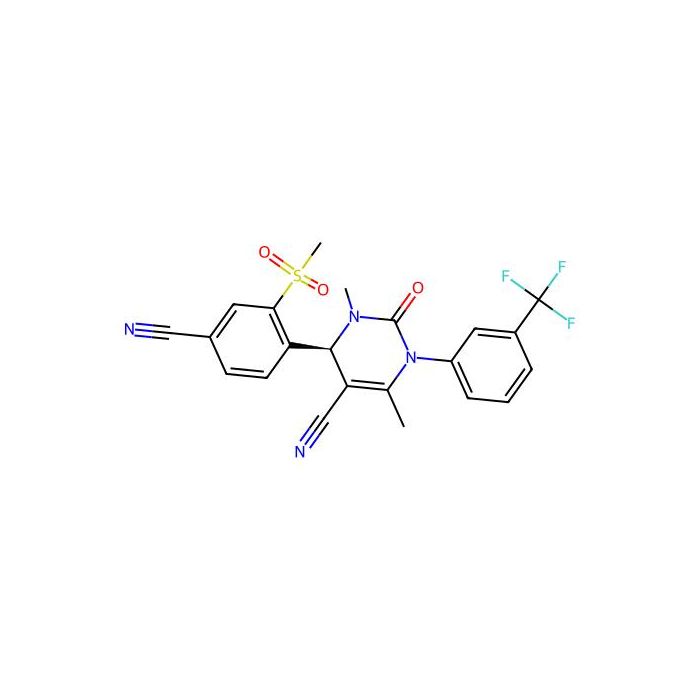
BAY-85-8501 is a selective, reversible and potent inhibitor of Human Neutrophil Elastase (HNE) , with an IC 50 of 65 pM.
In Vivo
In this model the exogenous HNE noxa is the primary cause of injury and lung hemorrhage. Based on picomolar potency against HNE as well as single digit potency versus MNE, BAY-85-8501 (29) completely prevents the development of lung injury and subsequent inflammation when administered 1 h prior to the HNE noxa. In the 0.01 mg/kg dose group, hemoglobin concentration is already significantly decreased. At a dose of 0.1 mg/kg, a significant effect on neutrophil count is observed. In this setup, efficacy is predominantly driven by potency against HNE (K i =0.08 nM). As the highly HNE-selective inhibitor BAY 85-8501 has no effect on PPE, BAY-85-8501 could not prevent the primary lung injury in this setup. Nevertheless, BAY-85-8501 could inhibit MNE, the endogenous driver of inflammation and secondary injury, although with decreased potency. Consequently, the effects of BAY-85-8501 on inflammation and secondary injury are weaker at this point, and only observed at 30-fold higher doses. Efficacy is predominantly driven by potency against MNE (K i =6 nM) in this second setup . MCE has not independently confirmed the accuracy of these methods. They are for reference only.
Form:Solid
IC50& Target:IC50: 65 pM (HNE)
| Sonrisas canónicas | CC1=C(C(N(C(=O)N1C2=CC=CC(=C2)C(F)(F)F)C)C3=C(C=C(C=C3)C#N)S(=O)(=O)C)C#N |
|---|---|
| IUPAC Name | (4S)-4-(4-cyano-2-methylsulfonylphenyl)-3,6-dimethyl-2-oxo-1-[3-(trifluoromethyl)phenyl]-4H-pyrimidine-5-carbonitrile |
| InChIKey | YAJWYFPMASPAMM-HXUWFJFHSA-N |
| INCHI | 1S/C22H17F3N4O3S/c1-13-18(12-27)20(17-8-7-14(11-26)9-19(17)33(3,31)32)28(2)21(30)29(13)16-6-4-5-15(10-16)22(23,24)25/h4-10,20H,1-3H3/t20-/m1/s1 |
| Isómeros SMILES | CC1=C([C@H](N(C(=O)N1C2=CC=CC(=C2)C(F)(F)F)C)C3=C(C=C(C=C3)C#N)S(=O)(=O)C)C#N |
| CAS alternativo | 1161921-82-9 |
| PubChem CID | 66601502 |
| Términos de entrada MeSH | 4-(4-cyano-2-(methylsulfonyl)phenyl)-3,6-dimethyl-2-oxo-1-(3-(trifluoromethyl)phenyl)-1,2,3,4-tetrahydropyrimidine-5-carbonitrile;BAY 85-8501 |
| Peso molecular | 474.46 |
Comprehensive hazard, handling, storage, and regulatory compliance document.
Download SDS →Lot-specific quality data. Enter your lot number to retrieve the exact COA.
Look up COA →Full quality attributes and acceptance criteria for this grade.
View spec sheet →Taxonomy Tree
| Kingdom | Organic compounds |
|---|---|
| Superclass | Benzenoids |
| Clase | Benzene and substituted derivatives |
| Subclass | Trifluoromethylbenzenes |
| Intermediate Tree Nodes | Not available |
| Direct Parent | Trifluoromethylbenzenes |
| Alternative Parents | Benzenesulfonyl compounds Benzonitriles Pyrimidones Hydropyrimidines Sulfones Ureas Tertiary amines Nitriles Azacyclic compounds Organofluorides Organic oxides Hydrocarbon derivatives Carbonyl compounds Alkyl fluorides |
| Molecular Framework | Aromatic heteromonocyclic compounds |
| Substituents | Trifluoromethylbenzene - Benzenesulfonyl group - Benzonitrile - Pyrimidone - Hydropyrimidine - 1,2,3,4-tetrahydropyrimidine - Pyrimidine - Sulfonyl - Sulfone - Urea - Tertiary amine - Azacycle - Organoheterocyclic compound - Carbonitrile - Nitrile - Organic oxide - Organosulfur compound - Organooxygen compound - Organonitrogen compound - Organofluoride - Organohalogen compound - Amine - Organic oxygen compound - Alkyl halide - Alkyl fluoride - Carbonyl group - Organic nitrogen compound - Hydrocarbon derivative - Cyanide - Aromatic heteromonocyclic compound |
| Descripción | This compound belongs to the class of organic compounds known as trifluoromethylbenzenes. These are organofluorine compounds that contain a benzene ring substituted with one or more trifluoromethyl groups. |
| External Descriptors | Not available |
| Activity Type | Activity Value -log(M) | Mechanism of Action | Activity Reference | Publications (PubMed IDs) |
|---|
| Activity Type | Relation | Activity value | Units | Action Type | Journal | PubMed Id | doi | Assay Aladdin ID |
|---|
| Solubilidad | DMSO : 200 mg/mL (421.53 mM; Need ultrasonic) |
|---|---|
| Peso molecular | 474.500 g/mol |
| XLogP3 | 2.600 |
| Hydrogen Bond Donor Count | 0 |
| Hydrogen Bond Acceptor Count | 8 |
| Rotatable Bond Count | 3 |
| Exact Mass | 474.097 Da |
| Monoisotopic Mass | 474.097 Da |
| Topological Polar Surface Area | 114.000 Ų |
| Heavy Atom Count | 33 |
| Formal Charge | 0 |
| Complexity | 1030.000 |
| Isotope Atom Count | 0 |
| Defined Atom Stereocenter Count | 1 |
| Undefined Atom Stereocenter Count | 0 |
| Defined Bond Stereocenter Count | 0 |
| Undefined Bond Stereocenter Count | 0 |
| The total count of all stereochemical bonds | 0 |
| Covalently-Bonded Unit Count | 1 |