Determine the necessary mass, volume, or concentration for preparing a solution.
≥90%(HPLC) for sensitive chromatographic and analytical workflows requiring minimal baseline interference.
Protected from light,Store at -20°C,Desiccated Ships Ice chest + Ice pads Check lot-specific COA for exact specifications.
SDS, COA, datasheet, and spec sheet available for download. Lot-specific COA accessible via lot number lookup.
Cited in 2 peer-reviewed publications across chromatography, organic synthesis, and cross-coupling reactions.
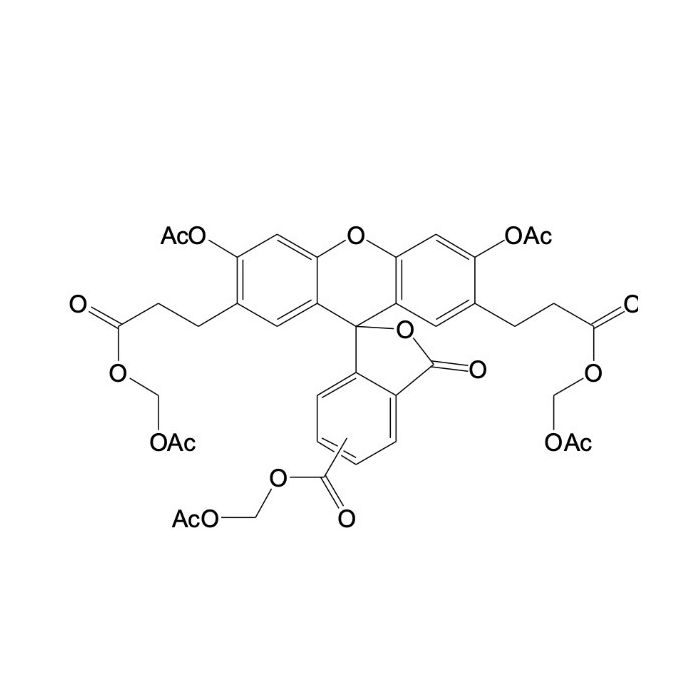
BCECF, AM is a fluorescent dye that can penetrate the cell membrane to detect intracellular pH. BCECF and AM have no fluorescence. After entering the cell, they can be cleaved by the intracellular esterase to form BCECF, thereby being retained in the cell. BCECF can be excited to form green fluorescence under proper pH. The maximum excitation wavelength and emission wavelength are different due to different pH. The maximum excitation wavelength is around 503nm, and the maximum emission wavelength is around 520nm. The recommended excitation wavelength for actual detection is 488nm and emission wavelength is 535nm.
BCECF and AM are not only widely used in the research of mammalian cells, but also reported to be used in the detection of intracellular pH levels in animal tissues, plant cells, bacteria and yeast. BCECF and AM are widely used in processes such as cytotoxicity, apoptosis, cell adhesion, drug resistance, and cell chemotaxis with changes in intracellular pH.
When used for intracellular pH detection, the commonly used concentration of BCECF and AM is 1~10μM.
BCECF-AM is a cell membrane permeable compound widely used as a fluorescent indicator for intracellular pH.
Operating Instructions (for Human Neutrophil)
(1) Reagent
1 mM BCECF, AM/DMSO
HEPES buffer (20 mM HEPES, 153 mM NaCl, 5 mM KCl, 5 mM glucose, pH 7.4)
(2) Operation
①. Prepare cell suspension with HEPES, the cell concentration is 4×10⁷ cells/mL.
②. Add 1mM BCECF, AM/DMSO solution to the cell suspension (1/300 volume of the cell suspension), the final concentration of BCECF, AM is 3μM.
③. Incubate at 37 ºC for 30 minutes.
④. Wash the cells 3 times with HEPES buffer to make a cell suspension of 3×10⁶ cells/mL.
⑤. Use a fluorescence microscope or a laser copolymerization microscope with an image analysis system to detect the fluorescence intensity of the cells.
*The labeling conditions vary depending on the cell type. Before each experiment, please determine the best conditions. The above method is for reference only.
Precautions
1) BCECF, AM may be harmful to human body, please pay attention to proper protection.
2) Fluorescent dyes have quenching problems, please try to avoid light to slow down fluorescence quenching.
3) For your safety and health, please wear lab coats and disposable gloves for operation.
| Sonrisas canónicas | CC(=O)OCOC1=CC2=C(C=C1CCC(=O)OCOC(=O)C)C3(C4=C(C=C(C=C4)C(=O)OCOC(=O)C)C(=O)O3)C5=C(O2)C=C(C(=C5)CCC(=O)OCOC(=O)C)OCOC(=O)C |
|---|---|
| IUPAC Name | acetyloxymethyl 3',6'-bis(acetyloxymethoxy)-2',7'-bis[3-(acetyloxymethoxy)-3-oxopropyl]-3-oxospiro[2-benzofuran-1,9'-xanthene]-5-carboxylate |
| InChIKey | NTECHUXHORNEGZ-UHFFFAOYSA-N |
| INCHI | 1S/C42H40O21/c1-22(43)52-17-57-34-15-36-32(13-27(34)7-10-38(48)59-19-54-24(3)45)42(31-9-6-29(12-30(31)41(51)63-42)40(50)61-21-56-26(5)47)33-14-28(8-11-39(49)60-20-55-25(4)46)35(16-37(33)62-36)58-18-53-23(2)44/h6,9,12-16H,7-8,10-11,17-21H2,1-5H3 |
| Isómeros SMILES | CC(=O)OCOC1=CC2=C(C=C1CCC(=O)OCOC(=O)C)C3(C4=C(C=C(C=C4)C(=O)OCOC(=O)C)C(=O)O3)C5=C(O2)C=C(C(=C5)CCC(=O)OCOC(=O)C)OCOC(=O)C |
| WGK Alemania | 1 |
| Peso molecular | 808.69 |
| Reaxy-Rn | 33576782 |
| Reaxys-RN_link_address | https://www.reaxys.com/reaxys/secured/hopinto.do?context=S&query=IDE.XRN=33576782&ln= |
Comprehensive hazard, handling, storage, and regulatory compliance document.
Download SDS →Lot-specific quality data. Enter your lot number to retrieve the exact COA.
Look up COA →Full quality attributes and acceptance criteria for this grade.
View spec sheet →Taxonomy Tree
| Kingdom | Organic compounds |
|---|---|
| Superclass | Organoheterocyclic compounds |
| Clase | Benzopyrans |
| Subclass | 1-benzopyrans |
| Intermediate Tree Nodes | Dibenzopyrans |
| Direct Parent | Xanthenes |
| Alternative Parents | m-Phthalate esters M-phthalic acid and derivatives Diarylethers Phthalides Benzofuranones Isobenzofurans Fatty acid esters Acylals Lactones Oxacyclic compounds Acetals Organic oxides Hydrocarbon derivatives Carbonyl compounds |
| Molecular Framework | Aromatic heteropolycyclic compounds |
| Substituents | Xanthene - Phthalate ester - Meta-phthalic acid ester - Meta_phthalic_acid - Diaryl ether - Isobenzofuranone - Phthalide - Benzofuranone - Isocoumaran - Isobenzofuran - Acylal - Fatty acid ester - Fatty acyl - Benzenoid - Lactone - Carboxylic acid ester - Oxacycle - Ether - Carboxylic acid derivative - Acetal - Organic oxygen compound - Organic oxide - Hydrocarbon derivative - Organooxygen compound - Carbonyl group - Aromatic heteropolycyclic compound |
| Descripción | This compound belongs to the class of organic compounds known as xanthenes. These are polycyclic aromatic compounds containing a xanthene moiety, which consists of two benzene rings joined to each other by a pyran ring. |
| External Descriptors | Not available |
Find and download the COA for your product by matching the lot number on the packaging.
| Lot Number | Certificate Type | Fecha | Articulo |
|---|---|---|---|
| Certificate of Analysis | May 20, 2026 | B273262 | |
| Certificate of Analysis | Mar 16, 2026 | B273262 | |
| Certificate of Analysis | Mar 16, 2026 | B273262 | |
| Certificate of Analysis | Aug 12, 2025 | B273262 |
| Solubilidad | Soluble in DMSO and DMF |
|---|---|
| Sensibilidad | Sensitive to light and humidity |
| Punto de ebullición (°C) | 692.41°C |
| Peso molecular | 880.800 g/mol |
| XLogP3 | 4.000 |
| Hydrogen Bond Donor Count | 0 |
| Hydrogen Bond Acceptor Count | 21 |
| Rotatable Bond Count | 27 |
| Exact Mass | 880.206 Da |
| Monoisotopic Mass | 880.206 Da |
| Topological Polar Surface Area | 264.000 Ų |
| Heavy Atom Count | 63 |
| Formal Charge | 0 |
| Complexity | 1610.000 |
| Isotope Atom Count | 0 |
| Defined Atom Stereocenter Count | 0 |
| Undefined Atom Stereocenter Count | 0 |
| Defined Bond Stereocenter Count | 0 |
| Undefined Bond Stereocenter Count | 0 |
| The total count of all stereochemical bonds | 0 |
| Covalently-Bonded Unit Count | 1 |
| 1. Xinyu Yao, Jinying Gao, Lanqiao Wang, Xiaoning Hou, Litao Ge, Xinxin Qin, Jiazhang Qiu, Xuming Deng, Wei Li, Jianfeng Wang. (2024) Cananga oil inhibits Salmonella infection by mediating the homeostasis of purine metabolism and the TCA cycle. JOURNAL OF ETHNOPHARMACOLOGY, [PMID:38325671] [10.1016/j.jep.2024.117864] |
| 2. Liang Peng, Chao Ma, Xiujuan Huang, Zhang Minrui, Xueni Huang, Lining Qi, Pimin Gong. (2025) Extracellular pH Modulates Intracellular Protein Aggregation to Balance Spray-Drying Resistance and Revival Kinetics of Dormant Lactobacillus bulgaricus. Food Bioscience, [PMID:] [10.1016/j.fbio.2025.107398] |