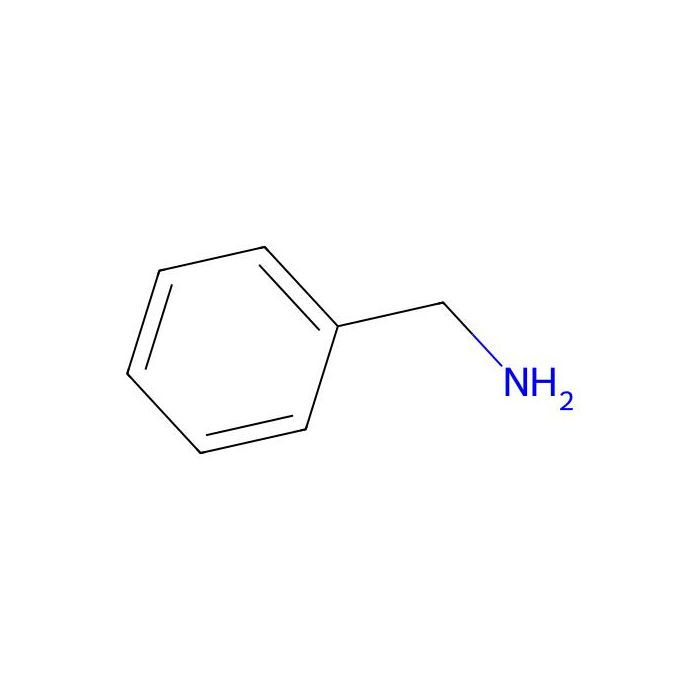
Benzylamine - 10mM in DMSO , CAS No.100-46-9

CAS: 100-46-9 Cat. No.: B661158 Fórmula: C7H9N Peso molecular: 107.15 Beilstein Registry Number: 741984 Número EC: 202-854-1
Disponible para pedir
CALIDAD & PUREZA 10mM in DMSO
Storage
Protected from light,Argon charged,Store at -80°C
Shipped In
Dry ice packs + Cold packs
★
Talla
USA
Alemania (EU)*
Precio
Cantidad
1ml
B661158-1ml
Fabricado bajo pedido · 8–12 semanas

285,90US$

333,90US$
Guardar 48,00 US$ (14.38%)
Enter a quantity for the sizes you want to add.

Descripción general

Benzylamine undergoes oxidative deamination reaction catalyzed by benzylamine oxidase and monoamine oxidase type B.
Benzylamine was used in modification of alkanethiol monolayers via amide and ester formation reactions for attachment onto metal electrodes. It was used as carrier electrolyte for separation of alkali, alkaline earth and ammonium cations in water samples by capillary electrophoresis with indirect UV detection. It was used in synthesis of cross-linked porous copolymer supports based on N-(p-vinylbenzoyl)-2-methylalanine, styrene and divinylbenzene.

Especificaciones

Especificaciones y pureza
10mM in DMSO
Condiciones de almacenamiento de almacenamiento
Protected from light,Argon charged,Store at -80°C
Enviado en
Dry ice packs + Cold packs
Este producto requiere envío en cadena de frío. Los servicios terrestres y otros servicios económicos no están disponibles.
Nombres e identificadores
Isómeros SMILES
C1=CC=C(C=C1)CN
WGK Alemania
1
RTECS
DP1488500
Número ONU
2735
Grupo de embalaje
I
Peso molecular
107.15
Beilstein
741984
Reaxy-Rn
741984
Reaxys-RN_link_address
https://www.reaxys.com/reaxys/secured/hopinto.do?context=S&query=IDE.XRN=741984&ln=

Datos avanzados

Certificados (CoA, COO, BSE/TSE y tabla de análisis)
C of A & Other Certificates(BSE/TSE, COO):
Analytical Chart:
Propiedades químicas y físicas
SolubilidadMiscible with water, ethanol, diethyl ether, acetone, benzene and chloroform.
SensibilidadLight sensitive.air sensitive
Índice de refracción1.544
Punto de inflamación (°F)149 °F
Punto de inflamación (°C)65 °C
Punto de ebullición (°C)184-185°C
Punto de fusión (°C)10°C
Preguntas frecuentes y artículos
Haloheterocycles and Cross-Coupling: A Research-Oriented Selection Framework from Substrate Identification to Bond-Forming Routes (Including Product Navigation and Tables 1–5)
β-Acyloxy Alkenyl Amides (AAAs): A New Approach to Amide Bond and Peptide Bond Construction Worth Attention
DAST-Mediated Amidation at Room Temperature: Method Features, Practical Value, and Scope of Applicability
Understanding ATD-DMAP: From Reagent Design to Esterification, Amidation, and Stereochemical Integrity
TCFH–NMI Amidation in Highly Aqueous Media: Research Value, Methodological Understanding, and Experimental Insights
Reassessing Trimethylaluminum: Method Design and Experimental Value of One-Pot Peptide Elongation from Unprotected Amino Acids
The Methodological Value of DSC: Building NHS-Type Activated Intermediates and Deciding When to Use Them
How to Construct Nitriles: Route Selection Across Direct Introduction, Precursor Dehydration, Oxidation/Dehydrogenation, and Cyanide-Free Processes
Boc₂O Selection Cannot Be Judged by Protection Installation Alone: Experimental Decision-Making from Substrate Nucleophilicity and Medium Effects to Deprotection Pathways
Experimental Evaluation of Triphosgene in Organic Synthesis: Understanding Its Selection Logic Through Reaction Tasks
Triphenylphosphine-Involved Carboxylic Acid Activation and Amide Bond Formation: Activation Pathways, Anhydride Competition, and Applicability Scenarios
Experimental Considerations for the Use of ADMP in the Conversion of Primary Amines to Organic Azides: Substrate Nucleophilicity, Base Matching, and Medium Selection
Cashew Nut Shell Liquid (CNSL): From Cashew Processing By-Product to Reactive Bio-Based Raw Material for Coating Resins
CTSOBt Benzotriazole–Sulfonate Coupling Reagent: Carboxylic Acid Activation and Synthetic Application Value
Strain Release of Azatricycloalkanes: Modular Bridge-Position Functionalization and Stereochemical Control of Three-Dimensional Bridged Aza Scaffolds
From Photocatalytic Ring Opening to Skeletal Reconstruction: Reaction Logic and Synthetic Applications of Oxygen-Atom Replacement in Oxetanes
Logic for Selecting Amidation Reagents in Aqueous Media: Competing Reactions, Activated Intermediates, and Substrate Effects
Why Primary and Secondary Amines Have Difficulty Participating Directly in the Classical Mitsunobu Reaction: Mechanism, Inversion of Configuration, and Reaction Scope of BEHT-Mediated Alcohol Amination
Construction and Transformation of Aziridines in Drug Synthesis: Ring Strain, N-Substituent Control, Selective Ring Opening, and Scaffold Expansion
Dual Role of NH₄SCN and CN Transfer: From Electrochemical Oxidation of SCN⁻ to the Construction of 1-Cyanoimidazo[1,5-a]pyridines
From Temporary Covalent Assembly to Intramolecular Smiles Aryl Migration: DCPDC-Mediated Phenol–Primary Amine C–N Cross-Coupling
Citations of This Product
Calculadoras de soluciones
Reseñas

Reseñas de cliente

¿Quieres que te enviemos un mensaje cuando tengamos descuentos disponibles?

Recordármelo más tarde

¡Gracias! Por favor, revisa tu bandeja de entrada de correo electrónico para confirmar.

¡Vaya! Las notificaciones están desactivadas.