GRADE & PURITYMoligand™?Moligand™ — Aladdin's line of ligands and bioactive small molecules. Use for receptor, pathway, and binding studies needing defined small-molecule tools.10 mM in DMSO
Moligand™, 10 mM in DMSO Moligand™ for sensitive chromatographic and analytical workflows requiring minimal baseline interference.
🌡
Storage & shipping
Store at -80°C Ships Dry ice packs + Cold packs Check lot-specific COA for exact specifications.
📋
Quality documents
SDS, COA, datasheet, and spec sheet available for download. Lot-specific COA accessible via lot number lookup.
📚
Literature proof
Cited in 0 peer-reviewed publications across chromatography, organic synthesis, and cross-coupling reactions.
Descripción general
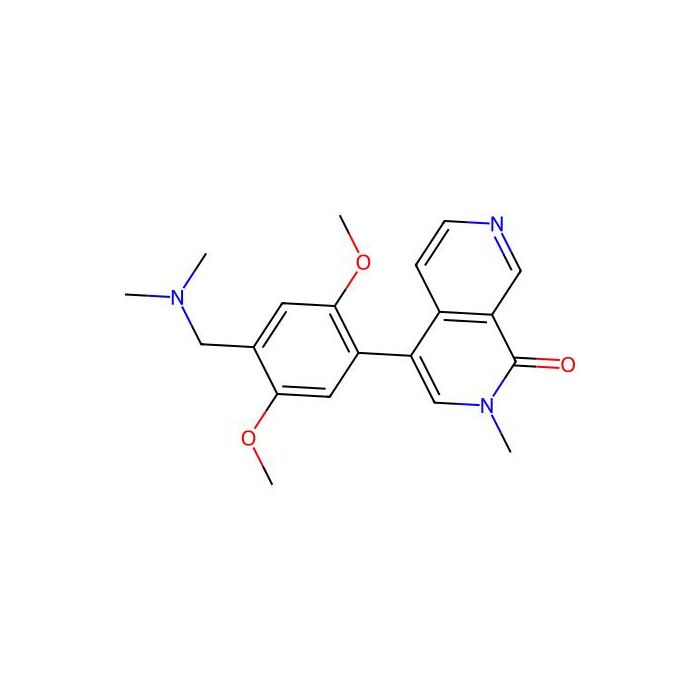
BI-9564 is a potent, selective and cell-permeable BRD9/BRD7 bromodomains inhibitor,with IC 50 s of 75 nM and 3.4 μM and K d s of 14 nM and 239 nM, respectively. BI-9564 has an IC 50 of > 100 μM for BET family.
Specifications
Especificaciones y pureza
Moligand™, 10 mM in DMSO
Condiciones de almacenamiento de almacenamiento
Store at -80°C
Enviado en
Dry ice packs + Cold packs
Este producto requiere envío en cadena de frío. Los servicios terrestres y otros servicios económicos no están disponibles.
Certificados (CoA, COO, BSE/TSE y tabla de análisis)
C of A & Other Certificates(BSE/TSE, COO):
Analytical Chart:
Calculadoras de soluciones
Molarity Calculator
Determine the necessary mass, volume, or concentration for preparing a solution.
Dilution Calculator
Determine the dilution needed to prepare a stock solution.
Reconstitution Calculator
Reseñas
Reseñas de cliente
Application Protocols
No tested application protocols (e.g., specific assay types, concentrations, or conditions) are provided for this item in the Product Data.
General workflow suggestions (research use only)
Preparing DMSO stocks: Bring vial to room temperature in a desiccated environment, briefly spin down, then add calculated volume of anhydrous DMSO for a desired stock (e.g., 10 mM). Vortex/sonicate until fully dissolved. Record exact concentration and date.
Plate-based assays: Use acoustic or pin-tool dispensing to minimize DMSO volume; target final vehicle ≤0.1–0.5% v/v where biology permits. Include vehicle and positive/negative controls.
Serial dilutions: Prepare in polypropylene plates with low-binding tips. Mix thoroughly at each step to avoid carryover errors. Confirm absence of precipitation visually or by light scatter.
Storage of working plates: Seal to minimize evaporation; store at recommended temperatures for your assay duration and validate stability/evaporation by mass or dye-tracking.
For any validated, item-specific protocols, please refer to the CoA/Spec Sheet or contact technical support with the SKU and lot number.
Biological Roles
Item-specific biological target information is not provided on this page. BI-9564 is offered for research use as a small-molecule ligand within screening and discovery workflows.
General considerations (chemistry/biochemistry knowledge)
Chemical probes and ligands of this class are employed to interrogate protein–ligand interactions, modulate biochemical activity, and serve as tool compounds for pathway studies in cells or lysates.
Typical study modalities include target engagement (thermal shift assays), displacement from binding domains (fluorescence polarization), and downstream pathway readouts (reporter gene, phospho-protein levels), always accompanied by vehicle and orthogonal controls.
Structure–activity relationships (SAR) are frequently developed by testing analog series to map key pharmacophoric elements. Parallel screening against off-target panels can help characterize selectivity profiles.
ADME-relevant parameters (permeability, stability in microsomes, plasma protein binding) may be profiled in early discovery to understand cellular potency versus biochemical affinity; these are assay-dependent and not provided here.
Note
For target identity, binding mode, or reported selectivity, consult peer-reviewed literature and the CoA/Spec Sheet. No medical or clinical use is intended or implied; for research use only.
Buffer Applications
This item is a small-molecule research ligand and does not function as a buffering agent.
Not applicable: It is not used to prepare buffer systems or maintain pH. For buffer-related needs (e.g., PBS, HEPES, Tris), refer to dedicated buffer and biochemistry reagents.
Practical note: When dosing into buffers for assays, verify compound stability across the working pH range, and control the final organic vehicle content (e.g., DMSO ≤0.1–1% v/v as permitted by your assay). Include vehicle-only controls to account for solvent effects.
Green Alternatives
Green chemistry substitution is generally relevant to solvents and bulk reagents. BI-9564 is a discrete small-molecule research ligand, not a process solvent or commodity reagent.
Not typically applicable: Replacing BI-9564 with a “greener” alternative is not meaningful in a screening/ligand-discovery context, as the compound itself is the object of study.
However, you can improve the overall greenness of your workflow by focusing on vehicles and processes:
Prefer greener stock solvents when compatible with biology (e.g., ethanol over DMF), and minimize final vehicle % in assay wells.
Use miniaturized assay formats (384/1536-well) to reduce solvent/compound consumption.
Implement plate mapping that consolidates controls, reducing replicate waste.
Employ solvent recycling programs for DMSO and alcohols where available.
Summary
Green alternatives: Not applicable to the compound itself.
Greener practices: Optimize solvent choice and assay scale to minimize environmental footprint while preserving assay performance.
Pharmaceutical Uses
This product is supplied strictly for research use and is not intended for human or veterinary use, diagnostics, or as an excipient.
Context (general)
Small-molecule ligands like this are commonly used in preclinical research to study biological targets and pathways. They are not compendial (no pharmacopeial monograph) and are not manufactured under GMP for clinical or manufacturing applications.
If formulating for in vivo research (where permitted by your institution), establish compatibility and stability in the intended vehicle through dedicated studies (solubility, precipitation on dilution, adsorption to plastics, and stability at storage/operating temperatures). Such uses are outside the scope of this catalog entry and require institutional approvals.
Not specified for this item; refer to CoA/Spec Sheet
Any excipient status, residual solvent specifications, or GMP-related statements are not provided for this listing.
Physical Properties
Item-specific physical constants are not listed for this product.
Appearance: Not specified for this item; refer to CoA/Spec Sheet.
Melting point: Not specified for this item; refer to CoA/Spec Sheet.
Boiling point: Not applicable/relevant for a high-MW organic solid; specific value not specified for this item; refer to CoA/Spec Sheet.
Density: Not specified for this item; refer to CoA/Spec Sheet.
Solubility: Not specified for this item; refer to CoA/Spec Sheet.
LogP/logD: Not specified for this item; refer to CoA/Spec Sheet.
pKa: Not specified for this item; refer to CoA/Spec Sheet.
Refractive index: Not applicable (typically for liquids); not specified for this item; refer to CoA/Spec Sheet.
General guidance (literature/practice)
Small-molecule screening ligands of this class are commonly supplied as solids, formulated into DMSO stock solutions (e.g., 10–50 mM) for bioassays. Water solubility is often limited and may require co-solvent or cyclodextrin if aqueous use is intended.
Prior to preparing working solutions, determine solubility experimentally in your assay-relevant solvent system (DMSO, DMF, ethanol, or aqueous buffer with 0.1–2% DMSO).
Hygroscopicity and polymorphism can affect handling; minimize headspace humidity and record any observed oiling-out or crystallinity changes upon warming.
Always consult the SDS for thermal stability and decomposition information before heating or drying.
Quality and Grades
Grade/Purity: Moligand™ (item-specific)
What Moligand™ implies (general description)
Moligand™ denotes suitability for molecular screening and ligand discovery workflows. Compounds in this category are intended for use in biochemical/biophysical target engagement, cell-based phenotypic assays, and hit validation.
Documentation: For exact specifications (purity metric, analytical methods, residual solvent levels), consult the lot-specific Certificate of Analysis (CoA) and/or Specification Sheet. Where provided, these typically include identity confirmation (e.g., MS), and purity by chromatographic method (e.g., HPLC/UPLC) appropriate for screening use.
Practical considerations
For screening campaigns, record lot/batch in your screening database to ensure reproducibility across replicates and follow-up procurement.
If low-UV applications (e.g., HPLC detection) are planned, check the CoA for UV spectra or evaluate background absorbance independently.
If your workflows require additional controls (e.g., counter-screens for aggregation), consider orthogonal QC (HRMS, qNMR) on first use.
Not provided for this item; refer to CoA/Spec Sheet
Exact purity percentage and assay method.
Water/volatile content, residual solvents, metals profile, and stabilizers (if any).
Reaction and Applications
This product is supplied as a research ligand for screening and target engagement rather than as a synthetic reagent. Consequently, it is not commonly used as a substrate, catalyst, or solvent in preparative organic reactions.
Applicable uses (research context)
Biochemical assays: Evaluate binding/functional modulation of protein targets in enzyme or reader-domain assays (e.g., fluorescence polarization, TR-FRET, AlphaScreen), subject to your laboratory’s chosen targets and controls.
Biophysical characterization: Assess target engagement by DSF, ITC, SPR, MST, or NMR, validating affinity and thermodynamics.
Cell-based studies: Probe cellular phenotypes and pathway responses, with careful control of vehicle concentration and compound exposure time.
Chemoinformatics: Use the CAS and CID to retrieve reference data (supplier-independent) and incorporate into virtual screening or SAR mapping.
Not typically applicable
Named organic reactions, cross-couplings, or catalysis are not relevant to this item’s primary use-case. If you require building blocks for synthesis, see other catalog categories focused on reagents and intermediates.
Reaction Conditions
Not applicable. BI-9564 is not offered as a reagent for chemical synthesis, and no item-specific reaction conditions are provided.
General guidance for assay preparation (research context)
Stock solutions: Often prepared in anhydrous DMSO at high concentration (e.g., 10–50 mM). Filter sterilization may be applied if required by the assay, provided the compound remains soluble.
Working concentrations: Determined empirically for each assay modality (biochemical vs. cellular). Include serial dilutions over multiple logs for potency determination.
Temperature: Most biochemical assays are run at ambient temperature or 25–37°C; confirm compound stability under assay conditions.
Light/oxidation: Protect from light if chromophores are present (unknown here). Minimize air exposure for potentially oxidizable motifs; use amber vials and inert headspace if needed.
For chemical reaction parameters (solvents, catalysts, yields), this section is not relevant to this product.
Safety and Handling
GHS classification and specific hazard statements are not provided on this page for BI-9564.
Signal word: Not specified for this item; refer to SDS.
GHS hazard statements/pictograms: Not specified for this item; refer to SDS.
General laboratory safety (should not replace the SDS)
PPE: Wear lab coat, safety glasses, and appropriate chemically resistant gloves (e.g., nitrile). Handle powders in a fume hood to avoid dust/airborne particulate exposure.
Avoid ingestion, inhalation, and skin/eye contact. Use closed-cap microtubes or crimp vials for DMSO stocks to reduce volatilization/contamination.
Incompatibilities: Avoid strong oxidizers and strong acids/bases unless compatibility is established. Do not mix concentrated DMSO solutions with strong oxidants.
First aid overview: Inhalation—move to fresh air; Skin—wash with soap/water; Eyes—rinse cautiously with water for several minutes; Ingestion—rinse mouth, seek medical attention. Always follow your institution’s emergency procedures.
Spill response: For small spills, absorb with inert material (e.g., vermiculite), collect in a compatible waste container. Decontaminate area with appropriate solvent and detergent.
Waste: Dispose via an approved chemical waste stream according to local regulations. DMSO solutions of organic actives are typically collected as halogen-free organic waste unless otherwise designated.
Transport/receipt: Product is shipped on dry ice and cold packs; allow parcels to equilibrate in a desiccated cold environment before opening to minimize condensation.
Always defer to the official SDS and institutional EHS guidance for authoritative safety information.
Solvent Selection
As a small-molecule research ligand, BI-9564 is typically prepared as a concentrated stock in an organic solvent for downstream dilution.
Item-specific solubility is not provided; the following are general, literature-based practices for similar compounds:
Primary stock solvent: DMSO is the default for bioassays due to broad solubilizing power and biological compatibility at ≤0.1–1% v/v in assays.
Alternatives: DMF (good solvator but less preferred biologically), ethanol or methanol (useful where permitted by assay/biology), or aqueous buffers containing 0.1–2% DMSO plus surfactant (e.g., 0.01% Tween-20) to mitigate precipitation.
Aqueous work: For limited solubility, consider co-solvents or carrier systems (e.g., 2-hydroxypropyl-β-cyclodextrin). Validate that vehicles do not perturb your assay readout.
Comparison (general guidance)
DMSO: Highest solvency; widely tolerated in cells up to 0.1–0.5% v/v; hygroscopic—store dry and anhydrous.
Ethanol: Lower solvency than DMSO; often tolerated up to ~0.1–0.5% v/v; can affect membrane integrity in some cell types.
DMF: Strong solvency but less biocompatible; consider only for in vitro biochemical assays with low final %.
Tips
Warm to room temperature and vortex/sonicate to ensure complete dissolution before sterile filtration (if applicable).
Pre-screen solubility at intended concentrations and temperatures; monitor for precipitation after dilution into assay buffer.
Storage and Reconstitution
Item-specific storage and shipping
Storage conditions: Store at −80°C (per Product Data). Keep tightly closed in the original container.
Shipped in: Dry ice packs + cold packs to maintain subzero temperatures during transit.
General handling
Upon receipt: Inspect the integrity of the cold chain. Without opening the inner vial, allow container to warm gradually to room temperature in a desiccated environment to prevent condensation on the solid.
Aliquoting: If the product will be converted to solution, prepare single-use aliquots to avoid repeated freeze–thaw cycles. Use low-bind tubes and inert caps.
Reconstitution (general guidance; item-specific solubility not provided)
Common vehicle: Anhydrous DMSO is typically used to make concentrated stocks (e.g., 10–50 mM). If aqueous use is required, dilute the DMSO stock into buffer while mixing to prevent local supersaturation; keep final DMSO at assay-compatible levels.
Filtration: If sterility is required and the compound is fully soluble, pass through a 0.22 µm PTFE syringe filter.
Stability: Track time-in-solution at room temperature, 4°C, and −20°C; discard aliquots that show precipitation, discoloration, or significant potency drift.
Do not store working solutions in frost-free freezers subject to temperature cycling. For authoritative, lot-specific information (purity, solubility, stability), consult the CoA/Spec Sheet.
Research use note: For research use only.
Structure and Identity
Product name: BI-9564 (SKU: B1493110)
CAS: 1883429-22-8
PubChem CID: 117072549
Molecular formula: Not specified for this item; refer to CoA/Spec Sheet.
Molecular weight: Not specified for this item; refer to CoA/Spec Sheet.
SMILES: Not specified for this item; refer to CoA/Spec Sheet.
InChIKey: Not specified for this item; refer to CoA/Spec Sheet.
Structural description
Item-specific structural features (ring systems, heteroatoms, stereochemistry): Not specified for this item; refer to CoA/Spec Sheet.
General note (chemistry knowledge): BI-9564 is a small-molecule research compound typically supplied for use as a ligand in target engagement and screening assays. Without an explicit structural string on the product page, end-users should rely on the Certificate of Analysis (CoA) or supplier structural file for unambiguous identity prior to critical use.
Best practices
Verify identity via independent analytical data where possible (e.g., LC–MS retention time match to reference, exact mass, and, if available, 1H NMR). Attach spectral data to your ELN entry for traceability.
If you maintain in-house compound registration, map the CAS and CID to your registry ID and capture lot-specific metadata (supplier, lot/batch, receipt date).
Synthetic Utility
This compound is supplied as a finished small-molecule research ligand and is not typically employed as a building block, catalyst, or reagent in synthetic chemistry.
Not applicable: No named transformations, reagent roles, or catalyst applications are associated with this catalog entry.
If your objective is synthetic method development or target synthesis, consider instead:
Functionalized building blocks (halogenated aromatics/heteroaromatics, boronic acids/esters, carboxylic acids, amines) suitable for cross-coupling and diversification.
Catalysts/ligands (e.g., phosphines, NHCs) and enabling solvents/reagents from other categories in the catalog.
Note
If you intend to derivatize or immobilize this molecule for assay development, first obtain the full structural information (SMILES, InChI) and assess derivatization handles. Such modification is outside the standard use-case and requires independent method development.
Target Specificity
Item-specific biological target(s), binding constant(s), and selectivity data are not provided in the Product Data for this listing.
Not specified for this item; refer to CoA/Spec Sheet.
Users seeking target information should consult peer-reviewed literature associated with the CAS or CID and verify alignment with the supplied lot via CoA.
Per catalog policy, only target data explicitly provided in the product listing or accompanying documentation should be used for critical decision-making.
Need help choosing the grade?
Our grade selection guide covers purity, stabilizer status, and application suitability for all variants in our catalog.
We use cookies to ensure the website functions properly and, where permitted, to improve your experience. You can manage your preferences at any time in Settings. Learn more in our Cookie Policy.
Shall we send you a message when we have discounts available?
Remind me later
Thank you! Please check your email inbox to confirm.
Products are supplied to verified businesses, institutions, and qualified professionals for research and development use only. Not for use in humans, animals, diagnosis, or therapy.