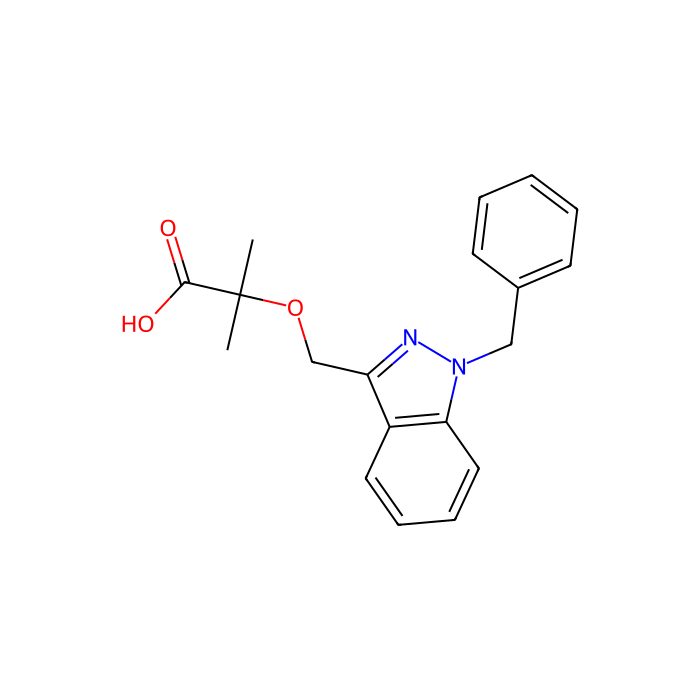
Determine the necessary mass, volume, or concentration for preparing a solution.
| Activity Type | Activity Value -log(M) | Mechanism of Action | Activity Reference | Publications (PubMed IDs) |
|---|

Information
Bindarit (AF 2838) Bindarit (AF 2838) exhibits selective inhibition against monocyte chemotactic proteins MCP-1/CCL2, MCP-3/CCL7 and MCP-2/CCL8.
In vitro
Bindarit treatment causes a dose-dependent inhibition of the capacity of human monocytes to produce monocyte chemotactic protein-1 (MCP-1) in response to bacterial LPS or C. albicans with IC50 of 172 µM and 403 µM, respectively. The inhibition of LP-induced MCP-1 production by Bindarit is associated with reduced levels of MCP-1 mRNA transcripts with IC50 of 75 µM. Bindarit inhibits the production of MCP-1 by LPS-stimulated MM6 cells with IC50 of 425 μM, without affecting the release of IL-8 or IL-6. Bindarit treatment inhibits the release of MCP-1 from IL-1 stimulated osteoblast cell line Saos-2. Bindarit, even at the maximal concentration, does not exhibit a direct in vitro cytotoxic effect on human IIB-MEL-J melanoma or ECs, although it inhibits MCP-1 expression. Bindarit (10-300 μM) reduces rat vascular smooth muscle cell (VSMC) proliferation, migration, and invasion. Bindarit induces the downregulation of the classical NF-κB pathway. Bindarit displays a specific inhibitory effect on the p65 and p65/p50 induced MCP-1 promoter activation, with no effect on other tested activated promoters, indicating that Bindarit acts on a specific subpopulation of NF-κB isoforms and selects its targets within the whole NF-κB inflammatory pathway. Bindarit modulates cancer-cell proliferation and migration, mainly through negative regulation of TGF-β and AKT signaling.
In vivo
Oral administration of Bindarit at 50 mg/kg in NZB/W mice delays the onset of proteinuria, significantly protects from renal function impairment, and prolongs survival of NZB/W mice or lupus mice. Bindarit treatment completely MCP-1 up-regulation during the progression of nephritis. Inhibition of MCP-1 with Bindarit also reduces tumor growth and macrophage recruitment, rendering necrotic tumor masses in human melanoma xenografts. Bindarit is effective in reducing neointima formation in both non-hyperlipidaemic and hyperlipidaemic animal models of vascular injury by a direct effect on VSMC proliferation and migration and by reducing neointimal macrophage content. Administration of Bindarit results in impaired metastatic disease in prostate cancer PC-3M-Luc2 xenograft mice and impairment of local tumorigenesis in Balb/c mice with murine breast cancer 4T1-Luc cells. In addition, Bindarit treatment significantly decreases the infiltration of tumor-associated macrophages and myeloid-derived suppressor cells in 4T1-Luc primary tumors.
Cell Data
cell lines:
Concentrations:
Incubation Time:
Powder Purity:≥99%
| Activity Type | Activity Value -log(M) | Mechanism of Action | Activity Reference | Publications (PubMed IDs) |
|---|
Nuestra guía de selección de calidades cubre la pureza, el estado del estabilizador y la idoneidad de la aplicación para todas las variantes de nuestro catálogo.
Ver la guía de calidades Moligand™ →