CALIDAD & PUREZAMoligand™?Moligand™ — Aladdin's line of ligands and bioactive small molecules. Use for receptor, pathway, and binding studies needing defined small-molecule tools.10 mM in DMSO
Certificados (CoA, COO, BSE/TSE y tabla de análisis)
C of A & Other Certificates(BSE/TSE, COO):
Analytical Chart:
Propiedades químicas y físicas
Punto de fusión (°C)
233 °C
Calculadoras de soluciones
Molarity Calculator
Determine the necessary mass, volume, or concentration for preparing a solution.
Dilution Calculator
Determine the dilution needed to prepare a stock solution.
Reconstitution Calculator
Reseñas
Reseñas de cliente
Application Protocols
Tested application types, dilutions, or kit-style protocols are not provided for this item. Refer to Reaction Conditions and Buffer Applications for literature-based guidance on typical concentrations, buffers, catalysts, and incubation parameters for hydrazone ligation and optional reductive stabilization.
Biological Roles
Context (general biochemistry; not a medical claim)
Biotin (vitamin B7/H) is a covalently bound cofactor for carboxylases in central metabolism (e.g., acetyl-CoA carboxylase, pyruvate carboxylase). Its bicyclic ureido–thiophane structure confers extremely high affinity to avidin/streptavidin (Kd ~10^−15 M; literature), enabling powerful affinity capture.
Biotin Hydrazide leverages this affinity by presenting biotin on a carbonyl-reactive hydrazide, allowing selective tagging of aldehyde/ketone-functional biomolecules.
Typical biochemical applications (literature)
Glycoprotein profiling: after periodate oxidation of sialylated glycans, hydrazide tagging permits enrichment/detection via streptavidin.
Proteostasis/oxidative damage studies: derivatization of protein carbonyls for quantitation by blotting or MS workflows.
Cell-surface engineering: mild periodate oxidation followed by hydrazide conjugation introduces biotin handles for imaging and sorting (subject to viability-compatible conditions).
Notes
Binding to streptavidin/avidin is noncovalent but extraordinarily tight; dissociation typically requires harsh conditions (boiling SDS, high pH, or excess free biotin), which should be considered in workflow design.
No inherent biological activity is implied for the hydrazide beyond its chemical reactivity; use is for research and analytical purposes only.
Buffer Applications
Relevance
As a labeling reagent rather than a buffering agent, Biotin Hydrazide is not used to control pH or ionic strength. However, buffer choice is critical for efficient hydrazone formation.
Practical buffer systems for hydrazone ligation (literature)
Sodium acetate, 50–100 mM, pH 5.0–6.0: promotes maximum hydrazone formation rates; compatible with proteins and carbohydrates.
MES, 50 mM, pH 5.5–6.0: similar performance to acetate with low UV background.
Phosphate-buffered saline (PBS), pH 7.2–7.4: slower hydrazone kinetics; consider aniline (10–100 mM) catalyst if neutral pH is required.
Working tips
Degas and filter buffers (0.22 μm) for sensitive assays; avoid primary amines (e.g., Tris) that may compete or interfere in downstream steps.
Include 0.01–0.05% nonionic surfactant (e.g., Tween-20) only if surface fouling is a concern; verify it does not inhibit downstream streptavidin binding.
Typical reagent loading: 0.1–2 mM Biotin Hydrazide relative to estimated aldehyde content; incubate 1–4 h at RT or 4–16 h at 4°C for delicate samples.
Green Alternatives
Greener choices focus on solvent systems and catalysts rather than the tag itself.
Strategies (general, literature)
Prefer aqueous buffers (50–100 mM sodium acetate, pH 5.0–6.0) with ≤5–10% DMSO/DMF instead of neat aprotic solvents.
Use aniline catalysts efficiently (10–50 mM) to shorten reaction times at ambient temperature, avoiding heating.
For stabilization, consider picoline borane (aqueous-compatible, milder odor/toxicity profile) as an alternative to NaBH3CN where appropriate.
Minimize periodate load and quench effectively to reduce inorganic waste; perform oxidations at low temperature and in the dark to limit over-oxidation.
Comparison (illustrative; not specifications)
Hydrazide vs aminooxy tags:
Aminooxy-biotin enables oxime ligation at neutral pH, often faster and potentially more water-compatible; however, aminooxy reagents can be more air-sensitive and may require careful storage.
Hydrazide-biotin is broadly robust, widely available, and performs well under mildly acidic, primarily aqueous conditions with modest catalyst loading.
Operational improvements
Employ micro-scale reactions and on-bead ligations to decrease solvent volumes.
Select greener cosolvents where feasible (e.g., ethanol at low percentages) while monitoring solubility.
Implement solid-phase capture and recycling of streptavidin supports to reduce consumables.
Pharmaceutical Uses
Applicability
Biotin Hydrazide is a research-use reagent for bioconjugation and analytical workflows. It is not an active pharmaceutical ingredient and is not an excipient in standard formulations.
Process and analytical roles (general; non-clinical)
Affinity tagging in process development: enables pull-down of oxidized glycoforms or carbonylated impurities for characterization.
Conjugation handle in biomaterials: coupling to aldehyde-terminated polymers/surfaces to create streptavidin-compatible capture interfaces for QC assays.
Bioanalytical assay development: creation of biotinylated standards, calibrators, and capture reagents for ELISA and ligand-binding assays.
Regulatory notes
Pharmacopeial status: Not specified for this item; refer to CoA/Spec Sheet.
Any use in GMP settings should be supported by appropriate documentation (identity/purity, residual solvent, elemental impurities, bioburden/endotoxin as applicable). Consult your QA unit and the SDS/CoA for specifications.
Physical Properties
Item-specific (from Product Data)
Appearance: Not specified for this item; refer to CoA/Spec Sheet.
Molecular weight: Not specified for this item; refer to CoA/Spec Sheet.
Literature/general values and behavior (for context; not specifications)
Physical state: typically an off-white to white solid (literature, supplier catalogs).
Solubility profile: readily soluble in polar aprotic solvents such as DMSO and DMF; limited to moderate solubility in water that can improve at mildly acidic pH (e.g., acetate buffer pH ~5–6) due to protonation of the hydrazide (literature). Sparingly soluble in alcohols; essentially insoluble in nonpolar solvents (hexanes, toluene).
Partitioning: strongly polar due to multiple heteroatoms (ureido + hydrazide); expected low logP and high H-bonding capacity (computed/property trends; qualitative).
pKa: the terminal hydrazide –NH–NH2 is weakly basic/acidic with typical hydrazide conjugate acid pKa values near 2–3 (carbonyl-adjacent) and ~7–8 (terminal –NH2), supporting hydrazone formation under mildly acidic conditions (literature, general for acyl hydrazides).
Thermal properties (melting/boiling): specific values vary by lot and hydration and are not provided here; consult CoA/SDS for definitive data.
Notes for users
When preparing concentrated stock solutions, anhydrous DMSO or DMF is commonly used to 10–100 mM. For aqueous work, dissolve in 50–100 mM sodium acetate, pH 5.0–6.0, with minimal organic cosolvent as needed (literature practice).
Quality and Grades
Item-specific (from Product Data)
Grade/Purity: Moligand™ (no further numeric purity specifications provided for this item).
Interpretation and guidance (general; not item-specific specs)
Moligand™ line: positioned for ligand- and tag-grade materials intended for bioconjugation and coordination to affinity partners. For Biotin Hydrazide, the key performance attribute is efficient formation of hydrazones with carbonyl groups and strong affinity capture via streptavidin/avidin.
What to verify before critical use:
Identity and purity by NMR/HRMS/HPLC: Not specified for this item; refer to CoA/Spec Sheet.
Residual solvents, water content, and bioburden/endotoxin (if relevant to your workflow): Not specified for this item; refer to CoA/Spec Sheet.
Stabilizers: None stated. If your application is sensitive to amine impurities (e.g., labeling kinetics), confirm absence of stabilizers on the CoA.
UV background: For detection applications, low UV background is desirable. Actual UV cutoff/absorbance: Not specified for this item; refer to CoA/Spec Sheet.
Practical tips
For reproducible conjugations, prepare fresh anhydrous stock solutions; aliquot to single-use to avoid moisture uptake.
If your downstream use is analytical (LC–MS, proteomics), request or consult certificate data for trace impurities and residuals to ensure compatibility.
Reaction and Applications
Core reactivity (general, literature)
Carbonyl capture: the terminal hydrazide reacts with aldehydes and ketones to form hydrazones (C=N–NH–), enabling selective conjugation to carbonyl-bearing substrates. This underpins labeling of:
Oxidized glycans on glycoproteins/cells (after NaIO4 oxidation to generate aldehydes from vicinal diols).
Carbonylated proteins/lipids formed during oxidative stress.
Aldehyde-functional polymers, nanoparticles, and surfaces.
Stabilization strategies:
Aniline-catalyzed hydrazone formation accelerates kinetics at pH 4.5–6.0.
Reductive amination (NaBH3CN, picoline borane) converts hydrazones to more stable hydrazides/secondary amines.
Practical tips
Degas buffers if working with oxidation-sensitive substrates; keep metal contaminants low when using borane/cyanoborohydride.
Typical conditions (literature): 0.1–5 mM Biotin Hydrazide, 50–100 mM sodium acetate buffer pH 5.0–6.0, room temperature to 37°C, 1–4 h (longer for low-density carbonyls). 10–100 mM aniline or p-anisidine as nucleophilic catalyst can reduce reaction times.
For cell-surface labeling post-periodate oxidation: perform oxidation on ice in the dark, quench residual periodate (e.g., with ethylene glycol), then add Biotin Hydrazide in acetate buffer. Minimize DMSO to maintain viability in live-cell workflows.
Applications (manufacturer text: none provided; expanded general uses)
Affinity enrichment via streptavidin/avidin capture of biotinylated targets (proteomics, glycomics).
Western blot and ELISA detection using streptavidin–HRP/AP probes after hydrazide labeling.
Immobilization of carbohydrates or oxidized polymers onto streptavidin-coated beads or surfaces.
Site-selective coupling to aldehyde-terminated PEGs and polysaccharides.
Reaction Conditions
General conditions for hydrazone ligation (literature guidance; not specifications)
Reagent concentration: 0.1–5 mM Biotin Hydrazide (higher for low-density or poorly accessible carbonyls).
Buffer: sodium acetate or MES, 50–100 mM, pH 5.0–6.0. Avoid primary amine buffers (e.g., Tris).
Catalyst: aniline or p-anisidine, 10–100 mM, to accelerate hydrazone formation at pH 5–7.
Temperature/time: RT to 37°C, 1–4 h; for delicate samples, 4°C for 4–16 h.
Organic cosolvent: 0–10% DMSO or DMF to aid solubility; minimize for biological samples.
Stabilization (optional): add NaBH3CN (5–20 mM) or picoline borane (10–50 mM) after ligation; incubate 1–2 h at RT. Ensure compatibility with substrates and safety procedures for cyanoborohydride.
Workup and analysis
Quench excess hydrazide with carbonyl scavengers or by desalting.
For proteomics: digest, then enrich on streptavidin beads; wash with high-salt and detergent-containing buffers as needed.
Verification: MS shift corresponding to biotinylation; streptavidin blotting; capture/release assays.
Notes
Shield samples from light during periodate oxidation and subsequent steps to minimize side reactions.
Remove residual oxidant (e.g., ethylene glycol quench) before adding hydrazide to prevent undesired modifications.
Safety and Handling
Item-specific (from Product Data)
GHS classification, signal word, pictograms, and H-statements: Not specified for this item; refer to the SDS.
Storage: Store at -80°C. Shipments are sent with dry ice packs + cold packs.
General safety information (consult SDS for authoritative guidance)
Likely hazards: hydrazide-containing compounds may cause skin/eye irritation and may be harmful if swallowed or inhaled. Avoid dust generation and aerosol formation. Handle in a chemical fume hood.
PPE: lab coat, safety glasses or face shield, and appropriate chemically resistant gloves (e.g., nitrile). Use respiratory protection if dusts/aerosols cannot be controlled.
Incompatibilities: strong oxidizers; nitrosating agents; reactive carbonyl compounds (may form hydrazones). Avoid prolonged exposure to moisture which can promote hydrolysis.
Special risks: although not an ether, hygroscopic uptake of moisture can degrade reactivity toward carbonyls. Keep container tightly closed under dry, inert atmosphere when possible.
First aid (overview):
Inhalation: move to fresh air; seek medical attention if symptoms persist.
Skin/eye contact: rinse with water for at least 15 minutes; remove contaminated clothing; seek medical attention for persistent irritation.
Ingestion: rinse mouth; do not induce vomiting; seek medical attention.
Spill/leak: avoid dust; collect with inert absorbent; dispose according to institutional and local regulations.
Waste: treat as organic laboratory waste; hydrazide-bearing residues should be collected separately if required by local regulations.
Solvent Selection
Use profile (general chemistry)
Polarity class: polar, highly hydrogen-bonding solute; behaves best in polar aprotic solvents (DMSO, DMF) or mildly acidic aqueous buffers.
Miscibility/solubility (literature):
DMSO, DMF: excellent; recommended for concentrated stocks (10–100 mM).
Water/buffers: moderate at pH 5–6 (acetate). Solubility can be improved by small fractions (5–20%) of DMSO or DMF.
Alcohols (MeOH/EtOH): limited; may be used as minor cosolvents.
Nonpolar solvents: poor.
When to choose which solvent
Hydrazone ligation to aldehydes/ketones on biomolecules: aqueous acetate buffer (50–100 mM, pH 5.0–6.0), optionally with 10–100 mM aniline catalyst; ≤10% DMSO to aid dissolution.
Surface/carbohydrate labeling where substrate is poorly soluble: DMF or DMSO stocks, add dropwise into buffered reaction to keep final organic content low.
Reductive amination stabilization: aqueous buffer compatible with NaBH3CN/NaBH(OAc)3; maintain low organic percentage for biocompatibility.
Comparison to alternatives (context)
Aminooxy-biotin (alkoxyamine) reacts faster at neutral pH but can be more sensitive to oxidation; hydrazide is robust and cost-effective, optimal under mildly acidic conditions.
NHS-biotin targets amines (lysines) in organic-buffer mixtures; hydrazide targets carbonyls (oxidized glycans, aldehyde-functional surfaces). Choose based on functional handle availability.
Storage and Reconstitution
Item-specific (from Product Data)
Storage conditions: Store at -80°C.
Shipping: Dry ice packs + cold packs.
General handling and reconstitution guidance (literature; not specifications)
Upon receipt: allow to equilibrate in a desiccator to avoid condensation before opening. Work quickly to minimize moisture exposure.
Reconstitution: dissolve in anhydrous DMSO or DMF to prepare 10–100 mM stock solutions. Alternatively, prepare fresh in 50–100 mM sodium acetate buffer (pH 5.0–6.0) immediately before use.
Aliquoting: dispense into single-use, low-adsorption microtubes; purge headspace with inert gas if possible; store aliquots at -80°C.
Stability: hydrazides can slowly hydrolyze or oxidize in solution; avoid repeated freeze–thaw cycles and prolonged storage in aqueous media. Prepare working solutions fresh the day of use.
Light/moisture protection: keep tightly capped, protected from light, and under dry conditions to maintain reactivity toward carbonyls.
Compatibility: avoid storage or dissolution in primary amine buffers (e.g., Tris) that may interfere with subsequent hydrazone formation.
Research use
For research use only (per Product Data). Consult the CoA and SDS for lot-specific specifications and safety before critical applications.
Structure and Identity
Item-specific (from Product Data)
Product name: Biotin Hydrazide (SKU: B1493088)
CAS: 66640-86-6; PubChem CID: 83872
Grade/Purity: Moligand™
Storage: Store at -80°C; Shipped on dry ice packs + cold packs
SMILES: Not specified for this item; refer to CoA/Spec Sheet.
InChIKey: Not specified for this item; refer to CoA/Spec Sheet.
Molecular formula: Not specified for this item; refer to CoA/Spec Sheet.
Molecular weight: Not specified for this item; refer to CoA/Spec Sheet.
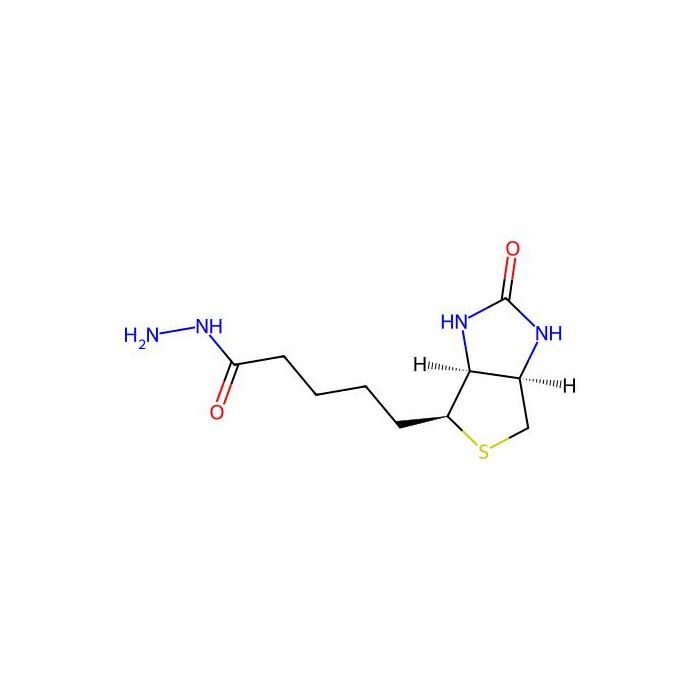
Biotin hydrazide is the hydrazide derivative of biotin. It retains the bicyclic biotin core: a fused ureido (imidazolidone) ring and a tetrahydrothiophene ring.
The valeric acid side chain of biotin is converted from –COOH to a terminal hydrazide –CONH–NH2, furnishing a nucleophilic carbonyl-reactive handle.
Functional groups: ureido (cyclic urea), thioether, secondary amide (within the ureido ring), and terminal hydrazide. No stereocenters are introduced beyond the native stereochemistry of biotin.
2D depiction in words: a bicyclic ring system (thiophene-like sulfur-containing five-membered ring fused to a ureido ring) with a five-carbon tether terminating in –C(=O)–NH–NH2 (hydrazide).
Synthetic Utility
Functional group leverage (general, literature)
Hydrazide functionality:
Nucleophilic addition–elimination with aldehydes/ketones → hydrazones (reversible; driven by water removal or catalysis).
Chemoselective capture of carbonyls on complex substrates; orthogonal to amine-reactive chemistries (e.g., NHS esters).
Biotin handle:
Provides universal affinity tag for streptavidin/avidin, enabling purification, immobilization, and detection post-conjugation.
Transformations and adaptations
Reductive stabilization: hydrazones reduced with NaBH3CN or picoline borane → stable secondary amine linkages, useful for durable immobilizations.
Ligation accelerants: aniline and substituted anilines form Schiff base intermediates that catalyze hydrazone formation, enabling near-neutral pH ligations when required.
Polymer and surface chemistry: reaction with aldehyde-terminated PEGs, polysaccharides (e.g., oxidized dextran, alginate), and carbonyl-functional resins yields biotinylated materials for affinity capture and assay platforms.
Retrosynthetic considerations
Positioning hydrazide on the biotin valeric chain maintains the biotin binding epitope. Protecting-group-free conditions are often feasible due to chemoselectivity toward aldehydes over most amides/alcohols under mild acidic aqueous media.
Target Specificity
This section is typically applicable to biological affinity reagents (e.g., antibodies) with defined antigen targets, clones, and species reactivity. Biotin Hydrazide is a small-molecule tagging reagent and does not possess intrinsic biological target specificity. For information on selectivity and use, see Reaction & Applications and Synthetic Utility.
¿Necesita ayuda para elegir la calidad?
Nuestra guía de selección de calidades cubre la pureza, el estado del estabilizador y la idoneidad de la aplicación para todas las variantes de nuestro catálogo.
Utilizamos cookies para garantizar el correcto funcionamiento del sitio web y, cuando esté permitido, para mejorar su experiencia. Puede gestionar sus preferencias en cualquier momento en Configuración. Más información en nuestra Política de Cookies.
¿Quieres que te enviemos un mensaje cuando tengamos descuentos disponibles?
Recordármelo más tarde
¡Gracias! Por favor, revisa tu bandeja de entrada de correo electrónico para confirmar.
Products are supplied to verified businesses, institutions, and qualified professionals for research and development use only. Not for use in humans, animals, diagnosis, or therapy.