≥99% for sensitive chromatographic and analytical workflows requiring minimal baseline interference.
🌡
Storage & shipping
Argon charged,Room temperature Ships Normal Check lot-specific COA for exact specifications.
📋
Quality documents
SDS, COA, datasheet, and spec sheet available for download. Lot-specific COA accessible via lot number lookup.
📚
Literature proof
Cited in 5 peer-reviewed publications across chromatography, organic synthesis, and cross-coupling reactions.
Descripción general
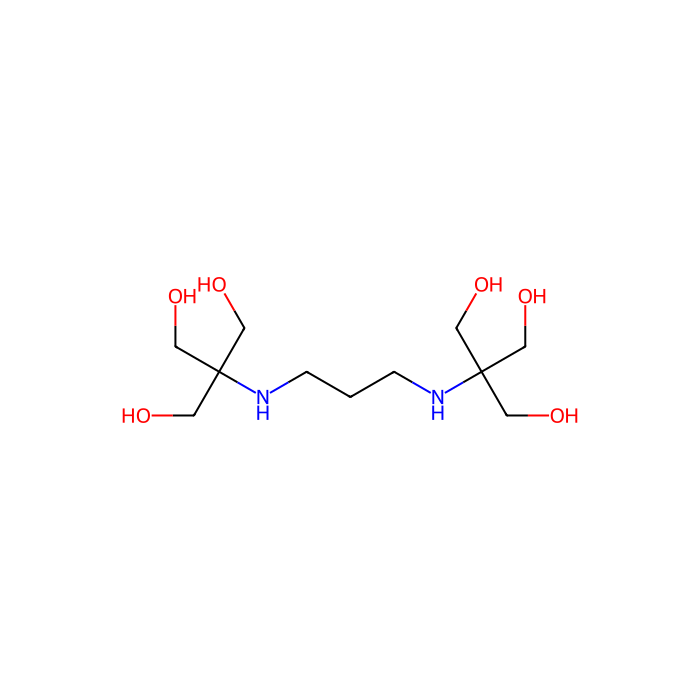
Bis-Tris Propane buffer, also known as BTP, is a zwitterionic biochemical buffer utilized for pH regulation in various laboratory applications, particularly in molecular biology, biochemistry, and electrophoresis. Its wide buffering range, spanning from pH 6.3 to 9.5, is attributed to its two pKa values of 6.8 (pKa1) and 9.0 (pKa2), which are close. This wide range makes it highly versatile for maintaining stable pH conditions in a variety of experiments. Furthermore, Bis-Tris Propane is a water-soluble buffer substance that plays a crucial role in enhancing the stability and activity of restriction enzymes. Specifically, its buffering capacity is advantageous for experiments that require pH levels as low as 6-7. When compared to Tris buffer, which has a poor buffering capacity below pH 7.5 and exhibits significant pKa fluctuations with temperature changes, Bis-Tris Propane proves to be a superior choice. Additionally, it finds application in conjunction with hydrochloric acid buffer to stabilize farnesyl diphosphate, particularly when isolated from Saccharomyces cerevisiae strains. Notably, it can also serve as a ligand, forming dinuclear hydroxo complexes with Lanthanides(III).
Product Application: BIS-TRIS Propane may be used in the following studies: as a buffer to investigate the influence of anions with varying nucleophilic properties on the autoxidation of oxymyoglobin (MbO2). for purification of glucose-binding protein from membranes of Sulfolobus solfataricus. as a buffer during GeO2 mineralisation. as a buffer component in a study pertaining to environmental research as a buffer component to maintain optimal pH conditions during the purification and preparation of engineered enzymes
Buffer that is useful in the pH 6.3-9.5 range. This wide buffering range is due to its two pKa values, 6.8 (pKa1) and 9.0 (pKa2), being so close.
Condiciones de almacenamiento de almacenamiento
Argon charged, Room temperature
Enviado en
Normal
Nota
Wherever possible, you should prepare and use solutions on the same day. However, if you need to make up stock solutions in advance, we recommend that you store the solution as aliquots in tightly sealed vials at -20°C. Generally, these will be useable for up to one month. Before use, and prior to opening the vial we recommend that you allow your product to equilibrate to room temperature for at least 1 hour. Need more advice on solubility, usage and handling? Please visit our frequently asked questions (FAQ) page for more details.
This compound belongs to the class of organic compounds known as 1,2-aminoalcohols. These are organic compounds containing an alkyl chain with an amine group bound to the C1 atom and an alcohol group bound to the C2 atom.
External Descriptors
hexol
1. Djoumbou Feunang Y, Eisner R, Knox C, Chepelev L, Hastings J, Owen G, Fahy E, Steinbeck C, Subramanian S, Bolton E, Greiner R, and Wishart DS. ClassyFire: Automated Chemical Classification With A Comprehensive, Computable Taxonomy. Journal of Cheminformatics, 2016, 8:61.
1.Jie Gu, Shuyun Zheng, Xiaolong Lu, Hao Zhang, Kai Ren, Ziqiang Liu, Chao Liu, Chunrui Wu. (2024) A new strategy for solving hydrophobic membrane wetting: membrane structure design for membrane pore drying by spontaneous dehydration. JOURNAL OF MEMBRANE SCIENCE, [PMID:][10.1016/j.memsci.2024.123664]
2.Jiandong Shen, Bijiang Zhong, Wenshui Xia, Yanshun Xu. (2024) Action of structural proteins in textural deterioration of grass carp (Ctenopharyngodon idellus) fillets during refrigerated storage. INTERNATIONAL JOURNAL OF FOOD SCIENCE AND TECHNOLOGY, 59 (4):(2659-2666). [PMID:][10.1111/ijfs.17010]
3.Seokjoon Kim, Seungjin Lee, Seokhwan Kim, Jiye Shin, Byung Seok Cha, Eun Sung Lee, Ki Soo Park. (2024) Colorimetric detection of arsenite using Tris-mediated gold nanoparticle aggregation and chitosan lateral flow strip-based signal enhancement. SENSORS AND ACTUATORS B-CHEMICAL, [PMID:][10.1016/j.snb.2024.135469]
4.Bao-Di Ma, Jia-Yi Li, Jian-He Xu, Tao Yu, Xu-Dong Kong. (2025) ADP-ribose is a competitive inhibitor of methanol dehydrogenases from Bacillus methanolicus. JOURNAL OF BIOLOGICAL CHEMISTRY, [PMID:40818608][10.1016/j.jbc.2025.110599]
5.Yu Han, Yuelin Luo, Bao-Di Ma, Jie Li, Jian-He Xu, Xu-Dong Kong. (2024) Structural Insights of a cis-Epoxysuccinate Hydrolase Facilitate the Development of Robust Biocatalysts for the Production of l-(+)-Tartrate. BIOCHEMISTRY, [PMID:38803051][10.1021/acs.biochem.4c00141]
Calculadoras de soluciones
Molarity Calculator
Determine the necessary mass, volume, or concentration for preparing a solution.
Dilution Calculator
Determine the dilution needed to prepare a stock solution.
We use cookies to ensure the website functions properly and, where permitted, to improve your experience. You can manage your preferences at any time in Settings. Learn more in our Cookie Policy.
Shall we send you a message when we have discounts available?
Remind me later
Thank you! Please check your email inbox to confirm.
Products are supplied to verified businesses, institutions, and qualified professionals for research and development use only. Not for use in humans, animals, diagnosis, or therapy.

 F2213241