Determine the necessary mass, volume, or concentration for preparing a solution.
≥95% for sensitive chromatographic and analytical workflows requiring minimal baseline interference.
Store at -20°C Ships Ice chest + Ice pads Check lot-specific COA for exact specifications.
SDS, COA, datasheet, and spec sheet available for download. Lot-specific COA accessible via lot number lookup.
Cited in 0 peer-reviewed publications across chromatography, organic synthesis, and cross-coupling reactions.
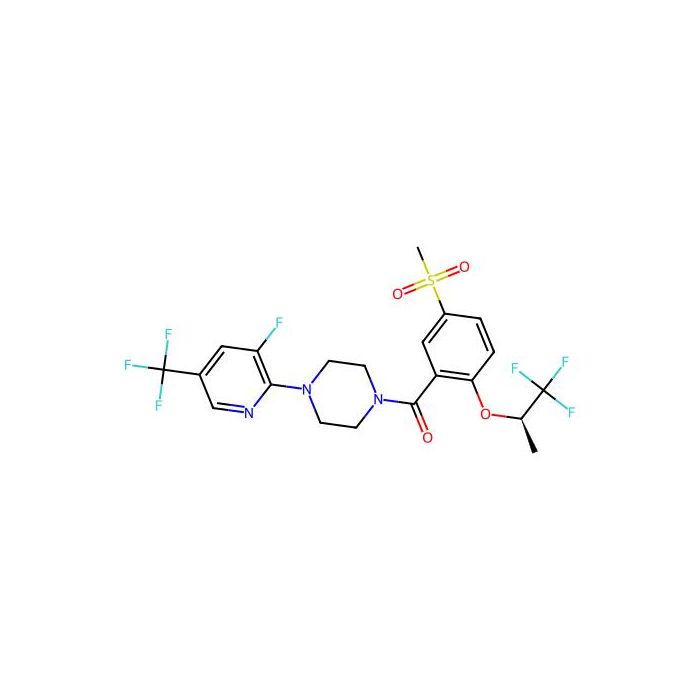
Bitopertin R enantiomer (RG1678 R enantiomer; RO4917838 R enantiomer) is the R-enantiomer of Bitopertin. Bitopertin is a potent, noncompetitive glycine reuptake inhibitor, inhibits glycine uptake at human GlyT1 with a concentration exhibiting IC50 of 25 nM.
In Vitro
Bitopertin (RG1678) competitively blocks [ 3 H]ORG24598 binding sites at human GlyT1b in membranes from Chinese hamster ovary cells. Bitopertin potently inhibits [ 3 H]glycine uptake in cells stably expressing hGlyT1b and mGlyT1b, with IC 50 values of 25±2 nM and 22±5 nM, respectively (n=6). Conversely, Bitopertin has no effect on hGlyT2-mediated glycine uptake up to 30 μM concentration. Bitopertin has high affinity for the recombinant hGlyT1b transporter. Under equilibrium conditions (1 h at room temperature), Bitopertin displaces [ 3 H]ORG24598 binding with a K i of 8.1 nM. In hippocampal CA1 pyramidal cells, Bitopertin enhances NMDA-dependent long-term potentiation at 100 nM but not at 300 nM. Additional profiling revealed that Bitopertin (RG1678) has an excellent selectivity profile against the GlyT2 isoform (IC 50 >30 μM) and toward a panel of 86 targets including transmembrane and soluble receptors, enzymes, ion channels, and monoamine transporters (<41% inhibition at 10 μM is measured for all targets). MCE has not independently confirmed the accuracy of these methods. They are for reference only.
In Vivo
Bitopertin (RG1678) dose-dependently increases cerebrospinal fluid and striatal levels of glycine measured bymicrodialysis in rats. Additionally Bitopertin attenuates hyperlocomotion induced by the psychostimulant D-amphetamine or the NMDA receptor glycine site antagonist L-687,414 in mice. Bitopertin also prevents the hyper-response to D-amphetamine challenge in rats treated chronically with phencyclidine, an NMDA receptor open-channel blocker. Administration of vehicle has no effect on extracellular levels of striatal glycine, which remained constant throughout the experiment. In contrast, p.o. administration of Bitopertin (1-30 mg/kg) produced a dose-dependent increase in extracellular glycine levels. Bitopertin 30 mg/kg produces glycine levels 2.5 times higher than pretreatment levels. A similar dose-dependent increase in glycine concentration is observed in the CSF of rats treated p.o. with Bitopertin (1-10 mg/kg) compared with vehicle-treated animals, 3 h after drug administration. Interestingly, the level of CSF glycine increase 3 h after Bitopertin dosing is very similar to the increase in the microdialysis experiment at the same time point . In vivo pharmacokinetic studies in rat and monkey reveals that Bitopertin (RG1678) has, in both species, a low plasma clearance, an intermediate volume of distribution, a good oral bioavailability (78% for rat, 56% for monkey), and a favorable terminal half-life (5.8 h for rat, 6.4 h for monkey). The plasma protein binding is high in the two preclinical species (97%) and in human (98%). The CNS penetration of Bitopertin in rat (brain/plasma=0.7) is better than that in mouse (brain/plasma=0.5). MCE has not independently confirmed the accuracy of these methods. They are for reference only.
Form:Solid
IC50& Target:IC50: 25 nM (GlyT1)
| Sonrisas canónicas | CC(C(F)(F)F)OC1=C(C=C(C=C1)S(=O)(=O)C)C(=O)N2CCN(CC2)C3=C(C=C(C=N3)C(F)(F)F)F |
|---|---|
| IUPAC Name | [4-[3-fluoro-5-(trifluoromethyl)pyridin-2-yl]piperazin-1-yl]-[5-methylsulfonyl-2-[(2R)-1,1,1-trifluoropropan-2-yl]oxyphenyl]methanone |
| InChIKey | YUUGYIUSCYNSQR-GFCCVEGCSA-N |
| INCHI | 1S/C21H20F7N3O4S/c1-12(20(23,24)25)35-17-4-3-14(36(2,33)34)10-15(17)19(32)31-7-5-30(6-8-31)18-16(22)9-13(11-29-18)21(26,27)28/h3-4,9-12H,5-8H2,1-2H3/t12-/m1/s1 |
| Isómeros SMILES | C[C@H](C(F)(F)F)OC1=C(C=C(C=C1)S(=O)(=O)C)C(=O)N2CCN(CC2)C3=C(C=C(C=N3)C(F)(F)F)F |
| CAS alternativo | 845614-12-2 |
| Peso molecular | 543.46 |
| Reaxy-Rn | 12199870 |
| Reaxys-RN_link_address | https://www.reaxys.com/reaxys/secured/hopinto.do?context=S&query=IDE.XRN=12199870&ln= |
Comprehensive hazard, handling, storage, and regulatory compliance document.
Download SDS →Lot-specific quality data. Enter your lot number to retrieve the exact COA.
Look up COA →Full quality attributes and acceptance criteria for this grade.
View spec sheet →Taxonomy Tree
| Kingdom | Organic compounds |
|---|---|
| Superclass | Organoheterocyclic compounds |
| Clase | Diazinanes |
| Subclass | Piperazines |
| Intermediate Tree Nodes | Not available |
| Direct Parent | Pyridinylpiperazines |
| Alternative Parents | N-arylpiperazines Benzenesulfonyl compounds Benzamides Phenoxy compounds Phenol ethers Dialkylarylamines Benzoyl derivatives Alkyl aryl ethers Aminopyridines and derivatives Imidolactams Aryl fluorides Tertiary carboxylic acid amides Sulfones Heteroaromatic compounds Amino acids and derivatives Azacyclic compounds Hydrocarbon derivatives Organic oxides Alkyl fluorides Organofluorides |
| Molecular Framework | Aromatic heteromonocyclic compounds |
| Substituents | Pyridinylpiperazine - N-arylpiperazine - Benzamide - Benzenesulfonyl group - Benzoic acid or derivatives - Phenoxy compound - Benzoyl - Phenol ether - Dialkylarylamine - Alkyl aryl ether - Aminopyridine - Aryl fluoride - Aryl halide - Monocyclic benzene moiety - Pyridine - Imidolactam - Benzenoid - Tertiary carboxylic acid amide - Sulfonyl - Sulfone - Heteroaromatic compound - Tertiary amine - Amino acid or derivatives - Carboxamide group - Azacycle - Ether - Carboxylic acid derivative - Organic oxygen compound - Organohalogen compound - Hydrocarbon derivative - Alkyl halide - Organic oxide - Alkyl fluoride - Organic nitrogen compound - Organofluoride - Organonitrogen compound - Organooxygen compound - Organosulfur compound - Amine - Aromatic heteromonocyclic compound |
| Descripción | This compound belongs to the class of organic compounds known as pyridinylpiperazines. These are compounds containing a pyridinylpiperazine skeleton, which consists of a pyridine linked (not fused) to a piperazine by a bond by a single bond that is not part of a ring. |
| External Descriptors | Not available |
| Peso molecular | 543.500 g/mol |
|---|---|
| XLogP3 | 4.000 |
| Hydrogen Bond Donor Count | 0 |
| Hydrogen Bond Acceptor Count | 13 |
| Rotatable Bond Count | 5 |
| Exact Mass | 543.106 Da |
| Monoisotopic Mass | 543.106 Da |
| Topological Polar Surface Area | 88.200 Ų |
| Heavy Atom Count | 36 |
| Formal Charge | 0 |
| Complexity | 872.000 |
| Isotope Atom Count | 0 |
| Defined Atom Stereocenter Count | 1 |
| Undefined Atom Stereocenter Count | 0 |
| Defined Bond Stereocenter Count | 0 |
| Undefined Bond Stereocenter Count | 0 |
| The total count of all stereochemical bonds | 0 |
| Covalently-Bonded Unit Count | 1 |