Information
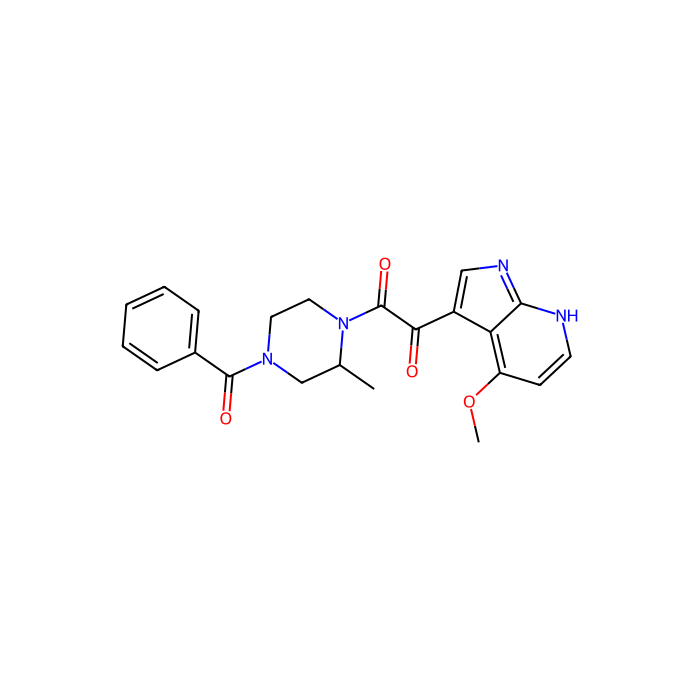
BMS-378806 BMS-378806 (BMS 806) selectively inhibits the binding of HIV-1 gp120 to the CD4 receptor with EC50 of 0.85-26.5 nM in virus.
In vitro
BMS-806, a 7-azaindole derivative, binds gp120 and interferes with the interaction of HIV surface protein gp120 with the host cell receptor CD4. BMS-806 inhibits a panel of macrophage- and T cell-tropic HIV-1 strains, which are laboratory strains that use either CCR5 (M-tropic) or CXR4 (T-tropic) co-receptors to enter cells and are classified as B subtypes. The aqueous solubility from the crystalline form of BMS-806 (BMS 378806) is 170 μg/mL. The solubility of BMS-806 is 1.3 mg/mL at pH=2.1 and 3.3 mg/mL at pH=11, a solubility profile that reveals the amphoteric nature of BMS-806 and estimates the pKa of the protonated form as 2.9 while that of the free base is approximately 9.6. BMS-806 competes with soluble CD4 binding to a monomeric form of gp120 in an ELISA assay with IC50 = ~ 100 nM. BMS-806 is specific towards HIV-1, with no significant inhibitory activity against HIV-2, SIV, MuLV, RSV, HCMV, BVDV, VSV, and influenza virus observed at concentrations ranging from 10 to 30 μM and no overt cytotoxicity toward host cells, CC50 values > 225 μM. BMS-806 binds directly to gp120 at a stoichiometry of approximately 1:1, with a binding affinity similar to that of soluble CD4. The potential BMS-806 target site is localized to a specific region within the CD4 binding pocket of gp120 by using HIV-1 gp120 variants carrying either compound-selected resistant substitutions or gp120-CD4 contact site mutations.
In vivo
When BMS-806 is administered dose-proportional increases in the AUC and Cmax is observed. In rat, dog and monkey, plasma levels of drug exceeded the concentrations required to half-maximally inhibit virus replication in vitro. The volume of distribution of BMS-806 ranges from 0.4 to 0.6 L/kg, indicative of partitioning beyond plasma; however, examination of brain levels in the rat revealed minimal CNS penetration. BMS-806 is stable in human, rat, dog and monkey blood at 37 °C during a 2-h incubation. The blood-to-plasma concentration ratios in humans, rats, dogs and monkeys are 1.1, 0.77, 1.2 and 0.92 (n=3), respectively, suggesting that BMS-806 is distributed to approximately the same extent between plasma and blood cells. The human clearance of BMS-806 predicted from microsomes is 9.2 ml/min/kg (46% of the hepatic blood flow).
Cell Data
cell lines:H1299 cells
Concentrations:0-3 mM
Incubation Time:6 days
Powder Purity:≥97%