GRADE & PURITYMoligand™?Moligand™ — Aladdin's line of ligands and bioactive small molecules. Use for receptor, pathway, and binding studies needing defined small-molecule tools.10mM in DMSO
Moligand™, 10mM in DMSO Moligand™ for sensitive chromatographic and analytical workflows requiring minimal baseline interference.
🌡
Storage & shipping
Store at -80°C Ships Dry ice packs + Cold packs Check lot-specific COA for exact specifications.
📋
Quality documents
SDS, COA, datasheet, and spec sheet available for download. Lot-specific COA accessible via lot number lookup.
📚
Literature proof
Cited in 0 peer-reviewed publications across chromatography, organic synthesis, and cross-coupling reactions.
Descripción general
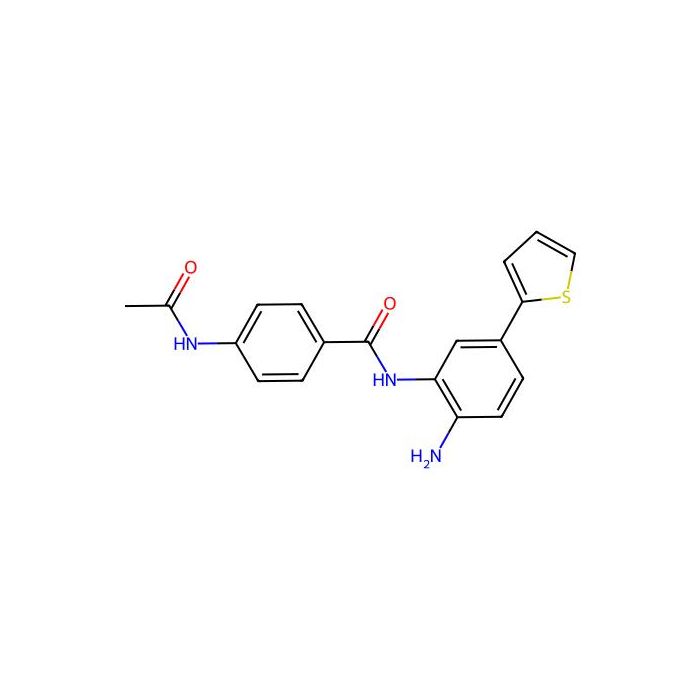
BRD-6929 is a potent, selective brain-penetrant inhibitor of class I histone deacetylase HDAC1 and HDAC2 inhibitor with IC 50 of 1 nM and 8 nM, respectively. BRD-6929 shows high-affinity to HDAC1 and HDAC2 with K i of 0.2 and 1.5 nM, respectively. BRD-6929 can be used for mood-related behavioral model research.
BRD-6929 is axa0potent, selective brain-penetrant inhibitor of class I histone deacetylase HDAC1 and HDAC2 inhibitor with IC 50 of 1 nM and 8 nM, respectively. BRD-6929 shows high-affinity to HDAC1 and HDAC2 with K i of 0.2 and 1.5 nM, respectively. BRD-6
Condiciones de almacenamiento de almacenamiento
Store at -80°C
Enviado en
Dry ice packs + Cold packs
Este producto requiere envío en cadena de frío. Los servicios terrestres y otros servicios económicos no están disponibles.
We use cookies to ensure the website functions properly and, where permitted, to improve your experience. You can manage your preferences at any time in Settings. Learn more in our Cookie Policy.
Shall we send you a message when we have discounts available?
Remind me later
Thank you! Please check your email inbox to confirm.
Products are supplied to verified businesses, institutions, and qualified professionals for research and development use only. Not for use in humans, animals, diagnosis, or therapy.