≥98% for sensitive chromatographic and analytical workflows requiring minimal baseline interference.
🌡
Storage & shipping
Store at 2-8°C,Desiccated Ships Wet ice Check lot-specific COA for exact specifications.
📋
Quality documents
SDS, COA, datasheet, and spec sheet available for download. Lot-specific COA accessible via lot number lookup.
📚
Literature proof
Cited in 0 peer-reviewed publications across chromatography, organic synthesis, and cross-coupling reactions.
Descripción general
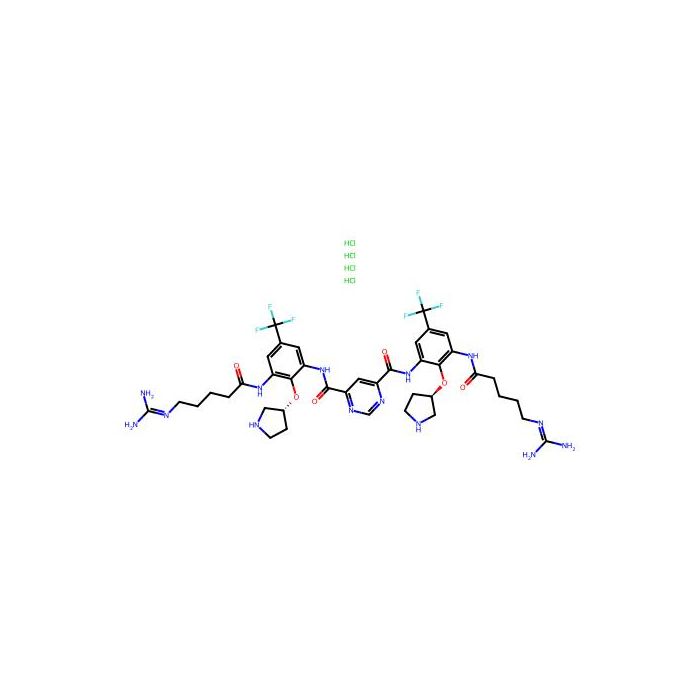
Brilacidin tetrahydrochloride (PMX 30063 tetrahydrochloride) is an anti-infective antimicrobial with MIC90s of 1 and 8 μg/mL for Gram-positive bacteria Streptococcus pneumonia and Streptococcus viridans , and MIC90 of 8 and 4 μg/mL for Gram-negative bacteria Haemophilus influenza and Pseudomonas aeruginosa. Brilacidin tetrahydrochloride is a defensin mimetic antibiotic compound.
In Vitro
Both Staphylococcus aureus (SA) and Staphylococcus epidermidis (SE) have the lowest minimum inhibitory concentrations among the bacterial groups. The MIC 90 s to Brilacidin for Streptococcus pneumonia (SP), Streptococcus viridians (SV), Moraxella (MS), Haemophilus influenza (HI), Pseudomonas aeruginosa (PA), and Serratia marcescens (SM) are 4, 32, 256, 32, 16, and 128-fold higher, respectively, than SA and SE. Brilacidin has Gram-positive in vitro activity; topical Brilacidin 0.5% is minimally irritating; and Brilacidin 0.5% was equally efficacious as Vancomycin (VAN) in a methicillin-resistant S. aureus (MRSA) keratitis model when the corneal epithelium is removed. Brilacidin acts primarily on the bacterial cell membrane by depolarization. Brilacidin is more potent for Gram-positive bacteria (except SV) than Gram-negative bacteria. MCE has not independently confirmed the accuracy of these methods. They are for reference only.
In Vivo
Brilacidin demonstrates dose-dependent ocular toxicity after 7 topical instillations (every 30 min for 3 h) in the NZW rabbit ocular toxicity model. Brilacidin 1% is determined to be Mildly Irritating (23.0), Brilacidin 0.5% (6.5), and Brilacidin 0.25% (4.0) are determined to be Minimally Irritating, while Brilacidin 0.1% (2.0) and TBS (1.0) are determined to be Practically Nonirritating and 0.01% Brilacidin (0.5) is determined to be Nonirritating based on their Maximum mean total scores (MMTS) values. MCE has not independently confirmed the accuracy of these methods. They are for reference only.
Brilacidin tetrahydrochloride (PMX 30063 tetrahydrochloride) is an anti-infective antimicrobial with MIC90s of 1 and 8 μg/mL for Gram-positive bacteria Streptococcus pneumonia and Streptococcus viridans , and MIC90 of 8 and 4 μg/mL for Gram-negative bacte
Condiciones de almacenamiento de almacenamiento
Store at 2-8°C, Desiccated
Enviado en
Wet ice
Este producto requiere envío en cadena de frío. Los servicios terrestres y otros servicios económicos no están disponibles.
This compound belongs to the class of organic compounds known as aromatic anilides. These are aromatic compounds containing an anilide group in which the carboxamide group is substituted with an aromatic group. They have the general structure RNC(=O)R', where R= benzene, and R = aryl group.
External Descriptors
Not available
1. Djoumbou Feunang Y, Eisner R, Knox C, Chepelev L, Hastings J, Owen G, Fahy E, Steinbeck C, Subramanian S, Bolton E, Greiner R, and Wishart DS. ClassyFire: Automated Chemical Classification With A Comprehensive, Computable Taxonomy. Journal of Cheminformatics, 2016, 8:61.
We use cookies to ensure the website functions properly and, where permitted, to improve your experience. You can manage your preferences at any time in Settings. Learn more in our Cookie Policy.
Shall we send you a message when we have discounts available?
Remind me later
Thank you! Please check your email inbox to confirm.
Products are supplied to verified businesses, institutions, and qualified professionals for research and development use only. Not for use in humans, animals, diagnosis, or therapy.