Determine the necessary mass, volume, or concentration for preparing a solution.
Reagent grade Reagent Grade for sensitive chromatographic and analytical workflows requiring minimal baseline interference.
Room temperature Ships Normal Check lot-specific COA for exact specifications.
SDS, COA, datasheet, and spec sheet available for download. Lot-specific COA accessible via lot number lookup.
Cited in 2 peer-reviewed publications across chromatography, organic synthesis, and cross-coupling reactions.
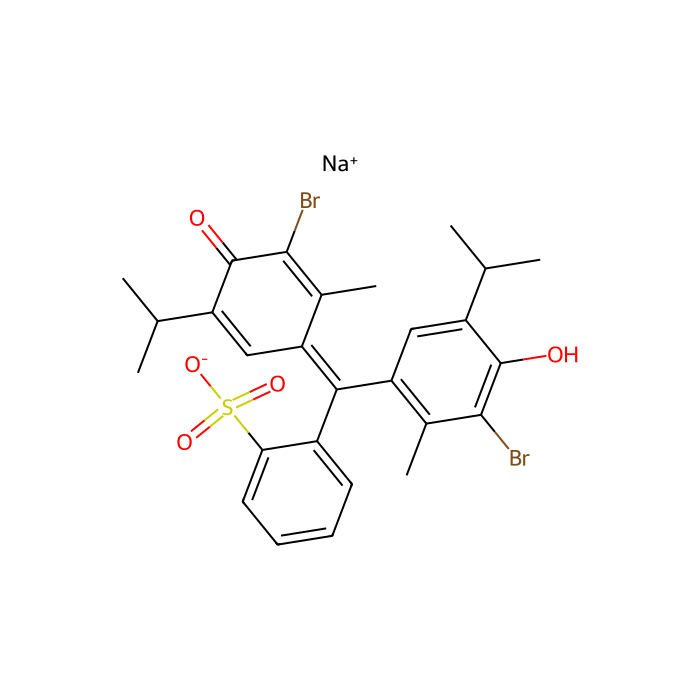
Bromothymol blue is a pH indicator for weak acids and bases. In neutral solution, it appears bluish-green. At pH above 7.6 it appears blue, and at pH below 6.0 it appears yellow.
Suitable for use: In preparations of pH indicator solutions In phospholipid staining on tissues and cells prepared on microscopy slides
| Pubchem Sid | 488200162 |
|---|---|
| Pubchem Sid Url | https://pubchem.ncbi.nlm.nih.gov/substance/488200162 |
| Sonrisas canónicas | CC1=C(C=C(C(=C1Br)O)C(C)C)C(=C2C=C(C(=O)C(=C2C)Br)C(C)C)C3=CC=CC=C3S(=O)(=O)[O-].[Na+] |
| IUPAC Name | sodium;2-[(Z)-(3-bromo-4-hydroxy-2-methyl-5-propan-2-ylphenyl)-(3-bromo-2-methyl-4-oxo-5-propan-2-ylcyclohexa-2,5-dien-1-ylidene)methyl]benzenesulfonate |
| InChIKey | NMKFVGALBGZKGW-FKWCIMQXSA-M |
| INCHI | 1S/C27H28Br2O5S.Na/c1-13(2)18-11-20(15(5)24(28)26(18)30)23(17-9-7-8-10-22(17)35(32,33)34)21-12-19(14(3)4)27(31)25(29)16(21)6;/h7-14,30H,1-6H3,(H,32,33,34);/q;+1/p-1/b23-21+; |
| Isómeros SMILES | CC1=C(C=C(C(=C1Br)O)C(C)C)/C(=C/2\C=C(C(=O)C(=C2C)Br)C(C)C)/C3=CC=CC=C3S(=O)(=O)[O-].[Na+] |
| WGK Alemania | 3 |
| Peso molecular | 646.36 |
| Beilstein | 6887926 |
| Reaxy-Rn | 21404171 |
| Reaxys-RN_link_address | https://www.reaxys.com/reaxys/secured/hopinto.do?context=S&query=IDE.XRN=21404171&ln= |
Comprehensive hazard, handling, storage, and regulatory compliance document.
Download SDS →Lot-specific quality data. Enter your lot number to retrieve the exact COA.
Look up COA →Full quality attributes and acceptance criteria for this grade.
View spec sheet →Taxonomy Tree
| Kingdom | Organic compounds |
|---|---|
| Superclass | Benzenoids |
| Clase | Benzene and substituted derivatives |
| Subclass | Diphenylmethanes |
| Intermediate Tree Nodes | Not available |
| Direct Parent | Diphenylmethanes |
| Alternative Parents | Aromatic monoterpenoids Benzenesulfonic acids and derivatives Monocyclic monoterpenoids 1-sulfo,2-unsubstituted aromatic compounds Phenylpropanes Benzenesulfonyl compounds Cumenes P-quinomethanes Meta cresols O-bromophenols Toluenes Bromobenzenes Aryl bromides Alpha-haloketones Sulfonyls Organosulfonic acids Bromoalkenes Vinyl bromides Organic metal halides Organic oxides Organic sodium salts Organobromides Hydrocarbon derivatives Organic cations |
| Molecular Framework | Aromatic homomonocyclic compounds |
| Substituents | Diphenylmethane - P-cymene - Aromatic monoterpenoid - Monocyclic monoterpenoid - Monoterpenoid - Benzenesulfonate - Arylsulfonic acid or derivatives - Cumene - Benzenesulfonyl group - Phenylpropane - 1-sulfo,2-unsubstituted aromatic compound - 2-halophenol - M-cresol - 2-bromophenol - P-quinomethane - Quinomethane - Halobenzene - Toluene - Bromobenzene - Phenol - Aryl bromide - Aryl halide - Alpha-haloketone - Organosulfonic acid - Sulfonyl - Organic sulfonic acid or derivatives - Organosulfonic acid or derivatives - Ketone - Cyclic ketone - Bromoalkene - Haloalkene - Vinyl halide - Organic metal halide - Vinyl bromide - Organic alkali metal salt - Organosulfur compound - Organic salt - Organic sodium salt - Hydrocarbon derivative - Organic oxide - Carbonyl group - Organic oxygen compound - Organohalogen compound - Organobromide - Organooxygen compound - Organic cation - Aromatic homomonocyclic compound |
| Descripción | This compound belongs to the class of organic compounds known as diphenylmethanes. These are compounds containing a diphenylmethane moiety, which consists of a methane wherein two hydrogen atoms are replaced by two phenyl groups. |
| External Descriptors | Not available |
Find and download the COA for your product by matching the lot number on the packaging.
| Lot Number | Certificate Type | Fecha | Articulo |
|---|---|---|---|
| Certificate of Analysis | Apr 11, 2026 | B111791 | |
| Certificate of Analysis | Aug 19, 2025 | B111791 | |
| Certificate of Analysis | Nov 20, 2024 | B111791 | |
| Certificate of Analysis | Nov 20, 2024 | B111791 | |
| Certificate of Analysis | Nov 20, 2024 | B111791 | |
| Certificate of Analysis | Nov 20, 2024 | B111791 | |
| Certificate of Analysis | Nov 12, 2024 | B111791 | |
| Certificate of Analysis | Nov 12, 2024 | B111791 | |
| Certificate of Analysis | Nov 12, 2024 | B111791 | |
| Certificate of Analysis | Aug 02, 2023 | B111791 | |
| Certificate of Analysis | Dec 13, 2022 | B111791 | |
| Certificate of Analysis | Dec 13, 2022 | B111791 | |
| Certificate of Analysis | Dec 13, 2022 | B111791 | |
| Certificate of Analysis | Dec 13, 2022 | B111791 |
| Solubilidad | Soluble in water |
|---|---|
| Peso molecular | 646.400 g/mol |
| XLogP3 | |
| Hydrogen Bond Donor Count | 1 |
| Hydrogen Bond Acceptor Count | 5 |
| Rotatable Bond Count | 5 |
| Exact Mass | 645.982 Da |
| Monoisotopic Mass | 643.984 Da |
| Topological Polar Surface Area | 103.000 Ų |
| Heavy Atom Count | 36 |
| Formal Charge | 0 |
| Complexity | 1040.000 |
| Isotope Atom Count | 0 |
| Defined Atom Stereocenter Count | 0 |
| Undefined Atom Stereocenter Count | 0 |
| Defined Bond Stereocenter Count | 1 |
| Undefined Bond Stereocenter Count | 0 |
| The total count of all stereochemical bonds | 1 |
| Covalently-Bonded Unit Count | 2 |
| 1. Chen Xiao, Zhang Zheng, Liu Xiaoxia, Cui Bo, Miao Wentao, Cheng Weiwei, Zhao Fengyun. (2019) Characteristics Analysis Reveals the Progress of Volvariella volvacea Mycelium Subculture Degeneration. Frontiers in Microbiology, [PMID:31551980] [10.3389/fmicb.2019.02045] |
| 2. Qian Liu, Chaoping Xu, Heng Liang. (2017) Laser carved micro-crack channels in paper-based dilution devices. TALANTA, [PMID:28841992] [10.1016/j.talanta.2017.07.009] |
Our grade selection guide covers purity, stabilizer status, and application suitability for all variants in our catalog.
View Reagent Grade grade guide →