Determine the necessary mass, volume, or concentration for preparing a solution.
| Activity Type | Relation | Activity value | Units | Action Type | Journal | PubMed Id | doi | Assay Aladdin ID |
|---|

≥98% for sensitive chromatographic and analytical workflows requiring minimal baseline interference.
Store at -20°C Ships Ice chest + Ice pads Check lot-specific COA for exact specifications.
SDS, COA, datasheet, and spec sheet available for download. Lot-specific COA accessible via lot number lookup.
Cited in 19 peer-reviewed publications across chromatography, organic synthesis, and cross-coupling reactions.
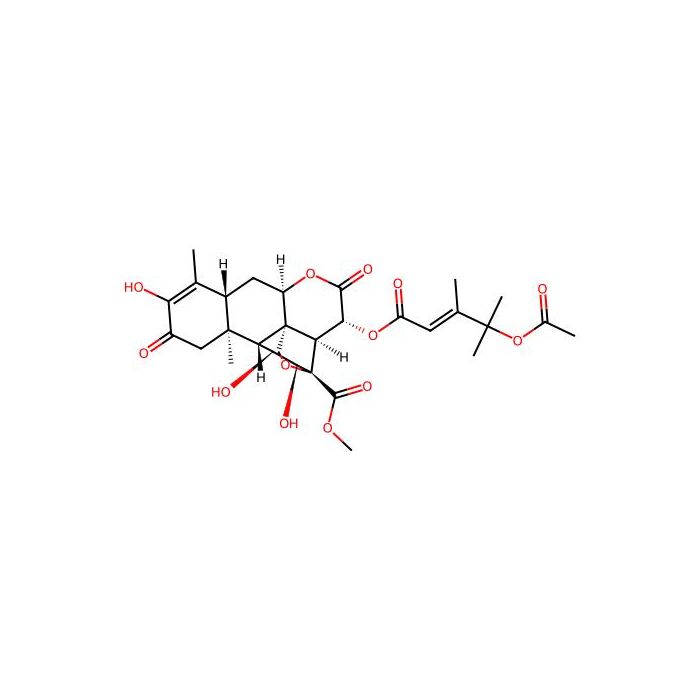
Bruceantinol, a quassinoid isolated from Brucea javanica , inhibits pepper mottle virus in pepper Bruceantinol is a STAT3 inhibitor demonstrating potent antitumor activity in in vitro and in vivo human colorectal cancer (CRC) models. Bruceantinol strongly inhibits STAT3 DNA-binding ability ( IC 50 =2.4 pM), blocks the constitutive and IL-6-induced STAT3 activation, and suppresses transcription of MCL-1 , PTTG1, survivin and c-Myc .
Form:Solid
IC50& Target:IC 50 : 2.4 pM (STAT3 DNA-binding ability)
| Sonrisas canónicas | CC1=C(C(=O)CC2(C1CC3C45C2C(C(C(C4C(C(=O)O3)OC(=O)C=C(C)C(C)(C)OC(=O)C)(OC5)C(=O)OC)O)O)C)O |
|---|---|
| IUPAC Name | methyl (1R,2S,3R,6R,8R,13S,14R,15R,16S,17S)-3-[(E)-4-acetyloxy-3,4-dimethylpent-2-enoyl]oxy-10,15,16-trihydroxy-9,13-dimethyl-4,11-dioxo-5,18-dioxapentacyclo[12.5.0.01,6.02,17.08,13]nonadec-9-ene-17-carboxylate |
| InChIKey | SREUSBYRKOPNJK-AJPRWBMOSA-N |
| INCHI | 1S/C30H38O13/c1-12(27(4,5)43-14(3)31)8-18(33)42-21-23-29-11-40-30(23,26(38)39-7)24(36)20(35)22(29)28(6)10-16(32)19(34)13(2)15(28)9-17(29)41-25(21)37/h8,15,17,20-24,34-36H,9-11H2,1-7H3/b12-8+/t15-,17+,20+,21+,22+,23+,24-,28-,29+,30-/m0/s1 |
| Isómeros SMILES | CC1=C(C(=O)C[C@]2([C@H]1C[C@@H]3[C@]45[C@@H]2[C@H]([C@@H]([C@]([C@@H]4[C@H](C(=O)O3)OC(=O)/C=C(\C)/C(C)(C)OC(=O)C)(OC5)C(=O)OC)O)O)C)O |
| CAS alternativo | 53729-52-5 |
| PubChem CID | 5281305 |
| Términos de entrada MeSH | bruceantinol;methyl (11beta,12alpha,15beta)-15-(((2E)-4-acetoxy-3,4-dimethyl-2-pentenoyl)oxy)-3,11,12-trihydroxy-2,16-dioxo-13,20-epoxypicras-3-en-21-oate;picras-3-en-21-oic acid, 15-(((2E)-4-(acetyloxy)-3,4-dimethyl-1-oxo-2-penten-1-yl)oxy)-13,20-epoxy-3 |
| Peso molecular | 606.6 |
Comprehensive hazard, handling, storage, and regulatory compliance document.
Download SDS →Lot-specific quality data. Enter your lot number to retrieve the exact COA.
Look up COA →Full quality attributes and acceptance criteria for this grade.
View spec sheet →Taxonomy Tree
| Kingdom | Organic compounds |
|---|---|
| Superclass | Lipids and lipid-like molecules |
| Clase | Prenol lipids |
| Subclass | Terpene lactones |
| Intermediate Tree Nodes | Not available |
| Direct Parent | Quassinoids |
| Alternative Parents | Triterpenoids Naphthopyrans Tetracarboxylic acids and derivatives Naphthalenes Furopyrans Beta hydroxy acids and derivatives Cyclohexenones Oxepanes Delta valerolactones Fatty acid esters Pyrans Oxanes Tetrahydrofurans Enoate esters Furans Methyl esters 1,2-diols Cyclic alcohols and derivatives Secondary alcohols Enols Dialkyl ethers Oxacyclic compounds Organic oxides Hydrocarbon derivatives |
| Molecular Framework | Aliphatic heteropolycyclic compounds |
| Substituents | Triterpenoid - C-20 quassinoid skeleton - Quassinoid - Naphthopyran - Tetracarboxylic acid or derivatives - Naphthalene - Furopyran - Beta-hydroxy acid - Cyclohexenone - Fatty acid ester - Delta_valerolactone - Delta valerolactone - Oxepane - Pyran - Oxane - Fatty acyl - Hydroxy acid - Cyclic alcohol - Alpha,beta-unsaturated carboxylic ester - Enoate ester - Furan - Methyl ester - Tetrahydrofuran - Ketone - 1,2-diol - Cyclic ketone - Lactone - Carboxylic acid ester - Secondary alcohol - Carboxylic acid derivative - Oxacycle - Organoheterocyclic compound - Dialkyl ether - Enol - Ether - Polyol - Alcohol - Organic oxide - Carbonyl group - Organic oxygen compound - Hydrocarbon derivative - Organooxygen compound - Aliphatic heteropolycyclic compound |
| Descripción | This compound belongs to the class of organic compounds known as quassinoids. These are a group of compounds chemically degraded from triterpenes. According to their basic skeleton, quassinoids are categorized into five distinct groups, C-18, C-19, C-20, C-22 and C-25 types. The C-20 quassinoids can be further classified into two types, tetracyclic and the pentacyclic. The tetracyclic variety does not have oxygenation at C-20, while the pentacyclic quassinoids possess additional oxygenation at C-20 that allows for the formation of an additional ring. |
| External Descriptors | Dammarenes |
| Activity Type | Relation | Activity value | Units | Action Type | Journal | PubMed Id | doi | Assay Aladdin ID |
|---|
| Activity Type | Relation | Activity value | Units | Action Type | Journal | PubMed Id | doi | Assay Aladdin ID |
|---|
| Peso molecular | 606.600 g/mol |
|---|---|
| XLogP3 | 0.800 |
| Hydrogen Bond Donor Count | 3 |
| Hydrogen Bond Acceptor Count | 13 |
| Rotatable Bond Count | 8 |
| Exact Mass | 606.231 Da |
| Monoisotopic Mass | 606.231 Da |
| Topological Polar Surface Area | 192.000 Ų |
| Heavy Atom Count | 43 |
| Formal Charge | 0 |
| Complexity | 1360.000 |
| Isotope Atom Count | 0 |
| Defined Atom Stereocenter Count | 10 |
| Undefined Atom Stereocenter Count | 0 |
| Defined Bond Stereocenter Count | 1 |
| Undefined Bond Stereocenter Count | 0 |
| The total count of all stereochemical bonds | 1 |
| Covalently-Bonded Unit Count | 1 |
| 1. Hai-Xia Xu, Hui Chen, Zhong-Ping Yin, Qing-Feng Zhang. (2023) Piceid dicarboxylic acid esters as potent α-glucosidase inhibitors and antiglycation agents: Synthesis, spectroscopic and molecular docking studies. JOURNAL OF MOLECULAR STRUCTURE, [PMID:] [10.1016/j.molstruc.2023.136938] |
| 2. Gui Yueyue, Zeng Yujing, Chen Binrui, Yang Yueping, Ma Jiehua, Li Chao. (2023) A smart pathogen detector engineered from intracellular hydrogelation of DNA-decorated macrophages. Nature Communications, 14 (1): (1-14). [PMID:37217531] [10.1038/s41467-023-38733-w] |
| 3. Yifang He, Yifang Hua, Jinxuan Chen, Junming Wang, Lijun Qian, Jun Sun, Hongfei Li, Xiaoyu Gu, Sheng Zhang. (2023) Preparation of a Novel Phosphorus–Nitrogen-Containing Flame Retardant by Supramolecular Reaction and its Application in Epoxy Resin. ADVANCED ENGINEERING MATERIALS, 25 (12): (2201815). [PMID:] [10.1002/adem.202201815] |
| 4. Hao Yin, Xingyan Fu, Hanyu Gao, Han Gao, Yannan Ma, Xitong Chen, Xueqi Zhang, Shan-Shan Du, Yun-Kun Qi. (2023) Hybrid peptide NTP-217 triggers ROS-mediated rapid necrosis in liver cancer cells by induction of mitochondrial leakage. Frontiers in Oncology, [PMID:36713538] [10.3389/fonc.2022.1028600] |
| 5. Ping Chen, Xiaoyong Zhao, Hui Wang, Mengdan Zheng, Qinghua Wang, Wenjuan Chang. (2022) The Down-Regulation of lncRNA PCAT18 Promotes the Progression of Gastric Cancer via MiR-107/PTEN/PI3K/AKT Signaling Pathway. OncoTargets and Therapy, [PMID:31853187] [10.2147/OTT.S225235] |
| 6. Pengxiang Zhao, Yi Jin, Xiang Wu, Jin Huang, Lupeng Chen, Yanjie Tan, Hong Yuan, Jian Wu, Zhuqing Ren. (2022) Artificial Lipid Droplets: Novel Effective Biomaterials to Protect Cells against Oxidative Stress and Lipotoxicity. Nanomaterials, 12 (4): (672). [PMID:35215001] [10.3390/nano12040672] |
| 7. Lixia Chen, Yang Zhang, Xinming Zhang, Ruijuan Lv, Rongtian Sheng, Ruimeng Sun, Ting Du, Yuhan Li, Yanfei Qi. (2021) A GdW10@PDA-CAT Sensitizer with High-Z Effect and Self-Supplied Oxygen for Hypoxic-Tumor Radiotherapy. MOLECULES, 27 (1): (128). [PMID:35011360] [10.3390/molecules27010128] |
| 8. Bin Shang, Yuan Zhan, Min Chen, Limin Wu. (2020) NIR triggered healable underwater superoleophobic coating with exceptional anti-biofouling performance. APPLIED SURFACE SCIENCE, [PMID:] [10.1016/j.apsusc.2020.146805] |
| 9. Zhiyong Song, Huajuan Wang, Yang Wu, Jiangjiang Gu, Shuojun Li, Heyou Han. (2018) Fabrication of Bis-Quaternary Ammonium Salt as an Efficient Bactericidal Weapon Against Escherichia coli and Staphylococcus aureus. ACS Omega, [PMID:30411069] [10.1021/acsomega.8b01265] |
| 10. Ben Wang, Kai Fung Chan, Jiangfan Yu, Qianqian Wang, Lidong Yang, Philip Wai Yan Chiu, Li Zhang. (2018) Reconfigurable Swarms of Ferromagnetic Colloids for Enhanced Local Hyperthermia. ADVANCED FUNCTIONAL MATERIALS, 28 (25): (1705701). [PMID:] [10.1002/adfm.201705701] |
| 11. Zuhong Li, Haibo Wang, Yangjun Chen, Yin Wang, Huan Li, Haijie Han, Tingting Chen, Qiao Jin, Jian Ji. (2016) pH- and NIR Light-Responsive Polymeric Prodrug Micelles for Hyperthermia-Assisted Site-Specific Chemotherapy to Reverse Drug Resistance in Cancer Treatment. Small, 12 (20): (2731-2740). [PMID:27043935] [10.1002/smll.201600365] |
| 12. Jiale Chen, Pan Ran, Yizhao Xu, Mouna Khouchani, Xin Li, Ling Jian, Takoui Abdelmajid, Nadia Aittahssaint, Qian Yang, Jingyi Li, Long Zhao. (2025) Biomimetic multifunctional nanoparticles for improved radiotherapy and immunotherapy in cancer treatment. Materials Today Bio, [PMID:40225127] [10.1016/j.mtbio.2025.101698] |
| 13. Siyi Li, Jiaoting E, Xiucheng Zhao, Rui Xie, Jiaming Wu, Lili Feng, He Ding, Fei He, Piaoping Yang. (2025) Hetero-Trimetallic Atom Catalysts Enable Targeted ROS Generation and Redox Signaling for Intensive Apoptosis and Ferroptosis. ADVANCED MATERIALS, [PMID:40123217] [10.1002/adma.202417198] |
| 14. Zifan Xue, Yunfan Zhang, Yuting Zheng, Shengnan Shen, Hui Li. (2025) Porous Microneedle Array Electrode Using Interstitial Fluid as Conductive Fillers for Biosafe and Long-Term Biopotential Monitoring. IEEE TRANSACTIONS ON ELECTRON DEVICES, [PMID:] [10.1109/TED.2024.3525456] |
| 15. Yuting Zheng, Yunfan Zhang, Zifan Xue, Hui Li, Shengnan Shen. (2025) Wearable biosensor with high specific surface area PGA-CNTs electrode for sweat glucose detection. MICROCHEMICAL JOURNAL, [PMID:] [10.1016/j.microc.2025.112965] |
| 16. Chen Wang, Shuhan Zhang, Fei Zeng, Congcong Huang, Zhengwei Liu, Haofei Ni, Chuanqi Zhao, Yujun Song, Jingsheng Niu. (2025) Neutrophil Extracellular Traps-Inspired Hydrogen-Bonded Organic Framework-Based Bio-orthogonal Nanozymes for Enhanced Bacterial Capture and Sterilization. ACS Applied Materials & Interfaces, [PMID:40785617] [10.1021/acsami.5c11332] |
| 17. Ting Sun, Chuanyezi Cai, Jiacheng Guo, Gengqi Tong, Yu He, Xi Chen, Lu Ye, Jianjun Zhang, Sude Ma. (2025) Solvothermal synthesis of functionalized MOF particles to enhance energy storage stability of BaTiO3/UiO-66-NH2/PVDF/PI nanocomposite films. CERAMICS INTERNATIONAL, [PMID:] [10.1016/j.ceramint.2025.09.293] |
| 18. Guozhang Wu, Yuanbiao Liu, Gaopeng Shi. (2021) New Experimental Evidence for Thermodynamic Links to the Kinetic Fragility of Glass-Forming Polymers. MACROMOLECULES, [PMID:] [10.1021/acs.macromol.1c00670] |
| 19. Xuemei Yin, Qindong Guo, Xingqi Ji, Xiaoqian Li, Hao Xue, Qian Xin, Jiawei Zhang, Zhuocheng Yan, Aimin Song. (2025) Paper-based degradable, label-free microRNA sensing platform based on oxide thin-film transistor arrays. BIOSENSORS & BIOELECTRONICS, [PMID:39999610] [10.1016/j.bios.2025.117291] |