GRADE & PURITYMoligand™?Moligand™ — Aladdin's line of ligands and bioactive small molecules. Use for receptor, pathway, and binding studies needing defined small-molecule tools.10 mM in DMSO
Moligand™, 10 mM in DMSO Moligand™ for sensitive chromatographic and analytical workflows requiring minimal baseline interference.
🌡
Storage & shipping
Protected from light,Argon charged,Store at -80°C Ships Dry ice packs + Cold packs Check lot-specific COA for exact specifications.
📋
Quality documents
SDS, COA, datasheet, and spec sheet available for download. Lot-specific COA accessible via lot number lookup.
📚
Literature proof
Cited in 4 peer-reviewed publications across chromatography, organic synthesis, and cross-coupling reactions.
Descripción general
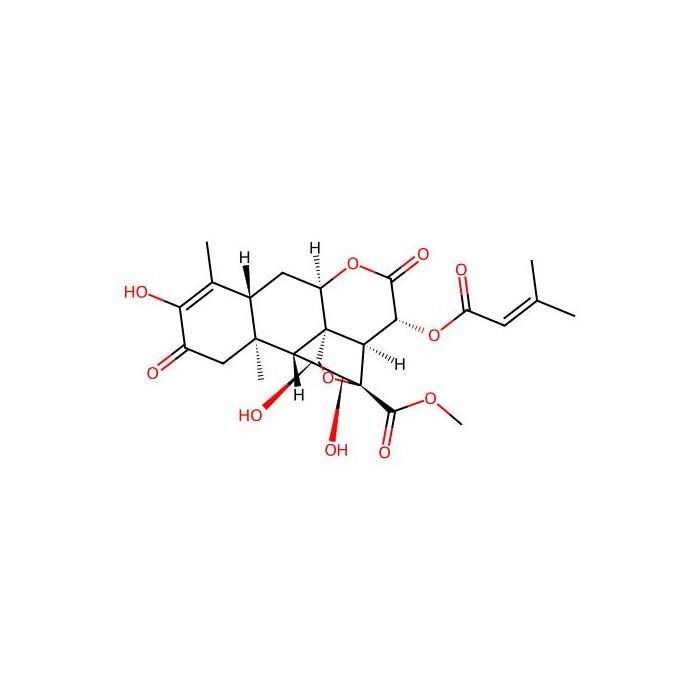
Brusatol (NSC?172924) is a unique inhibitor of the Nrf2 pathway that sensitizes a broad spectrum of cancer cells to Cisplatin and other chemotherapeutic agents. Brusatol enhances the efficacy of chemotherapy by inhibiting the Nrf2-mediated defense mechanism. Brusatol can be developed into an adjuvant chemotherapeutic agent. Brusatol increases cellular apoptosis.
Specifications
Especificaciones y pureza
Moligand™, 10 mM in DMSO
Condiciones de almacenamiento de almacenamiento
Protected from light,Argon charged,Store at -80°C
Enviado en
Dry ice packs + Cold packs
Este producto requiere envío en cadena de frío. Los servicios terrestres y otros servicios económicos no están disponibles.
1.Wang Zhi-shun, Shu Bo, Han Qi, Li Guo-hao, Guo Yong-lian. (2023) Effects of grape seed-derived proanthocyanidin B2 pretreatment on oxidative stress, endoplasmic reticulum stress and apoptosis of renal tubular epithelial cells in renal ischemia–reperfusion injury model of mice. INTERNATIONAL UROLOGY AND NEPHROLOGY, [PMID:36935438][10.1007/s11255-023-03494-4]
2.Na Wei, Tan Lu, Libin Yang, Yonghan Dong, Xiaotan Liu. (2021) Lipoxin A4 protects primary spinal cord neurons from Erastin-induced ferroptosis by activating the Akt/Nrf2/HO-1 signaling pathway. FEBS Open Bio, 11 (8):(2118-2126). [PMID:34048148][10.1002/2211-5463.13203]
3.Mengmeng Zhang, Tianchui Wang, Sixian Ou, Yucong Zou, Xuan Xin. (2024) Betaine activates the Nrf2-Keap1-ARE pathway by increasing the methylation level of Keap1 DNA promoter. INTERNATIONAL JOURNAL OF FOOD SCIENCE AND TECHNOLOGY, 59 (9):(6231-6242). [PMID:][10.1111/ijfs.17359]
4.Zhi-shun Wang, Qi Han, Hao Shen, Bo Shu, Cheng-cheng Ying, Guo-hao Li, Yong-lian Guo. (2025) Impact of grape seed proanthocyanidin B2 pretreatment on mitochondrial oxidative stress, endoplasmic reticulum stress, and apoptosis in renal tubular epithelial cells during in-vitro hypoxia-reoxygenation. Acta Cirurgica Brasileira, [PMID:40498953][10.1590/acb404125]
Calculadoras de soluciones
Molarity Calculator
Determine the necessary mass, volume, or concentration for preparing a solution.
Dilution Calculator
Determine the dilution needed to prepare a stock solution.
Reconstitution Calculator
Reseñas
Reseñas de cliente
Application Protocols
No vendor-validated application protocols are provided for this item.
General research-use suggestions (to be adapted to your system):
DMSO stock preparation: 10–50 mM under argon, amber vial. Make small, single-use aliquots and store at −80 °C. Thaw on ice, use immediately, and avoid repeated freeze–thaw.
Cell-free biochemical assay setup: Prepare serial dilutions in assay buffer ensuring constant DMSO percentage across wells (e.g., 0.1–1%). Include vehicle controls and, if available, a positive control compound for pathway benchmarking.
Cell-based assays: Titrate across ≥8 concentrations with at least triplicate technical replicates. Consider pre-binding to serum proteins; test with and without serum. Confirm compound integrity post-incubation by LC–MS when possible.
Analytical reference use: Inject freshly prepared solutions for LC–MS quantitation. Use stable isotope internal standards when available or bracketing calibration with matrix-matched standards.
Important: This product is for research use only. Performance depends on assay design, matrix, and handling. Item-specific conditions (e.g., solubility limits, extinction coefficients) are not specified here; consult the CoA/Spec Sheet or determine empirically.
Biological Roles
General/literature context (not a medical claim; for research use only):
Brusatol is a plant secondary metabolite of the quassinoid family, isolated from species in the Simaroubaceae (e.g., Brucea spp.). Quassinoids are highly oxygenated degraded triterpenoids implicated in plant defense.
In biochemical research, brusatol has been widely studied as a tool compound affecting cellular stress-response and protein synthesis regulatory pathways, and is frequently used to interrogate transcriptional responses in cell-based models. Reports include modulation of pathways centered on redox and stress-responsive transcription factors. Users should verify primary literature for their specific biological system.
The compound’s dense stereochemical array and multiple oxygen functionalities contribute to specific interactions with biomolecular targets in vitro, making it of interest in chemical biology, proteomics target deconvolution, and pathway mapping studies.
Practical experimental notes:
Maintain consistent DMSO carrier percentages across control and treated samples to isolate brusatol-specific effects.
Confirm compound integrity in the final assay matrix (e.g., serum-containing media can bind small molecules); short preincubations and fresh dilutions can improve reproducibility.
For omics workflows, verify intracellular exposure by LC–MS/MS quantification to correlate phenotypes with compound levels.
Item-specific note: No biological activity specifications or guarantees are provided for this lot; performance will depend on assay design, cell type, and handling.
Buffer Applications
Brusatol is a small-molecule quassinoid and is not used as a buffering agent. It does not constitute a classical acid/base buffer system.
Practical guidance:
For aqueous assay preparation, dissolve brusatol in DMSO (stock), then dilute into your chosen biological or biochemical buffer (e.g., PBS, HEPES, Tris) while keeping DMSO at a low final percentage to avoid precipitation and solvent effects.
Select the buffer based on your biological target/system; brusatol imposes no specific buffering requirements beyond general compatibility and compound stability.
Item-specific buffer parameters (pKa, pH range, buffering capacity): Not applicable to this compound type.
Green Alternatives
As a research screening compound, brusatol itself does not have a “greener substitute.” However, greener choices can be made in its handling, dissolution, and purification workflows.
Solvent and process considerations (general guidance):
Stock solutions: DMSO is standard for bioassays; when possible, minimize stock concentration and aliquot to reduce waste. For non-biological work, ethanol (bio-based) can sometimes be used instead of chlorinated solvents.
Chromatography: if purifying or characterizing related analogs, prefer ethanol/ethyl acetate/2-MeTHF over acetonitrile/DMF/DCM when compatible with stability. Supercritical CO2 with polar modifiers can be an option for scalable separations.
Avoid halogenated solvents during workup and analysis unless required by method sensitivity.
Illustrative comparison (general; not item-specific):
DCM vs Ethyl acetate: EtOAc provides lower toxicity and better biodegradability; check brusatol’s solubility and stability.
THF vs 2-MeTHF/CPME: 2-MeTHF or CPME are greener ethers and can reduce peroxide concerns and improve lifecycle metrics; suitability depends on brusatol’s solubility profile.
Operational tips:
Use amber glass micro-vials with low dead volume to reduce solvent usage.
Employ microscale analytical methods (UHPLC with shorter columns and greener eluents) to decrease solvent consumption.
Implement cold-chain logistics efficiently to cut dry ice usage while maintaining the specified −80 °C storage and light protection.
Pharmaceutical Uses
This product is supplied strictly for research use only and is not intended for human or veterinary use, diagnostics, or as an excipient.
General/literature context:
Brusatol is a natural product tool compound commonly used in discovery-stage studies and chemical biology. It is not described in pharmacopoeial monographs as a standard excipient.
In pre-formulation style laboratory work (non-clinical), researchers may evaluate solubilization strategies (e.g., DMSO concentrates, ethanol/PEG co-solvent systems, lipid-based carriers) to enable in vitro exposure; these are research techniques and not pharmaceutical recommendations.
Operational considerations for research formulations:
Prepare small DMSO-based stocks and dilute into assay-compatible media immediately before use to minimize precipitation and degradation.
Avoid strong bases and high temperatures that could cleave ester/lactone functionalities.
Item-specific regulatory status: No pharmacopeial or GMP status is provided for this item; consult your quality unit if considering use beyond basic research.
Physical Properties
Item-specific physical constants are not provided in this listing. Use the CoA/Spec Sheet for procurement-batch specifications.
Item-specific (this product):
Appearance: Not specified for this item; refer to CoA/Spec Sheet.
Melting point, boiling point, density, refractive index, UV cutoff, water/peroxide/metal content: Not specified for this item; refer to CoA/Spec Sheet.
General/literature guidance for brusatol (for context only; not product specifications):
State: typically an oxygen-rich, non-volatile organic solid (quassinoid). Many quassinoids melt/decompose on heating rather than exhibiting a sharp distillation range.
Solubility profile: commonly soluble at assay-relevant concentrations in polar aprotic organic solvents (e.g., DMSO); sparingly soluble in water due to the rigid polycyclic core despite multiple oxygens. Co-solvents such as ethanol or methanol can aid preparation of intermediate stocks before dilution into aqueous media with surfactant or protein carriers. Always confirm experimentally.
Stability considerations: polyoxygenated lactones can be sensitive to strong base (saponification of esters) and prolonged exposure to moisture/heat/light. Oxygen exclusion and low temperature slow degradation and acyl migration.
Practical notes:
Prepare concentrated stocks in anhydrous DMSO under inert gas to minimize hydrolysis/oxidation.
Filter sterilization of DMSO stocks (0.2 µm PTFE) can be used for cell-free screening contexts; verify compatibility for any downstream biological assay.
If you require quantitative physical constants for modeling/QC, obtain batch-specific data or measure under your lab conditions.
Quality and Grades
Grade: Moligand™ (item-specific)
What Moligand™ typically implies (general description):
Intended for small-molecule libraries, screening campaigns, and chemical biology workflows where identity and assay-ready handling are prioritized.
Emphasis on confirmed identity (e.g., NMR/HRMS), controlled impurity profile suitable for discovery screening, and packaging conducive to low-oxygen/light exposure.
Item-specific notes for this SKU:
The listing specifies argon-charged packaging and −80 °C storage with light protection, consistent with maintaining integrity of oxygen-sensitive, polyfunctional natural products.
No explicit numerical purity or stabilizer is provided here. For exact acceptance criteria (purity %, residual solvents, water content, inorganic residues, UV profile), see the CoA/Spec Sheet for your lot.
How to interpret grades for use:
Screening/discovery: Moligand™ grade is suitable for hit-finding, mechanistic biochemistry, and probe development in early research.
Regulated analytics or reference-standard work: verify the certificate details (purity assay method, identity spectra) meet your internal SOPs; consider additional in-house QC if required (qNMR, HPLC-UV/ELSD, LC–MS, water by KF).
Recommendations:
On receipt, record vial mass, appearance, and create an initial QC chromatogram under your standard analytical method to baseline stability over time at −80 °C.
If low-UV background is critical, request UV-cutoff or HPLC trace from the lot’s CoA; not specified in this product page.
Reaction and Applications
This product is supplied primarily as a research small molecule for screening, mechanism studies, and as a quassinoid reference material, rather than as a general-purpose synthetic reagent.
Research applications (general/literature context):
Chemical biology: frequently used as a tool compound in studies of cellular stress-response pathways and protein translation control. When used as a probe, maintain rigorous control of concentration, exposure time, and DMSO content to ensure reproducibility across assays (research use only).
Analytical reference: serves as a standard for profiling quassinoid content in botanical extracts (e.g., LC–MS method development, retention/fragmentation benchmarking). Store authentic standards under inert gas and low temperature to limit degradation and acyl migration.
Synthetic/derivatization notes:
The quassinoid scaffold offers handles for selective acylation/deacylation, lactone opening under basic conditions, and formation of carbamates/ethers from free hydroxyls. Protection strategies (e.g., silyl ethers, acyl groups) must balance with sensitivity to strong base and heat.
Semisynthetic analog generation often targets modulation of ester substituents to probe SAR; use mild acyl transfer conditions (DMAP/anhydride at low temperature) and monitor for overacylation.
Practical handling for assays:
Prepare single-use aliquots of DMSO stock (e.g., 100–500 µL) under argon in amber vials; avoid repeated freeze–thaw.
Verify concentration by UV or quantitative NMR where feasible; polyoxygenated natural products can exhibit batch-to-batch extinction variability depending on microimpurities.
Reaction Conditions
Because brusatol is supplied as a research tool compound rather than a reagent, there are no standard “reaction conditions” for its use. However, for common laboratory operations involving brusatol and close analogs, the following general, literature-style guidance may be useful. These are not product specifications and should be validated experimentally.
Stock solution preparation: Dissolve in anhydrous DMSO at 10–50 mM under argon, protected from light. Mix gently until clear; avoid heating. Filter if needed (0.2 µm PTFE). Aliquot and store at −80 °C.
Mild acylation (derivatization): Anhydride (1.2–2.0 equiv), catalytic DMAP (0.05–0.10 equiv), Et3N (1.5–2.0 equiv), DCM or acetonitrile, 0–25 °C, 0.5–4 h. Monitor by LC–MS. Quench with saturated NH4Cl; avoid strong base.
Ester hydrolysis (selective): Aqueous NaHCO3 or Na2CO3 (pH 9–10), MeOH–H2O (4:1 to 1:1), 0–10 °C to limit overreaction; minutes to 1 h. Rapid workup and neutralization recommended.
Lactone opening/reclosure studies: Use buffered nucleophiles (e.g., methoxide generated in situ at low concentration) at ≤0 °C; reclosure upon neutralization can be assessed by NMR.
Analytical:
LC–MS: reverse-phase C18, aqueous formic acid (0.05–0.1%) with acetonitrile or methanol gradient. Monitor multiple adducts ([M+H]+, [M+Na]+). Use low lamp energy/amber glass for autosampler stability.
NMR: DMSO-d6 or CD3OD typically provide good solubility; verify for exchangeable protons and acyl migration over time.
Safety and Handling
Safety classifications for this specific item are not provided in the listing. Always consult the product SDS for authoritative information.
Item-specific (this product):
GHS classification, signal word, pictograms, H-statements: Not specified for this item; refer to the SDS.
Storage conditions (from Product Data): Protect from light; Argon charged; Store at −80 °C. Shipped on dry ice packs + cold packs.
General laboratory handling guidance for small, oxygen-rich natural products (quassinoids):
Assume harmful if swallowed, inhaled, or in contact with skin/eyes. Handle in a fume hood. Avoid aerosol formation and dust generation.
PPE: lab coat, safety glasses, and suitable chemical-resistant gloves (e.g., nitrile). Change gloves regularly when handling DMSO solutions (skin permeation risk with many actives).
Incompatibilities: avoid strong bases (risk of ester/lactone cleavage), strong acids (possible dehydration/rearrangement), and strong oxidants/reductants unless intended in a controlled synthesis.
Special risks: Potential light/oxygen sensitivity; use amber vials, minimize headspace with inert gas, and avoid repeated freeze–thaw.
First-aid overview (non-exhaustive; defer to SDS):
Inhalation: move to fresh air; seek medical attention if symptoms persist.
Skin/eye contact: rinse with water for at least 15 minutes; remove contaminated clothing; obtain medical advice.
Ingestion: rinse mouth; do not induce vomiting; seek medical attention.
Spill and disposal:
Small spills: absorb with inert medium, collect for hazardous waste disposal.
Dispose of contents/container in accordance with local regulations and your institution’s hazardous waste program.
Solvent Selection
Brusatol is a polyoxygenated, rigid small molecule that is typically handled as concentrated DMSO stocks for screening and biochemical assays.
Primary stock solvent: DMSO (anhydrous) is commonly used owing to high solvating power for polyfunctional natural products.
Alternative organic solvents: ethanol or methanol can dissolve moderate concentrations; propylene glycol or PEG-400 may assist for non-biological formulations.
Aqueous compatibility: direct dissolution in water is generally poor. For working solutions, dilute DMSO stocks into aqueous buffers while maintaining a low final DMSO percentage (e.g., 0.1–1%), using gentle vortexing and, if needed, surfactants or carrier protein to prevent precipitation.
Nonpolar solvents (e.g., hexanes) are generally unsuitable given the polar functionalization and hydrogen-bonding capacity of quassinoids.
Selection tips:
For cell-free enzyme or binding assays, DMSO stocks (10–50 mM) are typical; filter through 0.2 µm PTFE to remove particulates.
For spectroscopic work, methanol or acetonitrile–water mixtures may provide cleaner baselines; confirm stability against transesterification in alcoholic solvents over time.
Avoid strong basic media during dissolution to prevent ester/lactone hydrolysis.
Item-specific note: No measured solubility or UV-cutoff is provided for this lot; consult the CoA/Spec Sheet or determine empirically under your assay conditions.
Shipped on dry ice packs + cold packs to maintain cold chain.
Reconstitution and handling (general guidance for this compound class; validate locally):
Allow the container to equilibrate to room temperature in a desiccator before opening to avoid moisture condensation on cold material.
Open under inert atmosphere if possible (argon glove box or rapid backfill with argon) and immediately prepare single-use aliquots.
Prepare concentrated stocks in anhydrous DMSO. Vortex gently until fully dissolved; avoid heating. Filter if necessary through 0.2 µm PTFE.
Dispense aliquots into amber, gas-tight microvials, backfill with argon, and return to −80 °C promptly.
Stability considerations:
Avoid repeated freeze–thaw cycles; thaw an aliquot once, use immediately, and discard leftovers.
Minimize exposure to light and air during weighing and solution handling to mitigate oxidation and acyl migration common to polyoxygenated lactones.
Unspecified parameters:
Appearance, exact solubility, and stability-in-solution for this lot: Not specified for this item; refer to CoA/Spec Sheet.
For long-term projects, establish an internal stability program (periodic LC–MS/HPLC checks of a retained aliquot stored at −80 °C) to track potency and purity over time.
Structure and Identity
Brusatol (SKU B1498887) is a highly oxygenated plant-derived small molecule classified among quassinoids (degraded triterpenoids) commonly found in Simaroubaceae.
CAS: 14907-98-3 (item-specific)
PubChem CID: 73432 (item-specific)
InChIKey: Not specified for this item; refer to CoA/Spec Sheet.
SMILES: Not specified for this item; refer to CoA/Spec Sheet.
Molecular formula: Not specified for this item; refer to CoA/Spec Sheet.
Molecular weight: Not specified for this item; refer to CoA/Spec Sheet.
Structural features (general/literature description):
Brusatol is a quassinoid scaffold (a highly oxidized, tetracyclic, degraded triterpenoid framework) bearing multiple oxygen functionalities.
Typically includes: several secondary/tertiary alcohols, lactone functionality, and acylated hydroxyl groups (e.g., tiglate/acetate esters reported in quassinoids; exact substitution should be confirmed via structure data in primary sources).
The 2D structure can be described as a compact, polycyclic carbocycle with multiple fused rings decorated by oxygen substituents and one or more lactone rings, giving a dense stereochemical array with multiple chiral centers.
Notes:
Item-specific identifiers beyond CAS and CID are not provided in the current listing and should be confirmed from the product CoA/Spec Sheet or by consulting authoritative databases for brusatol.
If your workflow requires exact stereochemistry and atom numbering (e.g., for docking or NMR assignment), fetch the vendor-provided structure file or verify against curated databases before use.
Synthetic Utility
Brusatol is primarily a target molecule/reference standard rather than a building block. Nevertheless, its richly functionalized quassinoid scaffold offers multiple sites for selective chemical modification in SAR and probe development.
Functional group landscape (general):
Multiple alcohols (secondary/tertiary) enabling acylation, carbamate formation, or etherification under mild conditions.
One or more lactone rings susceptible to nucleophilic opening under basic conditions; reversible under carefully controlled conditions.
Pre-existing ester substituents that can be exchanged or modified to tune lipophilicity and polarity.
Site-selective acylation using anhydrides/acid chlorides with DMAP/Et3N at 0–25 °C to probe the impact of acyl groups on activity and permeability.
Hydrolysis of labile esters under buffered basic conditions (e.g., Na2CO3/MeOH–H2O) followed by re-esterification with alternative acyl donors.
Carbamate installation via chloroformates under non-basic, catalytic conditions to protect hindered alcohols.
Late-stage diversification via Mitsunobu-type inversions is typically limited by steric congestion and competing elimination; if attempted, use DEAD/DIAD under strictly anhydrous, low-temperature conditions and monitor closely.
Caveats:
The dense stereochemical array can lead to regio- and chemoselectivity challenges; rigorous, multi-nuclear NMR and HRMS are essential to confirm substitution patterns.
Prolonged exposure to base or heat can cause lactone opening and rearrangement; employ the mildest feasible conditions and short reaction times.
Target Specificity
This product is not an antibody, enzyme preparation, or affinity reagent; no target-binding specifications are provided.
Item-specific data:
Target, epitope, clone/isotype, species reactivity: Not applicable/not specified for this item.
General research context (literature, for orientation only):
Brusatol is used as a chemical biology tool compound to interrogate cellular stress-response pathways in vitro. Any “specificity” claims depend on experimental system and concentration and should be established by each laboratory with appropriate controls.
For definitive target engagement or selectivity data relevant to your assay, consult primary literature and generate in-house validation (e.g., CETSA/TPP, chemoproteomics, genetic rescue).
We use cookies to ensure the website functions properly and, where permitted, to improve your experience. You can manage your preferences at any time in Settings. Learn more in our Cookie Policy.
Shall we send you a message when we have discounts available?
Remind me later
Thank you! Please check your email inbox to confirm.
Products are supplied to verified businesses, institutions, and qualified professionals for research and development use only. Not for use in humans, animals, diagnosis, or therapy.