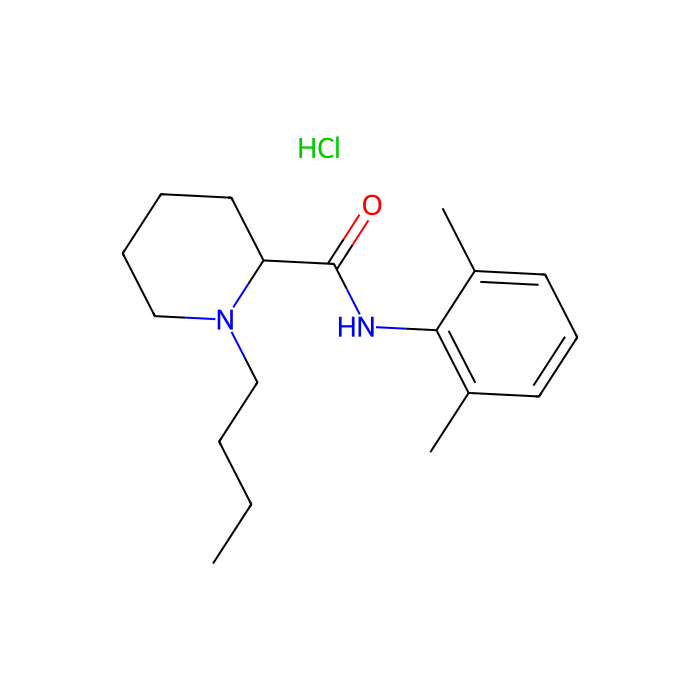
10mM in DMSO for sensitive chromatographic and analytical workflows requiring minimal baseline interference.
🌡
Storage & shipping
Store at -80°C Ships Dry ice packs + Cold packs Check lot-specific COA for exact specifications.
📋
Quality documents
SDS, COA, datasheet, and spec sheet available for download. Lot-specific COA accessible via lot number lookup.
📚
Literature proof
Cited in 0 peer-reviewed publications across chromatography, organic synthesis, and cross-coupling reactions.
Descripción general
Information
Bupivacaine HCl Bupivacaine HCl binds to the intracellular portion of voltage-gated sodium channels and blocks sodium influx into nerve cells, used for treating cardiac arrhythmias. In vitro
Bupivacaine solution is cytotoxic to bovine articular chondrocytes and articular cartilage in vitro after only 15 to 30 minutes exposure. Bupivacaine acts in isolated mitochondria, as uncouplers between oxygen consumption and phosphorylation of adenosine diphosphate. Bupivacaine causes a concentration-dependent mitochondrial depolarization and pyridine nucleotide oxidation in isolated mitochondria, which are matched by an increased oxygen consumption at bupivacaine concentrations of 1.5 mm or less at pH 7.4, whereas respiration is inhibited at higher concentrations. Bupivacaine causes the opening of the permeability transition pore (PTP), a cyclosporin A-sensitive inner membrane channel that plays a key role in many forms of cell death. Bupivacaine causes mitochondrial depolarization and pyridine nucleotides oxidation that are matched by increased concentrations of cytosolic free Ca(2+), release of cytochrome c, and eventually, hypercontracture in intact flexor digitorum brevis fibers. Bupivacaine inhibits GIRK channels within seconds of application, regardless of whether channels are activated through the muscarinic receptor or directly via coexpressed G protein G(beta)gamma subunits. Bupivacaine also inhibits alcohol-induced GIRK currents in the absence of functional pertussis toxin-sensitive G proteins. Bupivacaine HCl also potently inhibits cAMP production with an IC50 of 2.3 μM.
In vivo
Bupivacaine does not only induce Ca2+ release from the sarcoplasmic reticulum (SR) in rats, but also inhibits Ca2+ uptake by the SR, which is mainly regulated by SR Ca2+ adenosine triphosphatase activity. Cell Data
Bupivacaine HCl binds to the intracellular portion of voltage-gated sodium channels and blocks sodium influx into nerve cells, used for treating cardiac arrhythmias.
Condiciones de almacenamiento de almacenamiento
Store at -80°C
Enviado en
Dry ice packs + Cold packs
Este producto requiere envío en cadena de frío. Los servicios terrestres y otros servicios económicos no están disponibles.
We use cookies to ensure the website functions properly and, where permitted, to improve your experience. You can manage your preferences at any time in Settings. Learn more in our Cookie Policy.
Shall we send you a message when we have discounts available?
Remind me later
Thank you! Please check your email inbox to confirm.
Products are supplied to verified businesses, institutions, and qualified professionals for research and development use only. Not for use in humans, animals, diagnosis, or therapy.