
Determine the necessary mass, volume, or concentration for preparing a solution.
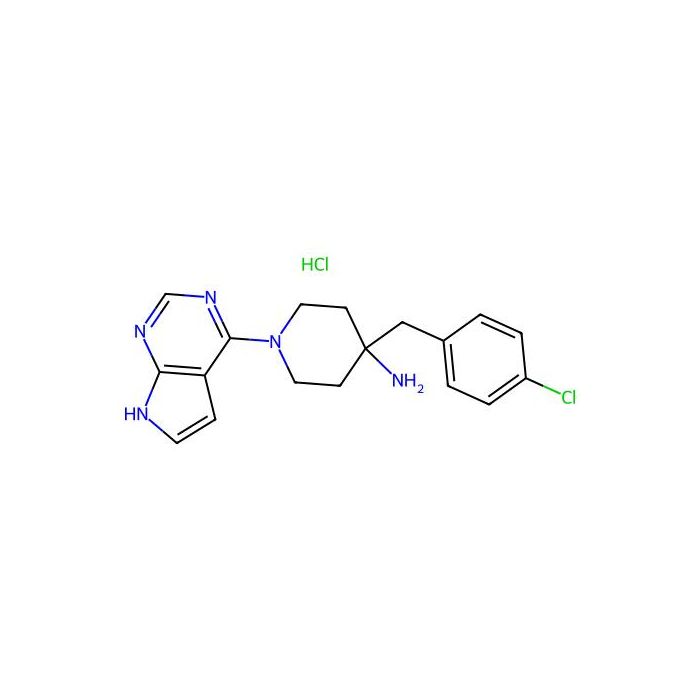
CCT128930 hydrochloride - ≥98% , CAS No.2453324-32-6
Disponible para pedir
GRADE & PURITY ≥98%
Storage
Store at 2-8°C,Desiccated
Shipped In
Wet ice
≥98% for sensitive chromatographic and analytical workflows requiring minimal baseline interference.
Store at 2-8°C,Desiccated Ships Wet ice Check lot-specific COA for exact specifications.
SDS, COA, datasheet, and spec sheet available for download. Lot-specific COA accessible via lot number lookup.
Cited in 0 peer-reviewed publications across chromatography, organic synthesis, and cross-coupling reactions.
CCT128930 hydrochloride is a potent and selective inhibitor of AKT ( IC 50 =6 nM). CCT128930 hydrochloride has 28-fold selectivity over the closely related PKA kinase (IC 50 =168 nM) through the targeting of Met282 of AKT (Met173 of PKA-AKT chimera), as well as 20-fold selectivity over p70S6K (IC 50 =120 nM). CCT128930 hydrochloride induces cell cycle arrest, DNA damage, and autophagy . Antitumor activity
In Vitro
The GI 50 values of CCT128930 hydrochloride for growth inhibition are 6.3 μM for U87MG human glioblastoma cells, 0.35 μM for LNCaP human prostate cancer cells, and 1.9 μM for PC3 human prostate cancer cells, all of which are PTEN-deficient human tumor cell lines. CCT128930 (0.1-60 μM; 1 hour; U87MG human glioblastoma cells) hydrochloride shows an initial induction of AKT phosphorylation at serine 473 up to 20 μM, followed by a decreased in phosphorylation at higher concentrations. CCT128930 hydrochloride inhibits direct substrates of AKT (Ser9 GSK3β, pThr246 PRAS40 and pT24 FOXO1/p32 FOXO3a) at ≥5 μM, and the downstream target, pSer235/236 S6RP at ≥10 μM, with generally constant levels of the respective total proteins and GAPDH. CCT128930 (18.9 μM; U87MG human glioblastoma cells) hydrochloride causes an increase in phosphorylation of pSer473 AKT after 30 minutes, which is sustained for 48 hours. Total AKT protein signal decreases gradually from 8 hours to 48 hours of treatment. CCT128930 ( PTEN - U87MG human glioblastoma cells; over a 24-hour time period) hydrochloride results in an increase in G0/G1 phase cells from 43.6% to 64.8% after 24 hours of treatment. CCT128930 (0-10 μM; 24 hours) hydrochloride increases, but not inhibites, the phosphorylation of Akt in HepG2 and A549 cells. CCT128930 (0-20 μM; 24 hours) hydrochloride inhibits cell proliferation by inducing cell cycle arrest in G1 phase through downregulation of cyclinD1 and Cdc25A, and upregulation of p21, p27 and p53. CCT128930 (20 μM) hydrochloride triggers cell apoptosis with activation of caspase-3, caspase-9, and PARP. CCT128930 (0-20 μM; 24 hours) hydrochloride increases phosphorylation of ERK and JNK in HepG2 cells. CCT128930 (0-20 μM; 24 hours) hydrochloride activates DNA damage response of HepG2 cell characterized by phosphorylation of H2AX, ATM (ataxia-telangiectasia mutated), Chk1 and Chk2. MCE has not independently confirmed the accuracy of these methods. They are for reference only.
In Vivo
CCT128930 (25 or 40 mg/kg; i.p. daily or twice daily for 5 days) hydrochloride shows antitumor activities in U87MG and BT474 human breast cancer xenografts .\nSummary of the pharmacokinetic parameters of CCT128930 (25 mg/kg) in CrTacNCr- Fox1nu mice Tissue Route T 1/2 (h) T max (h) C max (μM) V ss (L) Cl (L/h) AUC 0-∞ (µMh) Bioavailability (%) Plasma i.v. 0.95 0.083 6.36 0.25 0.325 4.62 100 Plasma i.p. 2.33 0.5 1.28 N/A 0.372 1.33 28.8 Tumor i.p. 3.89 1 8.02 N/A 0.06 * 25.8 N/A Plasma p.o. 0.57 0.5 0.432 N/A 0.317 0.392 8.5 * Apparent clearance. MCE has not independently confirmed the accuracy of these methods. They are for reference only. Animal Model: 6-8 weeks old female CrTacNCr- Fox1nu mice Dosage: 25 mg/kg (U87MG human glioblastoma xenografts) or 40 mg/kg (BT474 human breast cancer xenografts) Administration: i.p. daily for 5 days (U87MG human glioblastoma xenografts); i.p. twice daily for 5 days (BT474 human breast cancer xenografts) Result: Giving a treated:control (T/C) ratio on day 12 of 48%. There was no weight loss associated with this regime in U87MG human glioblastoma xenografts. Had a profound antitumor effect with complete growth arrest and a T/C ratio of 29% on day 22. This regimen was associated with minimal weight loss, with a nadir of only 94.8% of the initial body weight on day 15 of treatment in BT474 human breast cancer xenografts.
Form:Solid
IC50& Target:Akt2 6 nM (IC 50 ) PKA 168 nM (IC 50 ) p70S6K 120 nM (IC 50 ) Autophagy Apoptosis
| Sonrisas canónicas | C1CN(CCC1(CC2=CC=C(C=C2)Cl)N)C3=NC=NC4=C3C=CN4.Cl |
|---|---|
| IUPAC Name | 4-[(4-chlorophenyl)methyl]-1-(7H-pyrrolo[2,3-d]pyrimidin-4-yl)piperidin-4-amine;hydrochloride |
| InChIKey | OFLOSUNRPFWODP-UHFFFAOYSA-N |
| INCHI | 1S/C18H20ClN5.ClH/c19-14-3-1-13(2-4-14)11-18(20)6-9-24(10-7-18)17-15-5-8-21-16(15)22-12-23-17;/h1-5,8,12H,6-7,9-11,20H2,(H,21,22,23);1H |
| PubChem CID | 146013807 |
| Peso molecular | 378.3 |
Comprehensive hazard, handling, storage, and regulatory compliance document.
Download SDS →Lot-specific quality data. Enter your lot number to retrieve the exact COA.
Look up COA →Full quality attributes and acceptance criteria for this grade.
View spec sheet →Taxonomy Tree
| Kingdom | Organic compounds |
|---|---|
| Superclass | Organoheterocyclic compounds |
| Clase | Piperidines |
| Subclass | Benzylpiperidines |
| Intermediate Tree Nodes | Not available |
| Direct Parent | 4-benzylpiperidines |
| Alternative Parents | Pyrrolopyrimidines Dialkylarylamines Chlorobenzenes Aminopyrimidines and derivatives Substituted pyrroles Imidolactams Heteroaromatic compounds Vinyl chlorides Propargyl-type 1,3-dipolar organic compounds Dialkylamines Chloroalkenes Carboximidamides Azacyclic compounds Amidines Organopnictogen compounds Organochlorides Monoalkylamines Hydrochlorides Hydrocarbon derivatives |
| Molecular Framework | Aromatic heteropolycyclic compounds |
| Substituents | 4-benzylpiperidine - Pyrrolopyrimidine - Dialkylarylamine - Tertiary aliphatic/aromatic amine - Halobenzene - Chlorobenzene - Aminopyrimidine - Imidolactam - Benzenoid - Substituted pyrrole - Pyrimidine - Monocyclic benzene moiety - Heteroaromatic compound - Pyrrole - Tertiary amine - Azacycle - Chloroalkene - Haloalkene - Organic 1,3-dipolar compound - Propargyl-type 1,3-dipolar organic compound - Carboximidamide - Vinyl halide - Vinyl chloride - Secondary amine - Secondary aliphatic amine - Amidine - Organic nitrogen compound - Organopnictogen compound - Hydrocarbon derivative - Hydrochloride - Organonitrogen compound - Organochloride - Organohalogen compound - Primary aliphatic amine - Amine - Aromatic heteropolycyclic compound |
| Descripción | This compound belongs to the class of organic compounds known as 4-benzylpiperidines. These are organic compounds containing a benzyl group attached to the 4-position of a piperidine. |
| External Descriptors | Not available |
| Solubilidad | DMSO : 20 mg/mL (52.87 mM; ultrasonic and warming and heat to 60°C) |
|---|