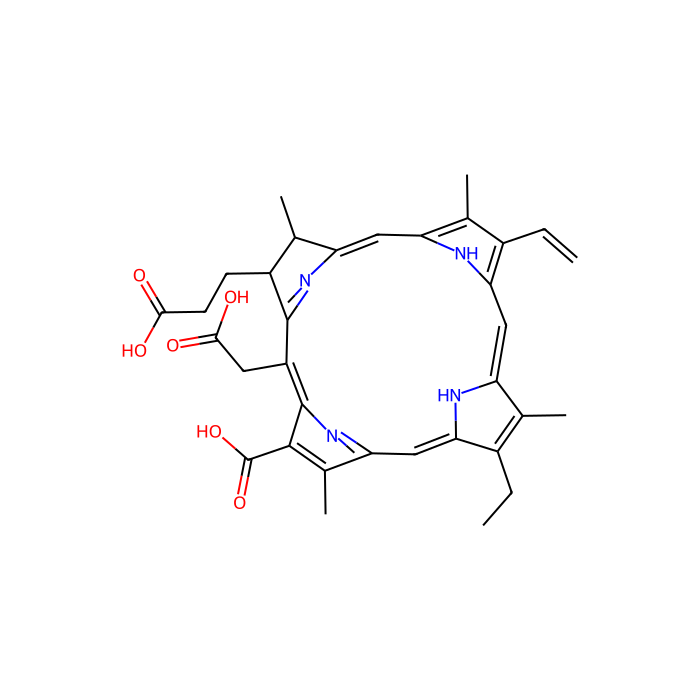
CHLORIN E6 - 94% , CAS No.19660-77-6

CAS: 19660-77-6 Cat. No.: C302680 Fórmula: C34H36N4O6 Peso molecular: 596.67 Número EC: 243-209-4
Disponible para pedir
Synonyms
Photolon | UNII-5S2CCF3T1Z | PHYTOCHLORIN E6 | chlorine e6 | 21H,23H-Porphine-7-propanoic acid, 3-carboxy-5-(carboxymethyl)-13-ethenyl-18-ethyl-7,8-dihydro-2,8,12,17-tetramethyl-, (7S,8S)- | Diethyl phenylamidophosphate # | 21H,23H-Porphine-2-propanoic ac
Storage
Protected from light,Store at -20°C
Shipped In
Ice chest + Ice pads
★
Talla
USA
Alemania (EU)*
Precio
Cantidad
100mg
C302680-100mg
5 Disponible
—

438,90US$

549,90US$
Guardar 111,00 US$ (20.19%)
500mg
C302680-500mg
2 Disponible
—

1.454,90US$

1.819,90US$
Guardar 365,00 US$ (20.06%)
1g
C302680-1g
1 Disponible
—

2.334,90US$

2.918,90US$
Guardar 584,00 US$ (20.01%)
Enter a quantity for the sizes you want to add.
🧪
Por qué esta calidad

94% para flujos de trabajo cromatográficos y analíticos sensibles que requieren una interferencia mínima de la línea base.

🌡

Almacenamiento y envío

Protected from light,Store at -20°C Envío Ice chest + Ice pads. Consulte el COA específico del lote para conocer las especificaciones exactas.

📋

Documentos de calidad

SDS, COA, ficha técnica y hoja de especificaciones disponibles para descargar. COA específico del lote accesible mediante búsqueda por número de lote.

📚

Prueba documental

Citado en 67 publicaciones revisadas por pares sobre cromatografía, síntesis orgánica y reacciones de acoplamiento cruzado.

Especificaciones

Sinónimos
Photolon | UNII-5S2CCF3T1Z | PHYTOCHLORIN E6 | chlorine e6 | 21H,23H-Porphine-7-propanoic acid, 3-carboxy-5-(carboxymethyl)-13-ethenyl-18-ethyl-7,8-dihydro-2,8,12,17-tetramethyl-, (7S,8S)- | Diethyl phenylamidophosphate # | 21H,23H-Porphine-2-propanoic ac
Especificaciones y pureza
94%
Condiciones de almacenamiento de almacenamiento
Protected from light,Store at -20°C
Enviado en
Ice chest + Ice pads
Este producto requiere envío en cadena de frío. Los servicios terrestres y otros servicios económicos no están disponibles.
Nombres e identificadores
Sonrisas canónicas
CCC1=C(C2=CC3=C(C(=C(N3)C=C4C(C(C(=N4)C(=C5C(=C(C(=N5)C=C1N2)C)C(=O)O)CC(=O)O)CCC(=O)O)C)C)C=C)C
IUPAC Name
(17S,18S)-18-(2-carboxyethyl)-20-(carboxymethyl)-12-ethenyl-7-ethyl-3,8,13,17-tetramethyl-17,18,22,23-tetrahydroporphyrin-2-carboxylic acid
InChIKey
OYINILBBZAQBEV-UWJYYQICSA-N
INCHI
1S/C34H36N4O6/c1-7-19-15(3)23-12-25-17(5)21(9-10-29(39)40)32(37-25)22(11-30(41)42)33-31(34(43)44)18(6)26(38-33)14-28-20(8-2)16(4)24(36-28)13-27(19)35-23/h7,12-14,17,21,35-36H,1,8-11H2,2-6H3,(H,39,40)(H,41,42)(H,43,44)/t17-,21-/m0/s1
Isómeros SMILES
CCC1=C(C2=CC3=C(C(=C(N3)C=C4[C@H]([C@@H](C(=N4)C(=C5C(=C(C(=N5)C=C1N2)C)C(=O)O)CC(=O)O)CCC(=O)O)C)C)C=C)C
Peso molecular
596.67
Reaxy-Rn
10635835
Reaxys-RN_link_address
https://www.reaxys.com/reaxys/secured/hopinto.do?context=S&query=IDE.XRN=10635835&ln=

Documentación

📋 Hoja de datos de seguridad (SDS)

Documento completo sobre peligros, manipulación, almacenamiento y cumplimiento normativo.

<<<<<<< HEAD Descargar SDS → ======= Descargar SDS → >>>>>>> release248-p3

✅ Certificado de análisis (COA)

Datos de calidad específicos del lote. Introduzca su número de lote para obtener el COA exacto.

Buscar COA →

📊 Ficha técnica

Resumen de referencia rápida de las especificaciones y aplicaciones del producto.

Ver ficha técnica →

🔬 Hoja de especificaciones

Atributos de calidad completos y criterios de aceptación para esta calidad.

Ver hoja de especificaciones →

Datos avanzados

Taxonomic Classification

Taxonomy Tree

KingdomOrganic compounds
SuperclassOrganoheterocyclic compounds
ClaseTetrapyrroles and derivatives
SubclassChlorins
Intermediate Tree Nodes Not available
Direct ParentChlorins
Alternative Parents Tricarboxylic acids and derivatives  Pyrrole carboxylic acids  Substituted pyrroles  Heteroaromatic compounds  Carboxylic acids  Azacyclic compounds  Organopnictogen compounds  Organonitrogen compounds  Organic oxides  Hydrocarbon derivatives  Carbonyl compounds  
Molecular FrameworkAromatic heteropolycyclic compounds
Substituents Chlorin - Tricarboxylic acid or derivatives - Pyrrole-3-carboxylic acid - Pyrrole-3-carboxylic acid or derivatives - Substituted pyrrole - Pyrrole - Heteroaromatic compound - Carboxylic acid - Carboxylic acid derivative - Azacycle - Hydrocarbon derivative - Organic oxide - Organopnictogen compound - Organic oxygen compound - Organooxygen compound - Organonitrogen compound - Organic nitrogen compound - Carbonyl group - Aromatic heteropolycyclic compound
DescripciónThis compound belongs to the class of organic compounds known as chlorins. These are large heterocyclic aromatic ring systems consisting, at the core, of three pyrroles and one pyrroline coupled through four methine linkages.
External Descriptors Not available
Estructura 3D
Modelo de Estructura Química Interactiva


Objetivos asociados (humanos)
MCF7 (126967 Activities)
Activity TypeRelationActivity valueUnitsAction TypeJournalPubMed IddoiAssay Aladdin ID
SK-OV-3 (52876 Activities)
Activity TypeRelationActivity valueUnitsAction TypeJournalPubMed IddoiAssay Aladdin ID
SW480 (6023 Activities)
Activity TypeRelationActivity valueUnitsAction TypeJournalPubMed IddoiAssay Aladdin ID
HEp-2 (3859 Activities)
Activity TypeRelationActivity valueUnitsAction TypeJournalPubMed IddoiAssay Aladdin ID
HepG2 (196354 Activities)
Activity TypeRelationActivity valueUnitsAction TypeJournalPubMed IddoiAssay Aladdin ID
HeLa (62764 Activities)
Activity TypeRelationActivity valueUnitsAction TypeJournalPubMed IddoiAssay Aladdin ID
Mecanismos de acción
Certificados (CoA, COO, BSE/TSE y tabla de análisis)
C of A & Other Certificates(BSE/TSE, COO):
Analytical Chart:

Find and download the COA for your product by matching the lot number on the packaging.

7 results found

Lot NumberCertificate TypeFechaArticulo
D23061408D23061408Certificate of AnalysisJan 21, 2026 C302680
D23061412D23061412Certificate of AnalysisJan 21, 2026 C302680
D23061419D23061419Certificate of AnalysisJan 21, 2026 C302680
D23061407D23061407Certificate of AnalysisMar 21, 2023 C302680
D23061409D23061409Certificate of AnalysisMar 21, 2023 C302680
D23061410D23061410Certificate of AnalysisMar 21, 2023 C302680
G2312120G2312120Certificate of AnalysisMar 21, 2023 C302680
Propiedades químicas y físicas
SensibilidadLight sensitive
Peso molecular596.700 g/mol
XLogP34.600
Hydrogen Bond Donor Count5
Hydrogen Bond Acceptor Count8
Rotatable Bond Count8
Exact Mass596.263 Da
Monoisotopic Mass596.263 Da
Topological Polar Surface Area169.000 Ų
Heavy Atom Count44
Formal Charge0
Complexity1090.000
Isotope Atom Count0
Defined Atom Stereocenter Count2
Undefined Atom Stereocenter Count0
Defined Bond Stereocenter Count0
Undefined Bond Stereocenter Count0
The total count of all stereochemical bonds0
Covalently-Bonded Unit Count1
Citations of This Product
Calculadoras de soluciones
Reseñas

Reseñas de cliente

Application Protocols

Item-specific, validated protocols (WB, IHC, IF, FC, etc.) are not provided for this product.

General guidance for preparing working solutions for photochemical experiments (literature; not item-specific):

  • Stock preparation: Dissolve chlorin e6 in anhydrous DMSO or DMF to 1–10 mM. Vortex briefly and protect from light (foil wrap). Filter through 0.2 µm PTFE if needed.
  • Working solution: Dilute stock into the reaction medium to the desired µM concentration immediately before illumination. For aqueous media, include mild surfactant or protein carrier to reduce aggregation.
  • Illumination: Use red LEDs (~660 nm). Record power density and exposure time for reproducibility. Maintain oxygenation for singlet-oxygen chemistry.
  • Controls: Include dark controls and singlet-oxygen quenchers (e.g., sodium azide) as mechanism checks.

For assay- or instrument-specific protocols (e.g., fluorescence quantum yield, ROS quantification by DPBF or SOSG), consult peer-reviewed literature and validate under your exact solvent, pH, and pathlength conditions.

Biological Roles

General biochemical context (literature; not item-specific or clinical):

  • Structural class: Chlorins are partially hydrogenated porphyrins—tetrapyrrolic macrocycles closely related to chlorophylls and heme. The conjugated macrocycle coordinates metals in many natural systems; however, chlorin e6 here is the free acid, not a metallo-complex.
  • Origin/derivation: Chlorin e6 can be obtained by controlled modification of chlorophyll derivatives (e.g., demetallation/de-esterification). It is not a native metabolite in humans but is structurally akin to plant chlorophyll breakdown products.
  • Photophysical role: The macrocycle’s Q-band absorption in the red facilitates efficient energy transfer to molecular oxygen to yield singlet oxygen (1O2)—a process analogous to light harvesting and energy conversion in photosynthetic assemblies (conceptual parallel; not a biological function claim for this item).
  • Interactions with biomolecules: The hydrophobic macrocycle and acidic side chains promote binding to proteins, membranes, and serum albumin; aggregation state and pH modulate uptake/association (literature observations).
  • Analytical/probe use: Employed as a fluorescent/photoreactive probe in biochemical research to map diffusion of ROS and to study protein/nucleic acid photooxidation mechanisms under controlled in vitro conditions.

Note: This product is for research use only and not intended for diagnostic or therapeutic applications.

Buffer Applications

Chlorin e6 is not a buffering agent and is not used to set or maintain pH. However, its behavior is strongly influenced by buffer composition (general guidance):

  • Solubilization in aqueous buffers: Enhanced at pH > 8 due to deprotonation of carboxylic acids; aggregation decreases with addition of mild surfactants (e.g., 0.01–0.1% nonionic detergents) or protein carriers (e.g., BSA) in some assays.
  • Light management: Prepare and handle buffer solutions under reduced light; use amber vials. Include antioxidants or 1O2 quenchers only if required as controls, recognizing they will suppress photosensitization.
  • Ionic strength: Higher ionic strength can promote aggregation; empirical optimization is advised for spectroscopy and photochemistry.

Item-specific buffer recipes, pKa values, and stock solution instructions are not provided for this product; refer to literature protocols and validate for your application.

Green Alternatives

Assessment relative to greener principles (general literature guidance):

  • Strengths of chlorin e6:

    • Absorbs in the red region (efficient use of safe, energy‑efficient LEDs).
    • Operates under ambient temperature/pressure with molecular oxygen as the terminal oxidant, minimizing stoichiometric reagents.
  • Considerations:

    • Often requires organic co-solvents (DMSO/DMF) for solubility; aggregation can necessitate additives.
    • Potential persistence and ecotoxicity of porphyrinoids must be considered in waste handling.
  • Alternative photosensitizers (trade-offs, literature):

    • Rose Bengal: Water-soluble, high ΦΔ for 1O2; absorbs green light (shorter λ), can be easier in aqueous media but may have dye carryover and halogen content.
    • Riboflavin (vitamin B2): Bio-based, biodegradable; effective under blue light; limited red absorption and may degrade faster.
    • Methylene Blue: Water-soluble cationic dye; absorbs red; can bind biomacromolecules nonselectively.
    • 2,4,6-Triphenylpyrylium or organic photocatalysts (e.g., Eosin Y): Green-light activation; different mechanism (SET vs energy transfer) enabling complementary reactivity.

Comparison snapshot (literature):

  • Red-light use: Chlorin e6, Methylene Blue excel.
  • Aqueous solubility: Rose Bengal, Methylene Blue, Riboflavin > Chlorin e6 (without surfactants).
  • Biogenic/renewable: Riboflavin > others.

Select based on wavelength, medium (water vs organic), and desired pathway (energy transfer vs SET). Dispose of dye-containing waste responsibly.

Pharmaceutical Uses

No pharmacopeial grade or excipient role is specified for this item. This product is supplied strictly for research and laboratory use.

General formulation context (non-clinical, literature/prototyping):

  • As a dye/photosensitizer in materials and device R&D, chlorin e6 may be incorporated into polymeric matrices, nanoparticles, or lipid carriers to study light-triggered release and photochemical response.
  • Solubilization strategies include salts of the carboxylates, cyclodextrin inclusion, and protein association (e.g., serum albumin) to improve aqueous handling for in vitro test systems.
  • Analytical standards: May serve as a calibrant for red-region absorbance/fluorescence in instrument method development.

Compliance notes:

  • No USP/EP monograph or GMP status is claimed here.
  • Avoid any use in humans or animals for therapeutic, diagnostic, or clinical purposes.

For any regulated application, obtain a detailed CoA/Spec Sheet and perform internal qualification (identity, purity, residual solvents, endotoxin/bioburden if relevant to your lab setting).

Physical Properties

Item-specific specifications (this lot):

  • Appearance: Not specified for this item; refer to CoA/Spec Sheet.
  • Grade/Purity: Not specified for this item; refer to CoA/Spec Sheet.

General/literature values (for reference only; not item-specific):

  • Physical form: Dark green to blackish solid (chlorin macrocycle; literature).
  • Solubility profile: Poorly soluble in neutral water; soluble in DMSO, DMF, pyridine, and in aqueous buffers at basic pH or with surfactants/micelles; forms aggregates in aqueous media (literature).
  • Acid–base behavior: Contains three carboxylic acids (deprotonation near mildly acidic to neutral pH; exact pKa values depend on medium; literature).
  • Spectroscopy: Intense Soret band near ~400–410 nm and Q-bands in red/NIR, strongest around ~660–665 nm (solvent-dependent; literature). Useful for photophysical assays and singlet-oxygen generation.
  • Partition/aggregation: Tends to self-associate in water; ionic strength, pH, and surfactants strongly affect monomer/aggregate balance (literature).
  • Melting point, boiling point, density, refractive index, logP: Not specified for this item; typical values are not routinely reported due to thermal lability and aggregation phenomena in chlorins.

Notes for practical work (general): Dissolve first in dry DMSO or DMF to prepare a concentrated stock, then dilute into the working medium while minimizing light exposure to avoid photobleaching.

Quality and Grades
  • Grade/Purity for this catalog item: Not specified for this item; refer to CoA/Spec Sheet.
  • Stabilizers: Not specified for this item; refer to CoA/Spec Sheet.

Context and implications (general guidance for chlorin e6):

  • Purity in photosensitizers: Trace metal ions, porphyrinic byproducts, and aggregated forms can affect quantum yields, fluorescence, and reproducibility. If your application is photophysical or analytical, request or review UV–Vis profiles and HPLC purity on the CoA.
  • Low-UV/LC-MS compatibility: For analytical use (e.g., as a standard or probe), look for documentation of low baseline absorbance outside the characteristic Soret/Q bands and absence of late-eluting oligomers.
  • Residual solvents/water/peroxide/metal limits: Not specified for this item; consult the CoA/Spec Sheet if these parameters are critical to your method validation.
  • Batch-to-batch consistency: Photosensitizer performance is sensitive to aggregation; lot-specific extinction coefficients may vary with counterions or residual moisture. Validate concentration by UV–Vis using literature ε at selected wavelengths in the same solvent used for calibration.

Recommendation: For quantitative photochemistry or materials work, pre-filter solutions (0.2 µm PTFE) and perform a quick HPLC/UV–Vis check to confirm monomeric state before critical experiments.

Reaction and Applications

This compound is primarily used as a visible-light photosensitizer. Under red light (~660 nm) and oxygen, chlorin e6 transfers energy to form singlet oxygen (1O2) and other ROS.

Key application areas (literature/general; not item-specific):

  • Photooxidations via 1O2:
    • Ene reactions (allylic hydroperoxidation of alkenes).
    • [4+2] cycloadditions with dienes (photo-Diels–Alder with 1O2 to form endoperoxides).
    • Oxidation of sulfides to sulfoxides/sulfones; aromatics to endoperoxides.
  • Polymer/materials:
    • Initiation of photopolymerizations and surface patterning; oxygen-tolerant curing when 1O2 reactivity is leveraged.
    • Doping in photonic materials or as a red-emitting fluorophore.
  • Chemical biology/tools:
    • Singlet-oxygen mapping, protein footprinting, and photolabeling under controlled illumination.
    • Conjugation through carboxyl groups (e.g., EDC/NHS chemistry) to attach to carriers, nanoparticles, or polymers for targeted photochemistry.

Practical tips:

  • Use red LEDs/lasers (λmax ~660–665 nm); maintain oxygenation (sparging or headspace O2) for 1O2 chemistry.
  • Control aggregation: low µM concentrations, small % organic co-solvent, surfactants for aqueous systems.
  • Monitor progress by UV–Vis (Soret/Q-band changes) or substrate/product GC/LC.
  • Quenchers: Sodium azide or DABCO suppress 1O2—use as controls.

Note: Avoid medical/clinical uses; this listing is for research/lab photochemistry only.

Reaction Conditions

General conditions for photochemical applications of chlorin e6 (literature guidance; not item-specific specs):

  • Illumination:
    • Red LEDs/lasers centered at ~660–665 nm; typical irradiance 10–100 mW/cm² depending on scale.
    • Use temperature control to dissipate heat from LEDs; maintain consistent photon flux.
  • Catalyst loading:
    • Organic synthesis: 0.1–5 mol% relative to substrate (low µM to sub-mM range) depending on extinction coefficient and pathlength.
    • Aqueous assays: 0.1–10 µM typical; minimize aggregation.
  • Atmosphere:
    • Oxygen-saturated solutions favored for 1O2 chemistry; sparge with O2 or use O2 headspace with agitation. Air may suffice for small-scale or highly reactive substrates.
  • Solvents:
    • MeCN, MeOH, DCM, or mixed aqueous/organic systems. Stock solutions often prepared in DMSO and diluted immediately before use.
  • Temperature/time:
    • Ambient temperature; reaction times from minutes to hours depending on substrate and light intensity.
  • Controls and quenchers:
    • Sodium azide or DABCO as 1O2 quenchers to confirm mechanism. Include dark controls.
  • Workup/analysis:
    • Quench light exposure, remove solvent under reduced light, analyze by GC/LC/NMR. Avoid silica exposure if the dye is to be recovered; use reverse-phase prep when needed.

Expected outcomes vary with substrate; literature yields for 1O2 ene oxidations and sulfide oxidations commonly range from moderate to high under optimized conditions.

Safety and Handling

Item-specific safety information:

  • GHS classification, pictograms, signal word, H-statements: Not specified for this item; refer to the product SDS for authoritative safety data.
  • Storage (from Product Data): Store at −20°C, protected from light. Shipments are made cold (ice chest + ice pads).

General safety considerations for chlorin photosensitizers (literature/practice; not item-specific):

  • Photosensitizer hazard: Upon light exposure (especially red light, ~660 nm) in the presence of oxygen, chlorins generate singlet oxygen (1O2) and reactive oxygen species (ROS). Avoid unnecessary illumination of solutions or skin/eyes—wrap vials in foil.
  • PPE: Use lab coat, nitrile gloves, and eye protection. Handle solutions in low-light conditions or under red/amber safelights when feasible.
  • Incompatibilities: Avoid strong oxidizers and reducing agents that may degrade the macrocycle; minimize exposure to bases/acids that can cause demetalation/ester hydrolysis in derivatives. Prevent contact with light-sensitive materials.
  • Engineering controls: Work in a fume hood to avoid inhalation of aerosols and to control light exposure. Use amber glassware/syringes where possible.
  • First aid (overview; defer to SDS):
    • Skin/eye contact: Rinse with water for at least 15 minutes. Remove contaminated clothing.
    • Inhalation: Move to fresh air.
    • Ingestion: Rinse mouth; seek medical attention.
  • Spill response: Cover to block light; absorb with inert material; collect as hazardous chemical waste.

Always consult the current SDS before use.

Solvent Selection

Chlorin e6 is amphiphilic with three carboxylates and a hydrophobic macrocycle; it exhibits strong solvent-dependent aggregation and photophysics.

  • Polarity/miscibility (literature):
    • Readily soluble: DMSO, DMF, NMP, pyridine.
    • Moderately soluble: Alcohols (MeOH/EtOH) with risk of aggregation; improve with small DMSO co-solvent.
    • Aqueous media: Poor solubility at low pH; improved in basic buffers (pH > 8), in presence of surfactants (e.g., Tween, SDS), cyclodextrins, or serum proteins (general literature guidance).
  • Practical strategies:
    • Prepare a concentrated stock in dry DMSO (e.g., 1–10 mM), store at −20°C protected from light, and dilute into the working medium immediately prior to use.
    • To favor monomers, work at low micromolar concentrations, include small fractions of organic co-solvent, or use mild surfactants.
    • For spectroscopic calibration, match solvent and ionic strength to the literature reference used for ε.
  • Selection versus alternatives (general):
    • For purely aqueous systems, consider using a water-soluble photosensitizer (e.g., Rose Bengal, riboflavin) or employ buffer with surfactant/albumin carriers.
    • For organic photooxidations, dry, oxygenated MeCN, DCM, or MeOH with low fractions of DMSO stock are commonly used; ensure oxygen saturation for 1O2 chemistry.

Note: Item-specific solubility data are not provided; verify empirically for your matrix.

Storage and Reconstitution

Item-specific storage and shipping:

  • Storage conditions: Protected from light; store at −20°C (from Product Data).
  • Shipping: Ice chest + ice pads (from Product Data).

General best practices for handling chlorin e6 (not item-specific requirements):

  • Container: Store in amber, airtight vials with desiccant if possible. Minimize headspace and light exposure.
  • Aliquots: Prepare small single‑use aliquots to avoid repeated freeze–thaw and cumulative light exposure.
  • Reconstitution (if needed): Dissolve in anhydrous DMSO or DMF to make a concentrated stock (e.g., 1–10 mM). Mix gently; avoid vigorous shaking that can introduce oxygen before intended use. For aqueous applications, dilute into buffer immediately before experiments; consider adding surfactant or protein carriers to reduce aggregation.
  • Stability: Chlorins can undergo photobleaching and oxidation upon light exposure; keep solutions on ice and in the dark during setup. Assess stability by monitoring the Soret/Q-band profile over time.
  • Storage duration: Solid at −20°C protected from light is typically stable for months; solutions in DMSO are best used within days to weeks depending on concentration and light exposure (verify empirically for your setup).

For definitive stability and reconstitution guidance for this lot, consult the CoA/Spec Sheet and SDS.

Structure and Identity

Chlorin e6 is a chlorophyll-derived chlorin macrocycle bearing three carboxylic acid substituents; widely used as a red-light photosensitizer for singlet-oxygen generation.

  • Item-specific identifiers (from Product Data):

    • CAS: 19660-77-6
    • CID (PubChem): 5479494
    • InChIKey: 270732 (as provided; may be truncated—refer to CoA/Spec Sheet for full identifier)
  • Research use: For research use only

  • Storage note (item-specific): Protect from light; store at −20°C

  • Literature identity data (general reference; not item-specific specs):

    • Common name: Chlorin e6 (Ce6)
    • Molecular formula (literature): C34H36N4O6
    • Molecular weight (literature): ~596.7 g/mol
    • Core scaffold: Tetrapyrrolic chlorin (partially hydrogenated porphyrin) with one reduced pyrrole unit (dihydroporphyrin) producing intense Soret and Q-bands.
    • Functional groups: Three carboxylic acids, multiple vinyl/alkyl substituents, inner N4 macrocyclic core capable of metal coordination.
    • Stereochemistry: Macrocyclic planar/near-planar aromatic system; side-chain stereochemistry generally not stereogenic in the free acid.
    • 2D structure description: A 16-membered nitrogen macrocycle with alternating pyrrolic units; one ring is partially saturated (chlorin), bearing propionic/acetic-type side chains terminating in CO2H, and a conjugated substituent on the opposite side of the ring.
  • SMILES/InChI (literature): Not specified here to avoid inconsistency; consult trusted databases (PubChem CID 5479494) or the CoA/Spec Sheet.

Synthetic Utility

Chlorin e6 provides a versatile platform combining a red-light-harvesting macrocycle with three peripheral carboxylic acids suitable for derivatization and conjugation (literature/general):

  • Functional handles:
    • Three CO2H groups enable amide/ester formation (e.g., EDC/NHS or HATU couplings) to install linkers, polymers, or targeting ligands.
    • Macrocycle can be metalated (e.g., Zn(II), Al(III) complexes; literature) to tune photophysics and intersystem crossing.
  • Photochemical catalysis:
    • Efficient energy-transfer photocatalyst for generating 1O2 under red light. Useful in late-stage oxidation of complex molecules under mild conditions.
  • Materials assembly:
    • Covalent grafting to surfaces (amines on silica/polymers) via carbodiimide chemistry to generate photoactive coatings.
    • Formation of self-assembled nanostructures or incorporation into micelles/liposomes for ROS generation studies.
  • Retrosynthetic value:
    • Serves as a porphyrinoid building block where selective protection/activation of side chains affords asymmetric conjugates and dendrimers.

Notes:

  • Protect from light during synthesis/purification to avoid photodegradation.
  • Manage aggregation by using polar aprotic solvents and low concentrations for coupling reactions.
  • Item-specific reactivity specs (e.g., residual metal content, water content) are not provided; adjust protocols accordingly.
Target Specificity

Not applicable. This product is a small-molecule photosensitizer, not an antibody or affinity reagent.

  • Antigen/epitope, clone, isotype, species reactivity: Not applicable.
  • If conjugated targeting is desired, chlorin e6’s carboxyl groups can be used to couple to biomolecules (e.g., peptides, antibodies) via standard amide-coupling chemistries; any such targeting properties would be conferred by the chosen ligand, not by chlorin e6 itself.

Preguntas frecuentes

How should this product be stored?
Store at ?20 °C, protected from light. The material is light-sensitive — keep it in its original opaque or amber container.
How is this product shipped?
This product ships in an insulated container with ice pads. Unpack on arrival and transfer it to the storage condition stated above.

¿Quieres que te enviemos un mensaje cuando tengamos descuentos disponibles?

Recordármelo más tarde

¡Gracias! Por favor, revisa tu bandeja de entrada de correo electrónico para confirmar.

¡Vaya! Las notificaciones están desactivadas.