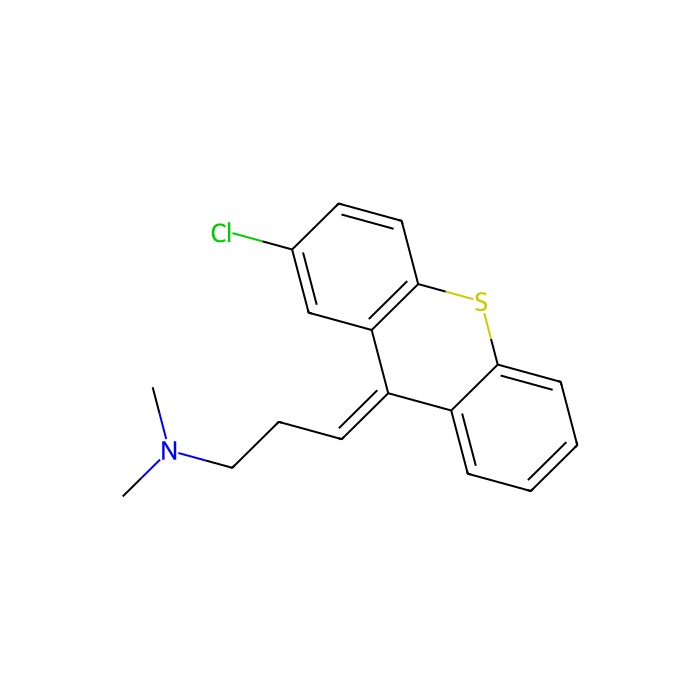
Determine the necessary mass, volume, or concentration for preparing a solution.
| Activity Type | Activity Value -log(M) | Mechanism of Action | Activity Reference | Publications (PubMed IDs) |
|---|

Moligand™, 10mM in DMSO Moligand™ for sensitive chromatographic and analytical workflows requiring minimal baseline interference.
Store at -80°C Ships Dry ice packs + Cold packs Check lot-specific COA for exact specifications.
SDS, COA, datasheet, and spec sheet available for download. Lot-specific COA accessible via lot number lookup.
Cited in 0 peer-reviewed publications across chromatography, organic synthesis, and cross-coupling reactions.
Information
Chlorprothixene has strong binding affinities todopamineandhistamine receptors, such asD1, D2, D3, D5, H1, 5-HT2, 5-HT6and5-HT7, withKiof 18 nM, 2.96 nM, 4.56 nM, 9 nM, 3.75 nM, 9.4 nM, 3 nM and 5.6 nM, respectively.
In vitro
Chlorprothixene exerts strong binding affinities to the dopamine and histamine receptors, such as D1, D2, D3, D5 and H1 with Ki values of 18nM, 2.96 nM, 4.56 nM, 9 nM and 3.75 nM, respectively, but has little affinity to H3 (Ki >1000 nM). Chlorprothixene also shows high affinities for both rat 5-HT6 from stably transfected HEK-293 cells, and rat 5-HT7 receptors from transiently expressed COS-7 cells, with Ki values of 3 nM and 5.6 nM, respectively. Administration of chlorprothixene results in inhibition of SARS-CoV replication in Vero 76 cells, with IC50 of 16.7 μM for Urbani strain, 13.0 μM for Frankfurt-1, 18.5 μM for CHUK-W1 and 15.8 μM for Toronto-2. There are similar to those detected with promazine
In vivo
Chlorprothixene blocks postsynaptic mesolimbic dopaminergic D1 and D2 receptors in the brain depressing the release of hypothalamic and hypophyseal hormones. High dose of chlorprothixene inhibits the protection afforded by iproniazid against the reserpine-induced release of catecholamines in adrenal medulla and brain as well as the decrease of 5HT, NE and DA due to reserpine or iproniazid in rat brain. Administration of Chlorprothixene restores normal ceramide concentrations in murine bronchial epithelial cells, reduces inflammation in the lungs of mice with cystic fibrosis (CF) and prevents infection with Pseudomonas aeruginosa, by inhibiting acidsphingomyelinase (Asm) and not neutral sphingomyelinase (Nsm).
Cell Data
cell lines:
Concentrations:
Incubation Time:
Powder Purity:≥97%
| ALogP | 5.2 |
|---|
| Isómeros SMILES | CN(C)CC/C=C\1/C2=CC=CC=C2SC3=C1C=C(C=C3)Cl |
|---|---|
| Peso molecular | 315.86 |
| Reaxy-Rn | 89898 |
| Reaxys-RN_link_address | https://www.reaxys.com/reaxys/secured/hopinto.do?context=S&query=IDE.XRN=89898&ln= |
Comprehensive hazard, handling, storage, and regulatory compliance document.
Download SDS →Lot-specific quality data. Enter your lot number to retrieve the exact COA.
Look up COA →Full quality attributes and acceptance criteria for this grade.
View spec sheet →| Activity Type | Activity Value -log(M) | Mechanism of Action | Activity Reference | Publications (PubMed IDs) |
|---|
| Activity Type | Activity Value -log(M) | Mechanism of Action | Activity Reference | Publications (PubMed IDs) |
|---|
| Activity Type | Activity Value -log(M) | Mechanism of Action | Activity Reference | Publications (PubMed IDs) |
|---|
| Activity Type | Activity Value -log(M) | Mechanism of Action | Activity Reference | Publications (PubMed IDs) |
|---|
| Activity Type | Activity Value -log(M) | Mechanism of Action | Activity Reference | Publications (PubMed IDs) |
|---|
| Activity Type | Activity Value -log(M) | Mechanism of Action | Activity Reference | Publications (PubMed IDs) |
|---|
| Solubilidad | Solubility (25°C) In vitro Water: 35 mg/mL (202.76 mM); DMSO: Insoluble; Ethanol: Insoluble; |
|---|---|
| Punto de fusión (°C) | 97 °C |
Our grade selection guide covers purity, stabilizer status, and application suitability for all variants in our catalog.
View Moligand™ grade guide →