Determine the necessary mass, volume, or concentration for preparing a solution.
| Activity Type | Relation | Activity value | Units | Action Type | Journal | PubMed Id | doi | Assay Aladdin ID |
|---|

≥98%(HPLC) for sensitive chromatographic and analytical workflows requiring minimal baseline interference.
Room temperature Ships Normal Check lot-specific COA for exact specifications.
SDS, COA, datasheet, and spec sheet available for download. Lot-specific COA accessible via lot number lookup.
Cited in 710 peer-reviewed publications across chromatography, organic synthesis, and cross-coupling reactions.
Comprehensive hazard, handling, storage, and regulatory compliance document.
Download SDS →Lot-specific quality data. Enter your lot number to retrieve the exact COA.
Look up COA →Full quality attributes and acceptance criteria for this grade.
View spec sheet →Taxonomy Tree
| Kingdom | Organic compounds |
|---|---|
| Superclass | Benzenoids |
| Clase | Benzene and substituted derivatives |
| Subclass | Biphenyls and derivatives |
| Intermediate Tree Nodes | Not available |
| Direct Parent | Benzidines |
| Alternative Parents | 1-naphthalene sulfonic acids and derivatives 1-naphthalene sulfonates 1-sulfo,2-unsubstituted aromatic compounds Sulfonyls Organosulfonic acids Azo compounds Propargyl-type 1,3-dipolar organic compounds Primary amines Organopnictogen compounds Organic sodium salts Organic oxides Hydrocarbon derivatives |
| Molecular Framework | Aromatic homopolycyclic compounds |
| Substituents | Naphthalene sulfonate - 1-naphthalene sulfonic acid or derivatives - Naphthalene sulfonic acid or derivatives - 1-naphthalene sulfonate - Benzidine - Naphthalene - 1-sulfo,2-unsubstituted aromatic compound - Arylsulfonic acid or derivatives - Organic sulfonic acid or derivatives - Organosulfonic acid or derivatives - Organosulfonic acid - Sulfonyl - Azo compound - Propargyl-type 1,3-dipolar organic compound - Organic 1,3-dipolar compound - Organic alkali metal salt - Amine - Organic salt - Organic sodium salt - Primary amine - Organosulfur compound - Organonitrogen compound - Hydrocarbon derivative - Organic oxide - Organopnictogen compound - Organic oxygen compound - Organic nitrogen compound - Aromatic homopolycyclic compound |
| Descripción | This compound belongs to the class of organic compounds known as benzidines. These are organic compounds containing the benzidine skeleton, made up of a biphenyl ring system substituted at the 4- and 4'-positions with a unsubstituted amine group. |
| External Descriptors | azo compound |
| Activity Type | Relation | Activity value | Units | Action Type | Journal | PubMed Id | doi | Assay Aladdin ID |
|---|
| Activity Type | Relation | Activity value | Units | Action Type | Journal | PubMed Id | doi | Assay Aladdin ID |
|---|
| Activity Type | Relation | Activity value | Units | Action Type | Journal | PubMed Id | doi | Assay Aladdin ID |
|---|
| Activity Type | Relation | Activity value | Units | Action Type | Journal | PubMed Id | doi | Assay Aladdin ID |
|---|
| Activity Type | Relation | Activity value | Units | Action Type | Journal | PubMed Id | doi | Assay Aladdin ID |
|---|
| Activity Type | Relation | Activity value | Units | Action Type | Journal | PubMed Id | doi | Assay Aladdin ID |
|---|
| Activity Type | Relation | Activity value | Units | Action Type | Journal | PubMed Id | doi | Assay Aladdin ID |
|---|
| Activity Type | Relation | Activity value | Units | Action Type | Journal | PubMed Id | doi | Assay Aladdin ID |
|---|
| Activity Type | Relation | Activity value | Units | Action Type | Journal | PubMed Id | doi | Assay Aladdin ID |
|---|
| Activity Type | Relation | Activity value | Units | Action Type | Journal | PubMed Id | doi | Assay Aladdin ID |
|---|
| Activity Type | Relation | Activity value | Units | Action Type | Journal | PubMed Id | doi | Assay Aladdin ID |
|---|
| Activity Type | Relation | Activity value | Units | Action Type | Journal | PubMed Id | doi | Assay Aladdin ID |
|---|
| Activity Type | Relation | Activity value | Units | Action Type | Journal | PubMed Id | doi | Assay Aladdin ID |
|---|
| Activity Type | Relation | Activity value | Units | Action Type | Journal | PubMed Id | doi | Assay Aladdin ID |
|---|
| Activity Type | Relation | Activity value | Units | Action Type | Journal | PubMed Id | doi | Assay Aladdin ID |
|---|
| Activity Type | Relation | Activity value | Units | Action Type | Journal | PubMed Id | doi | Assay Aladdin ID |
|---|
| Activity Type | Relation | Activity value | Units | Action Type | Journal | PubMed Id | doi | Assay Aladdin ID |
|---|
| Activity Type | Relation | Activity value | Units | Action Type | Journal | PubMed Id | doi | Assay Aladdin ID |
|---|
| Activity Type | Relation | Activity value | Units | Action Type | Journal | PubMed Id | doi | Assay Aladdin ID |
|---|
| Activity Type | Relation | Activity value | Units | Action Type | Journal | PubMed Id | doi | Assay Aladdin ID |
|---|
| Activity Type | Relation | Activity value | Units | Action Type | Journal | PubMed Id | doi | Assay Aladdin ID |
|---|
Find and download the COA for your product by matching the lot number on the packaging.
| Lot Number | Certificate Type | Fecha | Articulo |
|---|---|---|---|
 I2618373 | Certificate of Analysis | Sep 07, 2026 | C128371 |
| I2618362 | Certificate of Analysis | Sep 07, 2026 | C128371 |
| H2625385 | Certificate of Analysis | Jul 02, 2026 | C128371 |
| H2625384 | Certificate of Analysis | Jul 02, 2026 | C128371 |
| F2612361 | Certificate of Analysis | May 18, 2026 | C128371 |
| F2612373 | Certificate of Analysis | May 18, 2026 | C128371 |
| D2621254 | Certificate of Analysis | Apr 07, 2026 | C128371 |
| D2621260 | Certificate of Analysis | Apr 07, 2026 | C128371 |
| A2628334 | Certificate of Analysis | Jan 12, 2026 | C128371 |
| A2628332 | Certificate of Analysis | Jan 12, 2026 | C128371 |
| L2501229 | Certificate of Analysis | Nov 17, 2025 | C128371 |
| L2501228 | Certificate of Analysis | Nov 17, 2025 | C128371 |
| I2502260 | Certificate of Analysis | Aug 19, 2025 | C128371 |
| I2502262 | Certificate of Analysis | Aug 19, 2025 | C128371 |
| F2526260 | Certificate of Analysis | Jun 17, 2025 | C128371 |
| F2526259 | Certificate of Analysis | Jun 17, 2025 | C128371 |
| K2427136 | Certificate of Analysis | Nov 04, 2024 | C128371 |
| K2414413 | Certificate of Analysis | Nov 04, 2024 | C128371 |
| F2425171 | Certificate of Analysis | Jun 17, 2024 | C128371 |
| F2425158 | Certificate of Analysis | Jun 17, 2024 | C128371 |
| K2320398 | Certificate of Analysis | Nov 09, 2023 | C128371 |
| K2320366 | Certificate of Analysis | Nov 09, 2023 | C128371 |
| H2316338 | Certificate of Analysis | Aug 03, 2023 | C128371 |
| H2316339 | Certificate of Analysis | Aug 03, 2023 | C128371 |
| G2325229 | Certificate of Analysis | Jul 19, 2023 | C128371 |
| G2325234 | Certificate of Analysis | Jul 19, 2023 | C128371 |
| G2325233 | Certificate of Analysis | Jul 19, 2023 | C128371 |
| G2325223 | Certificate of Analysis | Jul 19, 2023 | C128371 |
| J2217331 | Certificate of Analysis | Sep 29, 2022 | C128371 |
| J2217296 | Certificate of Analysis | Sep 29, 2022 | C128371 |
| F2213409 | Certificate of Analysis | May 30, 2022 | C128371 |
| F2213381 | Certificate of Analysis | May 30, 2022 | C128371 |
| Solubilidad | Soluble in water; Soluble in Ethanol |
|---|---|
| Punto de fusión (°C) | >360°C |
| Peso molecular | 696.700 g/mol |
| XLogP3 | |
| Hydrogen Bond Donor Count | 2 |
| Hydrogen Bond Acceptor Count | 12 |
| Rotatable Bond Count | 5 |
| Exact Mass | 696.084 Da |
| Monoisotopic Mass | 696.084 Da |
| Topological Polar Surface Area | 233.000 Ų |
| Heavy Atom Count | 48 |
| Formal Charge | 0 |
| Complexity | 1180.000 |
| Isotope Atom Count | 0 |
| Defined Atom Stereocenter Count | 0 |
| Undefined Atom Stereocenter Count | 0 |
| Defined Bond Stereocenter Count | 0 |
| Undefined Bond Stereocenter Count | 0 |
| The total count of all stereochemical bonds | 0 |
| Covalently-Bonded Unit Count | 3 |
The following protocols are provided as general literature-based examples for research use only. Optimize for your system and consult primary references.
Congo red is not a native metabolite; its "biological roles" relate to noncovalent binding behaviors exploited in biochemical research (literature/general context, for research use only).
Amyloid-binding dye
Polysaccharide interactions
Protein and surfactant systems
Enzyme susceptibility
Note: No therapeutic or clinical claims are made. Use is limited to laboratory research, biophysical characterization, and qualitative visualization.
Congo red is not a buffer reagent; it does not provide significant buffering capacity. However, it is commonly used as an acid–base indicator within buffered systems (literature/general guidance).
Indicator range and preparation
Use in buffer titrations
Practical notes
Recipes (example, general)
Sustainability considerations focus on dye persistence, toxicity profile, and waste minimization.
Environmental profile (general)
Greener functional alternatives (literature/general)
Process improvements
Comparison summary (general)
No clinical use claims are made. Congo red is not typically used as a pharmaceutical active. In the context of pharmaceutical research/manufacturing (general literature context):
Process visualization and QC (research/manufacturing)
Excipient status
Analytical applications
Any application involving drug products must comply with regulatory guidance on color additives and impurities. This product is supplied strictly for research use only, as noted by the manufacturer.
Item-specific specifications
Literature/general values (for reference only; not item specifications)
Note: For exact numerical specifications (mp, λmax at stated conditions, water content, UV cutoffs, metal levels), consult the item’s CoA/Spec Sheet.
Item-specific grade/purity: Not specified for this item; refer to CoA/Spec Sheet.
How to interpret grades for dyes (general guidance)
Stabilizers/impurities
Recommendation
While Congo red is not commonly used as a stoichiometric reagent, it is a valuable chromophoric probe and indicator in synthetic and materials chemistry.
Indicator and probe uses (literature/general)
Materials/analytical applications
Practical tips
Limitations
Because Congo red serves mainly as a chromogenic probe/indicator, “reaction conditions” here refer to assay and analytical conditions (literature/general guidance).
Spectrophotometric assays
Indicator displacement assays (example setup)
Cellulose/polymer staining (research)
Stability considerations
Authoritative safety data must be taken from the product’s SDS. The following are general, literature-based considerations for azo sulfonate dyes and Congo red specifically.
GHS and hazards (item-specific):
General precautions (literature/good practice)
First-aid overview (general)
Special notes
Congo red is a dianionic disulfonated azo dye; solvent choice is governed by ionic character and supramolecular interactions.
Polarity and miscibility (literature/general)
pH effects
Practical selection guidance
Comparison notes
Item-specific conditions
General guidance (literature/best practice)
Solid dye: store tightly capped in a dry place at ambient temperature. Protect from excessive light and moisture to preserve color strength. Avoid contamination that can alter absorbance characteristics.
Shelf life: solid azo dyes are typically stable for years when kept dry and protected from light; verify performance periodically by UV–Vis at stated concentration.
Aqueous/stock solutions
Note: For any item-specific stability limits, purity, water content, or extinction coefficient, consult the CoA/Spec Sheet. Product is for research use only.
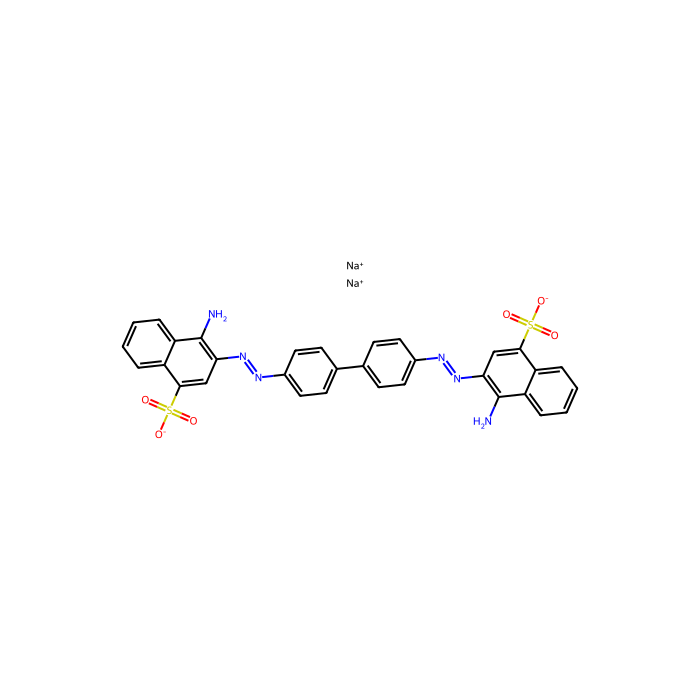
Brief overview: Congo red is a classical diazo anionic dye (disodium salt) comprising two azo (–N=N–) linkages connecting para-aminonaphthalene-1-sulfonate units through a 4,4′-biphenyl core. It bears two sulfonate groups (as disodium sulfonates) that impart high water solubility.
Item-specific identifiers (from Product Data)
Structural features (general/literature)
Common synonyms (literature): Direct Red 28; C.I. 22120; Sodium salt of benzidinediazo-bis-1-naphthylamine-4-sulfonic acid.
Congo red is principally a chromogenic probe rather than a building block. Nevertheless, its functional groups and supramolecular behavior can be synthetically useful in analytical/synthetic workflows (literature/general).
Functional group reactivity
Roles in synthesis/analysis
Limitations
Not applicable. This product is a small-molecule dye, not a biological targeting reagent (e.g., antibody, ligand with defined target selectivity provided by the manufacturer). No antigen/epitope, species reactivity, clone, or isotype information applies. For usage contexts where Congo red binds structured biomaterials (e.g., amyloid fibrils) or cationic polymers, see Reaction & Applications and Biological Roles for general literature-based behavior.