
Determine the necessary mass, volume, or concentration for preparing a solution.
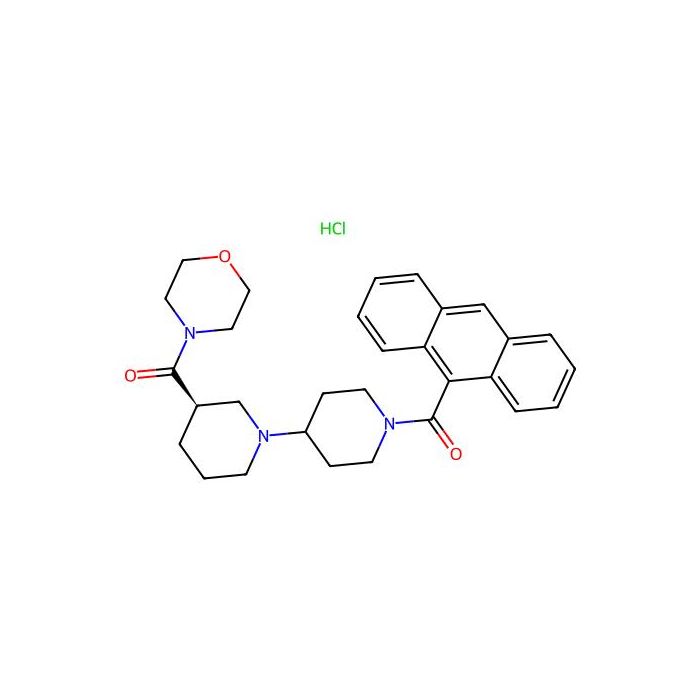
CP-640186 hydrochloride - ≥99% , CAS No.591778-70-0
Disponible para pedir
GRADE & PURITY ≥99%
Storage
Store at 2-8°C,Desiccated
Shipped In
Wet ice
≥99% for sensitive chromatographic and analytical workflows requiring minimal baseline interference.
Store at 2-8°C,Desiccated Ships Wet ice Check lot-specific COA for exact specifications.
SDS, COA, datasheet, and spec sheet available for download. Lot-specific COA accessible via lot number lookup.
Cited in 0 peer-reviewed publications across chromatography, organic synthesis, and cross-coupling reactions.
CP-640186 hydrochloride is an orally active and cell-permeable Acetyl-CoA carboxylase ( ACC ) inhibitor with IC 50 s of 53 nM and 61 nM for rat liver ACC1 and rat skeletal muscle ACC2 respectively. Acetyl-CoA carboxylase (ACC) is a key enzyme of fatty acid metabolism that enables the synthesis of malonyl-CoA. CP-640186 hydrochloride can also stimulate muscle fatty acid oxidation
In Vitro
CP-640186 (20 µM; 48 h) treatment can inhibit H460 cell growth. CP-640186 (0.1 nM-100 µM; 2 h) treatment increases fatty acid metabolism in a concentration-dependent manner in C2C12 cells and muscle strips. CP-640186 (0.62-1.8 µM; 2 h) treatment inhibits fatty acid synthesis and TG synthesis in HepG2 cells. MCE has not independently confirmed the accuracy of these methods. They are for reference only. Cell Proliferation AssayCell Line: Human fibroblasts and H460 cells Concentration: 20 µM Incubation Time: 48 hours Result: Led to a ∼30% decrease in cell number compared to vehicle-treated controls. Cell Viability AssayCell Line: C2C12 cells and muscle strips Concentration: 0.1 nM-100 µM Incubation Time: 2 hours Result: Stimulated palmitate acid oxidation with an EC 50 of 57 nM and a maximal stimulation of 280% in C2C12 cells. Stimulated palmitate acid oxidation with an EC 50 of 1.3 μM and a maximal stimulation of 240% in isolated rat epitrochlearis muscle. Cell Viability AssayCell Line: HepG2 cells Concentration: 0.62-1.8 µM Incubation Time: 6 hours Result: Inhibited fatty acid synthesis and TG synthesis in HepG2 cells with EC 50 s of 0.62 μM and 1.8 μM, respecticely.
In Vivo
CP-640186 (oral gavage; 4.6-21 mg/kg; once) demonstrates acute efficacy . CP-640186 (intravenous injection and oral gavage; Intravenous dose, 5 mg/kg; oral dose, 10 mg/kg; once) shows lowe drug exposure in the rat than the ob/ob mouse at equal doses . CP-640186 (oral gavage; 100 mg/kg; once) treatment shows a complete shift from carbohydrate utilization to fatty acid utilization as a source of energy at high exposure level . MCE has not independently confirmed the accuracy of these methods. They are for reference only. Animal Model: Male ob/ob mice Dosage: 4.6-21 mg/kg Administration: Oral gavage; 4.6-21 mg/kg; once Result: Demonstrated acute efficacy for up to 8 h after oral administration, exhibiting ED 50 values of 4.6, 9.7, and 21 mg/kg, at 1, 4, and 8 h, respectively, after treatment. Animal Model: Male Sprague-Dawley rats Dosage: Intravenous dose, 5 mg/kg; oral dose, 10 mg/kg Administration: Intravenous injection and oral gavage; intravenous dose, 5 mg/kg; oral dose, 10 mg/kg; once Result: Showed a plasma half-life of 1.5 h, a bioavailability of 39%, a Cl p of 65 ml/min/kg, a V dss of 5 liters/kg, an oral T max of 1.0 h, an oral C max of 345 ng/mL, and an oral AUC 0-∞ of 960 ng•h/mL. Animal Model: Male ob/ob mice Dosage: Intravenous dose, 5 mg/kg; oral dose, 10 mg/kg Administration: Intravenous injection and oral gavage; Intravenous dose, 5 mg/kg; oral dose, 10 mg/kg; once Result: Showed a plasma half-life of 1.1 h, a bioavailability of 50%, a Cl p of 54 ml/min/kg, an oral T max of 0.25 h, an oral C max of 2177 ng/mL, and an oral AUC 0-∞ of 3068 ng•h/mL. Animal Model: Twenty male Sprague-Dawley rats (350-400 g) fasted and then refed a high sucrose diet for 2 days; additional eight rats fasted for 24 h Dosage: 100 mg/kg Administration: Oral gavage; 100 mg/kg; once Result: Resulted in time-dependent reductions in RQ (a ratio of CO 2 production to O 2 consumption) of up to 64%.
Form:Solid
IC50& Target:IC50: 53 nM (rat liver ACC1) and 61 nM (rat skeletal muscle ACC2)
| Sonrisas canónicas | C1CC(CN(C1)C2CCN(CC2)C(=O)C3=C4C=CC=CC4=CC5=CC=CC=C53)C(=O)N6CCOCC6.Cl |
|---|---|
| IUPAC Name | [(3R)-1-[1-(anthracene-9-carbonyl)piperidin-4-yl]piperidin-3-yl]-morpholin-4-ylmethanone;hydrochloride |
| InChIKey | DUBNXJIOBFRASV-GJFSDDNBSA-N |
| INCHI | 1S/C30H35N3O3.ClH/c34-29(32-16-18-36-19-17-32)24-8-5-13-33(21-24)25-11-14-31(15-12-25)30(35)28-26-9-3-1-6-22(26)20-23-7-2-4-10-27(23)28;/h1-4,6-7,9-10,20,24-25H,5,8,11-19,21H2;1H/t24-;/m1./s1 |
| Isómeros SMILES | C1C[C@H](CN(C1)C2CCN(CC2)C(=O)C3=C4C=CC=CC4=CC5=CC=CC=C53)C(=O)N6CCOCC6.Cl |
| PubChem CID | 23589188 |
| Peso molecular | 522.08 |
Comprehensive hazard, handling, storage, and regulatory compliance document.
Download SDS →Lot-specific quality data. Enter your lot number to retrieve the exact COA.
Look up COA →Full quality attributes and acceptance criteria for this grade.
View spec sheet →Taxonomy Tree
| Kingdom | Organic compounds |
|---|---|
| Superclass | Benzenoids |
| Clase | Anthracenes |
| Subclass | Anthracenecarboxylic acids and derivatives |
| Intermediate Tree Nodes | Not available |
| Direct Parent | Anthracenecarboxylic acids and derivatives |
| Alternative Parents | N-benzoylpiperidines Naphthalenecarboxamides Piperidinecarboxamides Aminopiperidines Morpholines Tertiary carboxylic acid amides Trialkylamines Amino acids and derivatives Oxacyclic compounds Dialkyl ethers Azacyclic compounds Organic oxides Hydrochlorides Hydrocarbon derivatives Carbonyl compounds |
| Molecular Framework | Aromatic heteropolycyclic compounds |
| Substituents | Anthracene carboxylic acid or derivatives - N-benzoylpiperidine - 1-naphthalenecarboxamide - 1-naphthalenecarboxylic acid or derivatives - N-acyl-piperidine - Piperidinecarboxamide - 3-piperidinecarboxamide - 4-aminopiperidine - Morpholine - Piperidine - Oxazinane - Tertiary carboxylic acid amide - Amino acid or derivatives - Carboxamide group - Tertiary aliphatic amine - Tertiary amine - Carboxylic acid derivative - Dialkyl ether - Ether - Oxacycle - Azacycle - Organoheterocyclic compound - Organic oxygen compound - Organic nitrogen compound - Amine - Hydrocarbon derivative - Organic oxide - Hydrochloride - Carbonyl group - Organooxygen compound - Organonitrogen compound - Aromatic heteropolycyclic compound |
| Descripción | This compound belongs to the class of organic compounds known as anthracenecarboxylic acids and derivatives. These are organic compounds containing a carboxylic acid group (or a derivative thereof) attached to an anthracene ring system. |
| External Descriptors | Not available |
| Solubilidad | H2O : 50 mg/mL (95.77 mM; Need ultrasonic) DMSO : ≥ 48 mg/mL (91.94 mM) |
|---|---|
| Peso molecular | 522.100 g/mol |
| XLogP3 | |
| Hydrogen Bond Donor Count | 1 |
| Hydrogen Bond Acceptor Count | 4 |
| Rotatable Bond Count | 3 |
| Exact Mass | 521.245 Da |
| Monoisotopic Mass | 521.245 Da |
| Topological Polar Surface Area | 53.100 Ų |
| Heavy Atom Count | 37 |
| Formal Charge | 0 |
| Complexity | 753.000 |
| Isotope Atom Count | 0 |
| Defined Atom Stereocenter Count | 1 |
| Undefined Atom Stereocenter Count | 0 |
| Defined Bond Stereocenter Count | 0 |
| Undefined Bond Stereocenter Count | 0 |
| The total count of all stereochemical bonds | 0 |
| Covalently-Bonded Unit Count | 2 |