Determine the necessary mass, volume, or concentration for preparing a solution.
≥98% for sensitive chromatographic and analytical workflows requiring minimal baseline interference.
Conservar a 2-8°C Ships Hielo húmedo Check lot-specific COA for exact specifications.
SDS, COA, datasheet, and spec sheet available for download. Lot-specific COA accessible via lot number lookup.
Cited in 0 peer-reviewed publications across chromatography, organic synthesis, and cross-coupling reactions.
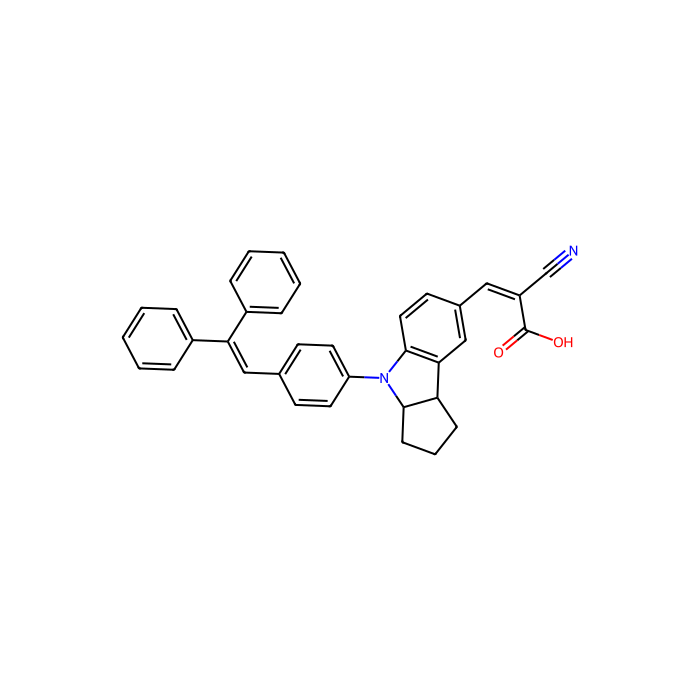
El colorante D131 es un colorante orgánico a base de indolina que tiene una gran brecha de banda y puede utilizarse como sensibilizador en electrónica orgánica. Presenta una eficiencia de conversión de energía del 5,6% y puede mejorar la fotoexcitación de los dispositivos electroquímicos.
Aplicación del producto
El D131 puede utilizarse en células solares sensibilizadas por colorantes (DSSC) como fotosensibilizador con alta movilidad de carga y coeficiente de absorción.
Colorante orgánico fotosensible de color amarillo que tiene una excelente eficiencia de conversión fotoeléctrica como colorante sin metal,
Mejora significativa de la eficiencia de conversión (11,1%) de células solares sensibilizadas por colorante negro mediante cosensibilización con colorante D131
| Pubchem Sid | 504771643 |
|---|---|
| Pubchem Sid Url | https://pubchem.ncbi.nlm.nih.gov/substance/504771643 |
| Sonrisas canónicas | C1CC2C(C1)N(C3=C2C=C(C=C3)C=C(C#N)C(=O)O)C4=CC=C(C=C4)C=C(C5=CC=CC=C5)C6=CC=CC=C6 |
| IUPAC Name | (E)-2-cyano-3-[4-[4-(2,2-diphenylethenyl)phenyl]-2,3,3a,8b-tetrahydro-1H-cyclopenta[b]indol-7-yl]prop-2-enoic acid |
| InChIKey | GOTRYMLNXIJMCB-VFCFBJKWSA-N |
| INCHI | 1S/C35H28N2O2/c36-23-28(35(38)39)20-25-16-19-34-32(22-25)30-12-7-13-33(30)37(34)29-17-14-24(15-18-29)21-31(26-8-3-1-4-9-26)27-10-5-2-6-11-27/h1-6,8-11,14-22,30,33H,7,12-13H2,(H,38,39)/b28-20+ |
| Isómeros SMILES | C1CC2C(C1)N(C3=C2C=C(C=C3)/C=C(\C#N)/C(=O)O)C4=CC=C(C=C4)C=C(C5=CC=CC=C5)C6=CC=CC=C6 |
| Peso molecular | 508.62 |
| Reaxy-Rn | 18884319 |
| Reaxys-RN_link_address | https://www.reaxys.com/reaxys/secured/hopinto.do?context=S&query=IDE.XRN=18884319&ln= |
Comprehensive hazard, handling, storage, and regulatory compliance document.
Download SDS →Lot-specific quality data. Enter your lot number to retrieve the exact COA.
Look up COA →Full quality attributes and acceptance criteria for this grade.
View spec sheet →Taxonomy Tree
| Kingdom | Organic compounds |
|---|---|
| Superclass | Phenylpropanoids and polyketides |
| Clase | Stilbenes |
| Subclass | Not available |
| Intermediate Tree Nodes | Not available |
| Direct Parent | Stilbenes |
| Alternative Parents | Diphenylmethanes Alkyldiarylamines 2,3-Cyclopentanoindolines Styrenes Aniline and substituted anilines Aralkylamines Amino acids Nitriles Monocarboxylic acids and derivatives Carboxylic acids Azacyclic compounds Organopnictogen compounds Organic oxides Hydrocarbon derivatives Carbonyl compounds |
| Molecular Framework | Aromatic heteropolycyclic compounds |
| Substituents | Stilbene - Diphenylmethane - Alkyldiarylamine - 2,3-cyclopentanoindoline - Indole or derivatives - Aniline or substituted anilines - Tertiary aliphatic/aromatic amine - Styrene - Aralkylamine - Benzenoid - Monocyclic benzene moiety - Amino acid - Tertiary amine - Amino acid or derivatives - Azacycle - Organoheterocyclic compound - Nitrile - Carbonitrile - Monocarboxylic acid or derivatives - Carboxylic acid - Carboxylic acid derivative - Organic nitrogen compound - Organic oxygen compound - Organopnictogen compound - Organic oxide - Hydrocarbon derivative - Organooxygen compound - Organonitrogen compound - Carbonyl group - Amine - Aromatic heteropolycyclic compound |
| Descripción | This compound belongs to the class of organic compounds known as stilbenes. These are organic compounds containing a 1,2-diphenylethylene moiety. Stilbenes (C6-C2-C6 ) are derived from the common phenylpropene (C6-C3) skeleton building block. The introduction of one or more hydroxyl groups to a phenyl ring lead to stilbenoids. |
| External Descriptors | Not available |
Find and download the COA for your product by matching the lot number on the packaging.
| Lot Number | Certificate Type | Fecha | Articulo |
|---|---|---|---|
| Certificate of Analysis | Jun 16, 2023 | D155501 | |
| Certificate of Analysis | Jun 16, 2023 | D155501 | |
| Certificate of Analysis | Jun 16, 2023 | D155501 | |
| Certificate of Analysis | Jun 16, 2023 | D155501 | |
| Certificate of Analysis | Jun 16, 2023 | D155501 | |
| Certificate of Analysis | Jun 16, 2023 | D155501 | |
| Certificate of Analysis | Jun 16, 2023 | D155501 |
| Solubilidad | DMF: soluble DMSO: soluble THF: soluble acetone: soluble chloroform: soluble ethanol: soluble methanol: soluble water: insoluble λmax:425 nm in methanol |
|---|---|
| Punto de fusión (°C) | 230 - 235 °C |
| Peso molecular | 508.600 g/mol |
| XLogP3 | 8.400 |
| Hydrogen Bond Donor Count | 1 |
| Hydrogen Bond Acceptor Count | 4 |
| Rotatable Bond Count | 6 |
| Exact Mass | 508.215 Da |
| Monoisotopic Mass | 508.215 Da |
| Topological Polar Surface Area | 64.300 Ų |
| Heavy Atom Count | 39 |
| Formal Charge | 0 |
| Complexity | 950.000 |
| Isotope Atom Count | 0 |
| Defined Atom Stereocenter Count | 0 |
| Undefined Atom Stereocenter Count | 2 |
| Defined Bond Stereocenter Count | 1 |
| Undefined Bond Stereocenter Count | 0 |
| The total count of all stereochemical bonds | 1 |
| Covalently-Bonded Unit Count | 1 |