Determine the necessary mass, volume, or concentration for preparing a solution.
BioReagent, ≥80%(HPLC) BioReagent for sensitive chromatographic and analytical workflows requiring minimal baseline interference.
Protected from light,Store at -20°C,Desiccated Ships Ice chest + Ice pads Check lot-specific COA for exact specifications.
SDS, COA, datasheet, and spec sheet available for download. Lot-specific COA accessible via lot number lookup.
Cited in 3 peer-reviewed publications across chromatography, organic synthesis, and cross-coupling reactions.
Deoxyribonucleic acid sodium salt is a biochemical reagent commonly used in scientific research and production fields. Sodium deoxyribonucleic acid is mainly used as a reference reagent and is widely used in experimental research in fields such as molecular biology and genetics.
PROPERTIES
From a technical perspective, sodium deoxyribonucleic acid is the sodium salt form of DNA, which has good water solubility and stability, and is suitable as a standard or control substance in experiments. In application scenarios, it is commonly used in molecular biology experiments such as PCR, gene cloning, sequencing, and can also be used for drug development and production of biotechnology products.
USAGE
In DNA extraction experiments, salt solutions (such as NaCl) neutralize DNA charges, regulate solubility, and promote DNA precipitation for subsequent extraction.
APPLICATION
Widely used in the biomedical field for wound repair, skin regeneration, and anti-aging products, the main application scenarios cover drugs, skincare products, and tissue repair materials, involving sub fields such as medical aesthetics, cosmetics, and healthcare.
ATTENTION
1. For your safety and health, please wear a lab coat and disposable gloves;
2. When using, it is necessary to operate under sterile conditions to avoid contamination;
3. It is recommended to use sterile deionized water for dissolution, and adjust the concentration according to experimental requirements.
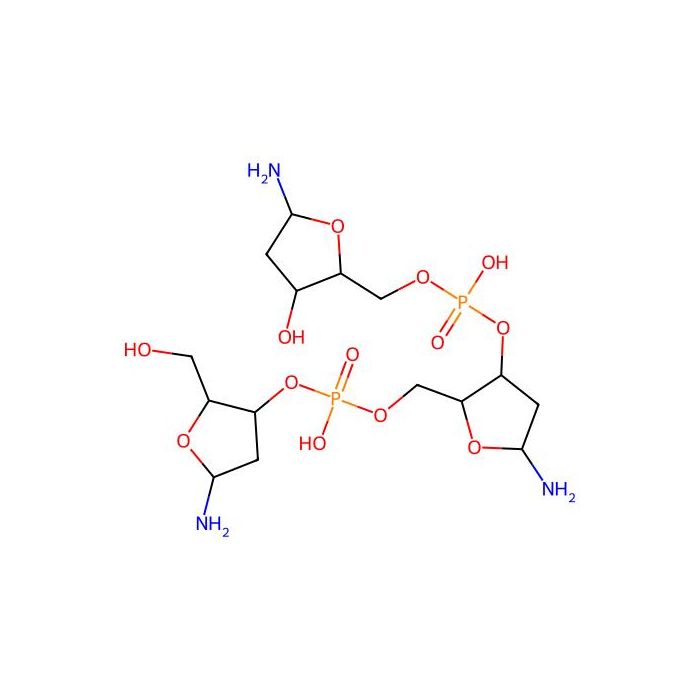
| Isómeros SMILES | C1C(C(OC1N)COP(=O)(O)OC2CC(OC2COP(=O)(O)OC3CC(OC3CO)N)N)O |
|---|---|
| RTECS | HG1933000 |
| PubChem CID | 44135672 |
Comprehensive hazard, handling, storage, and regulatory compliance document.
Download SDS →Lot-specific quality data. Enter your lot number to retrieve the exact COA.
Look up COA →Full quality attributes and acceptance criteria for this grade.
View spec sheet →| 1. Lingjie Meng, Chengqiang Xu, Tianhui Liu, Hua Li, Qinghua Lu, Jiangang Long. (2015) One-pot synthesis of highly cross-linked fluorescent polyphosphazene nanoparticles for cell imaging. Polymer Chemistry, 6 (16): (3155-3163). [PMID:] [10.1039/C5PY00196J] |
| 2. Fusheng Luo, Xin Qi, Qing Wu, Jinlong Zhang, Song Yang, Xiude Liu, Zeyu Yan, Jun Huang. (2025) Molecular recognition interfaces driving homogeneous zinc deposition for superior Zn metal anode. GREEN CHEMISTRY, [PMID:] [10.1039/D5GC02826D] |
| 3. Xin Mao, Bin Liu, Liu Yang, Nan Li, Guangchao Li, Pengwei Yan. (2025) Promoting effect of Far-UVC on the oxidation of diatrizoic acid in secondary effluent by heterogeneous MoS2/peroxymonosulfate catalysis. Journal of Environmental Chemical Engineering, [PMID:] [10.1016/j.jece.2025.119602] |
Our grade selection guide covers purity, stabilizer status, and application suitability for all variants in our catalog.
View BioReagent grade guide →