CALIDAD & PUREZATechnical grade?Technical grade — industrial-quality purity with no tight impurity guarantees. Use for large-scale or non-critical processes where cost matters most.
This compound belongs to the class of organic compounds known as benzene and substituted derivatives. These are aromatic compounds containing one monocyclic ring system consisting of benzene.
External Descriptors
Not available
1. Djoumbou Feunang Y, Eisner R, Knox C, Chepelev L, Hastings J, Owen G, Fahy E, Steinbeck C, Subramanian S, Bolton E, Greiner R, and Wishart DS. ClassyFire: Automated Chemical Classification With A Comprehensive, Computable Taxonomy. Journal of Cheminformatics, 2016, 8:61.
Determine the necessary mass, volume, or concentration for preparing a solution.
Dilution Calculator
Determine the dilution needed to prepare a stock solution.
Reconstitution Calculator
Reseñas
Reseñas de cliente
Application Protocols
No assay-specific protocols (e.g., WB, IHC, IF, FC) apply to this small-molecule reagent.
Practical laboratory guidance:
For air/moisture-sensitive transformations, degas solvents and maintain an inert atmosphere (N2/Ar).
Monitor reactions by 31P NMR where feasible to track conversion and oxidation state.
For workups, minimize acidic silica exposure if benzyl cleavage or transesterification is a concern; pre-neutralized silica or rapid chromatography can help.
Biological Roles
This product is an organophosphorus reagent intended for chemical synthesis. No specific biological role is associated with dibenzyl phosphite.
General context (literature):
Dialkyl phosphites are synthetic intermediates used to access phosphonates, phosphinates, and related P‑containing motifs found in biochemical probe design and agrochemical scaffolds.
The benzyl ester groups are typically used for protecting-group and solubility considerations in synthetic sequences rather than for any innate biological function.
Metabolism/biocompatibility:
Not recognized as a natural metabolite; hydrolysis or oxidation could yield benzyl alcohol and inorganic/organic phosphate derivatives under harsh conditions, but such processes are not biological functions and are not the intended use.
This product is designated For research use only and is not intended for food, drug, or household use.
Buffer Applications
Dibenzyl phosphite is a hydrophobic organophosphorus reagent and is not used to prepare aqueous laboratory buffers. It has no typical role in pH buffering, electrophoresis, or cell culture media.
Practical note: If an aqueous workup is required after reaction, standard neutral or mildly basic aqueous washes can be used to remove residual acids/bases, followed by extraction into an organic solvent. Avoid strong acid/base aqueous phases if preservation of benzyl esters is critical.
Green Alternatives
Choice of phosphite and solvent can influence the EHS profile of your synthesis. Consider the following general alternatives and trade-offs (literature-based; not item-specific recommendations):
Diethyl phosphite: lower molecular weight, typically lower viscosity and good availability; reduced aromatic content versus dibenzyl phosphite; often performs similarly in Pudovik/Kabachnik–Fields chemistry. Trade-off: different sterics/electronics can alter selectivity or rate; product deprotection profile differs (ethyl vs benzyl).
Dimethyl phosphite: higher volatility and good reactivity; easier removal of methanol byproducts. Trade-off: more flammable/volatile; methoxy group may be less desirable in some protecting-group strategies.
Solvent perspective for common reactions:
Replace chlorinated solvents (e.g., DCM in Atherton–Todd) with 2‑MeTHF, CPME, or toluene where feasible; evaluate reactivity and selectivity.
For Pd-catalyzed couplings, explore bio-based solvents (Cyrene, 2‑MeTHF) or propylene carbonate versus DMF/DMAc, balancing catalyst stability and solubility.
Energy and waste minimization:
Consider solvent-free or micellar conditions for Pudovik/Kabachnik–Fields reactions.
Apply catalyst recycling in Hirao couplings and continuous-flow setups to reduce solvent and energy usage.
Note: Validate any substitution through small-scale screening; changes in alcohol leaving group (benzyl vs ethyl/methyl) impact downstream deprotection and overall route greenness.
Pharmaceutical Uses
No direct excipient or pharmacopeial role is indicated for dibenzyl phosphite.
General formulation context (literature):
Organophosphite esters like dibenzyl phosphite are primarily used as synthetic intermediates to build phosphorus-containing functionalities; they are not typical formulation excipients.
The benzyl groups can be leveraged as temporary protecting groups in API intermediate synthesis, removable by hydrogenolysis.
This product is provided For research use only and is not intended for human or veterinary use.
Physical Properties
Item-specific specifications are not provided in the Product Data. Do not treat the following as product specifications; they are general literature descriptors for dibenzyl phosphite.
Item-specific values from Product Data:
Appearance: Not specified for this item; refer to CoA/Spec Sheet.
Molecular weight: Not specified for this item; refer to CoA/Spec Sheet.
Literature/computed properties (general guidance, not specifications):
Physical state: typically a colorless to pale yellow liquid or low-melting solid (literature, varies with purity and temperature).
Density, boiling point, melting point, refractive index: Not reliably consolidated in a single primary source; consult SDS or primary literature for exact values.
Solubility (qualitative, literature):
Miscible or highly soluble in common organic solvents (e.g., toluene, dichloromethane, THF, ethyl acetate, acetone, alcohols).
Practically insoluble in water; may hydrolyze slowly in protic media under acidic/basic conditions.
Acidity/basicity: P–H bond is mildly acidic (pKa typically in the 8–11 range for dialkyl phosphites; exact pKa for the benzyl diester not firmly established in open sources).
Partitioning: Aromatic, moderately lipophilic character expected due to two benzyl groups (qualitative literature expectation).
Always confirm critical parameters experimentally for your process design.
Quality and Grades
Item-specific quality:
Grade/Purity: Technical grade (per Product Data).
What “Technical grade” generally implies (general guidance):
Suitable for many synthetic and process-development applications where ultra-low impurity profiles (e.g., for analytical or semiconductor use) are not required.
Typical controls focus on identity and bulk purity; trace-level specifications (e.g., UV cutoff, water content, residual metals, stabilizer content) are commonly not guaranteed.
Batch-to-batch variability can be higher than for ACS/AR/HPLC grades.
Stabilizers/additives:
Not specified for this item; refer to CoA/Spec Sheet.
When to consider higher grades:
Moisture- or oxidation-sensitive transformations (e.g., metal-catalyzed P–C couplings, Atherton–Todd chlorination with low background) may benefit from additional purification (distillation under reduced pressure, drying over molecular sieves) or sourcing a higher assay grade if available.
Documentation:
For any regulated or critical application, request the CoA/Spec Sheet for lot-specific assay, appearance, and impurity information.
Note: This product is designated “For research use only” (per Product Data).
Reaction and Applications
The P–H functionality and nucleophilic phosphorus center in dibenzyl phosphite enable diverse organophosphorus transformations.
Representative reaction families (literature):
Atherton–Todd reaction: Conversion to dibenzyl phosphorochloridate using CCl4 or C2Cl6 and a base (e.g., Et3N), providing an activated P(V) chloride for subsequent coupling with alcohols, phenols, or amines.
Michaelis–Arbuzov-type alkylation: Alkylation at phosphorus with suitable alkyl halides to furnish dibenzyl alkylphosphonates (conditions vary; iodides/bromides preferred; elevated temperature or phase-transfer catalysis).
Pudovik addition: Nucleophilic addition of the P–H bond to aldehydes/activated ketones to form α‑hydroxyphosphonates; typically base- or Lewis acid-catalyzed.
Kabachnik–Fields (three-component): P–H addition to imines formed in situ from aldehydes/ketones and amines, yielding α‑aminophosphonates.
Hirao coupling: Pd-catalyzed cross-coupling of aryl halides (or pseudohalides) with dialkyl phosphites to generate aryl phosphonates (often requires base, ligand, and anhydrous polar aprotic solvent).
Radical hydrophosphinylation of alkenes/alkynes under peroxide/photoredox initiation to introduce phosphonyl groups across C=C/C≡C.
Practical notes:
Remove dissolved oxygen (argon sparge, freeze–pump–thaw) to limit oxidation to phosphate.
Control bases/acids to avoid transesterification or benzyl cleavage; benzyl groups are stable to many neutral conditions but can be labile under strong acids/bases or hydrogenolysis.
Water minimization is key for consistent yields in P–C and P–O bond-forming reactions.
Reaction Conditions
The following conditions are representative literature guidelines for dialkyl phosphites and should be optimized for dibenzyl phosphite; they are not product specifications.
Atherton–Todd chlorination to phosphorochloridate:
Reagents: CCl4 or C2Cl6 (or N‑chlorosuccinimide variants), base (Et3N, pyridine).
Solvent: DCM, CHCl3, toluene, or MeCN; dry conditions.
Temperature: 0–25 °C initial addition, then 20–40 °C until complete.
Notes: Exclude moisture; subsequent coupling with alcohols/amines proceeds readily.
Pudovik addition to aldehydes:
Catalyst: tertiary amines, DBU, or Lewis acids (e.g., TiCl4, ZnCl2) depending on substrate.
Solvent: toluene, MeCN, ethanol, or solvent-free.
Temperature: 0–25 °C for reactive aldehydes; up to 60 °C for less reactive ketones.
Typical times: 1–24 h; monitor by 31P NMR/ TLC.
Kabachnik–Fields (three-component):
Components: amine + carbonyl + phosphite.
Catalysts: acid (e.g., H3PO4), Lewis acids, or organocatalysts.
Conditions: solvent-free or MeCN/EtOH, 25–80 °C.
Hirao coupling (aryl halide + phosphite):
Catalyst: Pd(PPh3)4 or Pd(OAc)2 with P-ligands; base (Et3N, K2CO3, Cs2CO3).
Solvent: DMF, DMAc, dioxane, or toluene; inert atmosphere.
Conditions: neat or polar aprotic solvent; 60–140 °C depending on substrate.
Always confirm compatibility of benzyl esters with acids/bases and any hydrogenolytic steps downstream.
Safety and Handling
Authoritative safety classification for this item is not provided in the Product Data. The following are general precautions for dialkyl phosphites; defer to the product SDS for definitive guidance.
Item-specific hazard data:
Signal word: Not specified for this item; refer to SDS.
Hazard statements (H-codes): Not specified for this item; refer to SDS.
GHS classification and pictograms: Not specified for this item; refer to SDS.
General hazards (literature/analogous materials):
May cause skin/eye irritation and respiratory tract irritation upon vapor/aerosol exposure.
Can undergo slow oxidation in air to phosphate species; avoid strong oxidizers.
Reactivity: Dialkyl phosphites are nucleophilic at phosphorus and can react with acid chlorides (Atherton–Todd conditions), strong bases/acids, and halogenating agents.
Handling recommendations (best practice):
Use in a fume hood. Wear appropriate PPE: lab coat, safety glasses or face shield, and nitrile gloves.
Avoid inhalation and contact with skin/eyes. Prevent prolonged exposure to air if oxidation is a concern for your application.
Skin/eye contact: Rinse with copious water for ≥15 min; remove contaminated clothing; seek medical attention if irritation persists.
Inhalation: Move to fresh air; seek medical attention if symptoms occur.
Ingestion: Rinse mouth; do not induce vomiting; seek medical attention.
Always consult the current SDS before use.
Solvent Selection
Dibenzyl phosphite is an aromatic dialkyl phosphite that behaves as a moderately polar, aprotic organic reagent. It dissolves well in many organic solvents, enabling flexible solvent choices driven by the transformation.
Pudovik/Kabachnik–Fields additions: solvent-free, toluene, MeCN, or ethanol depending on catalyst system; temperature control limits side reactions.
Arbuzov-type alkylation: often neat or in high-boiling aprotics; avoid protic solvents.
Practical tips:
Ensure solvents are dry and oxygen-lean to minimize oxidation of the phosphite to phosphate.
Avoid strongly basic alcoholic media if retention of benzyl esters is required (to prevent transesterification).
Comparison note: Relative to dimethyl/diethyl phosphite, the dibenzyl derivative is more lipophilic and often better soluble in aromatic solvents (toluene, xylene).
Storage and Reconstitution
Item-specific storage and shipping (from Product Data):
Storage Conditions: Room temperature.
Shipped In: Normal.
General handling/storage best practices (literature; not to override label instructions):
Store tightly sealed to limit air/moisture ingress; consider an inert gas blanket (N2/Ar) for long-term storage to minimize oxidation of phosphite to phosphate.
Keep away from strong oxidizers, acids, and bases.
If crystallization or viscosity increases at lower temperatures, gentle warming and mixing can restore homogeneity.
Reconstitution: Not applicable; product is typically supplied neat. If solidification occurs, warm mildly (e.g., 30–40 °C water bath) and mix to ensure uniformity before dispensing.
Shelf-life considerations:
Monitor for peroxide is generally not necessary for phosphites; instead, watch for oxidation to phosphate (31P NMR diagnostic). If sensitivity is critical, test a small aliquot before use.
Always refer to the product CoA/Spec Sheet and SDS for lot-specific storage and handling guidance.
Structure and Identity
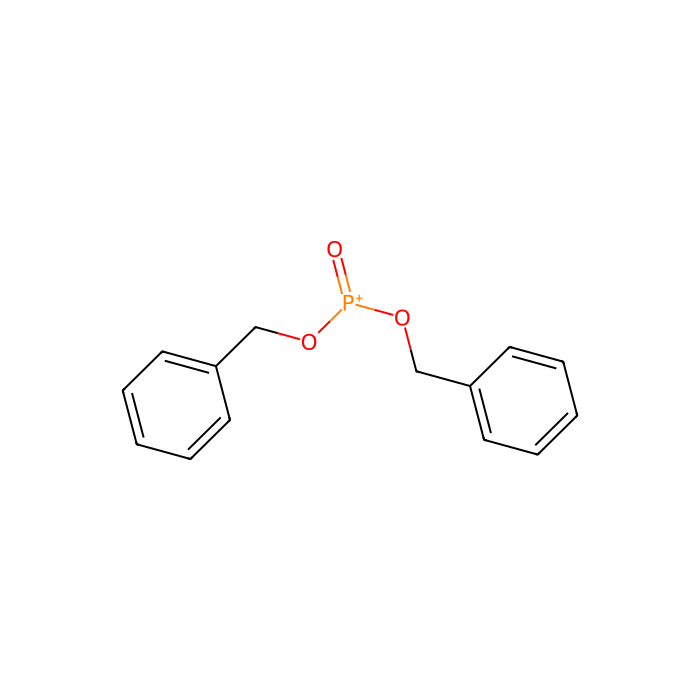
Dibenzyl phosphite is an organophosphorus H‑phosphonate diester bearing two benzyl oxy substituents and a P–H bond.
Item-specific identifiers (from Product Data):
CAS: 17176-77-1
CID (PubChem): 6334615
InChIKey: 323228 (as provided)
SKU: D131927
Grade: Technical grade
Literature/computed identifiers and structural description (general information):
Molecular formula (literature/computed): C14H15O3P
Core functional groups: phosphoryl (P=O), two benzyl ether substituents (–O–CH2–Ph), and a P–H bond characteristic of dialkyl phosphites (H‑phosphonates).
2D structure (verbal): A central tetra-coordinated phosphorus bears a doubly bonded oxygen (P=O), two single-bonded oxygens each linking to a benzylic methylene that connects to a phenyl ring, and one P–H substituent.
Stereochemistry: None (achiral phosphorus center in the ground state; no stereogenic centers in substituents).
Synthetic Utility
Dibenzyl phosphite is a versatile H‑phosphonate diester for constructing P–C, P–O, and P–N bonds.
Functional group reactivity (literature):
Nucleophilic P(III) center: engages electrophiles (alkyl/benzyl halides) to form phosphonates (Arbuzov-type) or, under Atherton–Todd conditions, converts to phosphorochloridates for further derivatization.
P–H bond: undergoes base- or radical-initiated addition across C=O (Pudovik) and C=N (Kabachnik–Fields), enabling α‑hydroxy- and α‑aminophosphonate synthesis.
Transition-metal coupling: Pd-catalyzed Hirao coupling with aryl/vinyl halides provides aryl/vinyl phosphonates; Cu- or Ni-catalyzed variants exist.
Protecting-group considerations:
Benzyl esters offer synthetic advantages: improved solubility in aromatic solvents and orthogonal deprotection by hydrogenolysis (Pd/C, H2) compared with alkyl esters that require harsher conditions.
Retrosynthetic value:
Serves as a unified P(III) synthon convertible to diverse P(V) derivatives (phosphonates, phosphates, phosphoramidates) by oxidation, chlorination, or substitution.
Workup/purification tips:
Minimize air/moisture exposure to limit oxidation/hydrolysis.
Residual benzyl alcohol (from side hydrolysis/transesterification) can often be removed by vacuum co-evaporation or silica chromatography (monitor for acid-catalyzed decomposition on silica).
Target Specificity
Not applicable. This product is a small-molecule reagent and does not possess biological target specificity, epitopes, or clone/isotype attributes. See Reaction & Applications and Synthetic Utility for relevant use cases.
¿Necesita ayuda para elegir la calidad?
Nuestra guía de selección de calidades cubre la pureza, el estado del estabilizador y la idoneidad de la aplicación para todas las variantes de nuestro catálogo.
Utilizamos cookies para garantizar el correcto funcionamiento del sitio web y, cuando esté permitido, para mejorar su experiencia. Puede gestionar sus preferencias en cualquier momento en Configuración. Más información en nuestra Política de Cookies.
¿Quieres que te enviemos un mensaje cuando tengamos descuentos disponibles?
Recordármelo más tarde
¡Gracias! Por favor, revisa tu bandeja de entrada de correo electrónico para confirmar.
Products are supplied to verified businesses, institutions, and qualified professionals for research and development use only. Not for use in humans, animals, diagnosis, or therapy.

 J2019158