This compound belongs to the class of organic compounds known as dicarboxylic acids and derivatives. These are organic compounds containing exactly two carboxylic acid groups.
External Descriptors
Not available
1. Djoumbou Feunang Y, Eisner R, Knox C, Chepelev L, Hastings J, Owen G, Fahy E, Steinbeck C, Subramanian S, Bolton E, Greiner R, and Wishart DS. ClassyFire: Automated Chemical Classification With A Comprehensive, Computable Taxonomy. Journal of Cheminformatics, 2016, 8:61.
Determine the necessary mass, volume, or concentration for preparing a solution.
Dilution Calculator
Determine the dilution needed to prepare a stock solution.
Reconstitution Calculator
Reseñas
Reseñas de cliente
Application Protocols
No manufacturer-validated biological or analytical application protocols are provided for this item.
Item-specific protocols: Not specified for this item; refer to CoA/Spec Sheet.
General lab protocol examples (literature/guidance; adapt as needed)
α-Alkylation setup: Dry glassware; charge solvent (THF), cool to −78 °C; add base (LDA) then diethyl 2,2-dimethylmalonate; stir 30–60 min; add electrophile dropwise; warm to 0–25 °C; quench with sat. NH4Cl; extract, dry, concentrate; purify by distillation or silica gel.
Hydrolysis/decarboxylation: Stir alkylated malonate in aq. NaOH/EtOH at 0–25 °C until saponified; acidify to pH ~1 with HCl to precipitate diacid; heat in 1–6 M HCl at reflux to decarboxylate; isolate tert-substituted acid.
Always confirm conditions on small scale and follow institutional safety/SOPs. For exact, lot-specific instructions or analytical methods, consult the CoA/Spec Sheet.
Biological Roles
This compound is a synthetic dialkyl malonate used for chemical synthesis and has no known native biological role.
General biochemical context (background, not specific to this item)
Dialkyl malonates are structural mimics of β-dicarbonyl motifs that can, in principle, undergo esterases-mediated hydrolysis to the corresponding acids/alcohols; however, diethyl 2,2-dimethylmalonate is not a recognized metabolite and is primarily encountered in synthetic chemistry.
The gem-dimethyl substitution increases steric hindrance, diminishing susceptibility to nonspecific enzymatic hydrolysis compared with diethyl malonate.
No established roles in metabolic pathways, signaling, or macromolecular structure have been reported in the primary literature.
Laboratory biology interface
When used in chemical biology or medicinal chemistry workflows, it typically serves as a building block/intermediate to install sterically congested carboxylate motifs, not as a bioactive probe itself.
Safety note
Any handling in biological systems should consider potential cytotoxicity of organic esters and hydrolysis products. For all biological testing, ensure appropriate controls and adhere to institutional safety protocols.
Research Use Note: For research use only. Not for human or veterinary use, diagnostic procedures, or clinical applications.
Buffer Applications
This product is a hydrophobic organic ester and is not used as a biological buffer or pH modifier.
Not typically applicable: It lacks acid/base pairs in the physiological pH range suitable for buffering and is poorly water-soluble.
For buffer preparation needs, consider dedicated buffering agents (e.g., phosphate, Tris, HEPES, MOPS) described in buffer-focused products.
Refer instead to the sections on Reaction & Applications and Synthetic Utility for practical uses relevant to this compound.
Green Alternatives
Opportunities to improve the sustainability profile center on solvent selection, base choice, and workup minimization; the core reagent is already a compact, atom-economical synthon for quaternary centers compared with multi-step alternatives.
Greener solvent swaps (literature/practice)
Replace THF/Et2O with 2-MeTHF or CPME: lower peroxide hazard, partially bio-based (2-MeTHF), reduced water miscibility simplifies workup.
Prefer toluene or heptane over DCM/CHCl3 for extractions and reactions when solubility permits; avoid chlorinated solvents.
Base and reagent considerations
Use K2CO3 or Cs2CO3 in polar aprotics for milder alkylations where feasible; however, α,α-dimethylmalonates typically require strong bases (LDA/KHMDS/NaH). If strong base is essential, optimize stoichiometry and temperature to minimize waste.
Explore phase-transfer catalysis to enable reactions in greener media and at lower temperatures.
Energy and workup
Conduct enolizations at the lowest effective temperature and utilize in situ solvent swaps to reduce distillation energy.
Aqueous workups with brine and minimal emulsifiers; consider membrane separations or solventless protocols where possible.
Comparative snapshot (general)
THF vs 2-MeTHF: Similar performance for LDA; 2-MeTHF offers greener sourcing and easier phase separation but slightly lower polarity.
DCM vs Toluene: Toluene avoids halogenated waste but may require higher temperatures or longer times.
Note: These are general greener-process ideas; process safety and product quality must be validated case-by-case.
Pharmaceutical Uses
No pharmacopeial or excipient-grade designation is provided for this item. It is primarily a synthetic intermediate for research and process development.
Item-specific status: Not specified for this item; refer to CoA/Spec Sheet.
General context (non-clinical)
Dialkyl malonates, including α,α-disubstituted variants, are frequently used in medicinal chemistry routes to construct tert-substituted carboxylic acids, β-keto esters, and related scaffolds. Their role is synthetic (building block), not functional as formulation excipients.
Potential relevance in process chemistry: As a precursor to congested acid motifs that appear in APIs or advanced intermediates, often via alkylation → hydrolysis → decarboxylation.
Quality considerations for pharmaceutical development
For GMP or regulatory work, define and control: identity (NMR/IR/MS), assay (GC/HPLC), residual solvents (per ICH Q3C), water (KF), and impurity profile (including any stabilizers). Elemental impurities should be assessed per ICH Q3D if process-relevant.
Ensure traceability and lot-specific CoA availability; establish specifications aligned to the intended step (early vs late-stage intermediate).
No therapeutic or clinical claims are made or implied for this product.
Physical Properties
Item-specific measured specifications are not provided. The following values are literature/typical for diethyl 2,2-dimethylmalonate and should be treated as guidance only (not specifications).
Phase/appearance (literature): Colorless to pale-yellow liquid; faint ester odor.
Boiling point (literature): Typically ~210–213 °C at 1 atm; reduced-pressure distillation is common to minimize thermal stress.
Melting point (literature): Not applicable (liquid at ambient conditions; no sharp mp observed).
Density (literature): Approx. 1.00–1.02 g/mL at 20–25 °C.
Refractive index n20/D (literature): ~1.419–1.423.
Vapor pressure (literature): Low at ambient temperature (consistent with high boiling ester).
Solubility (general):
Water: Low (practically immiscible; slow hydrolysis possible under basic conditions).
Organic solvents: Miscible with common organics (e.g., hexanes, toluene, Et2O, THF, DCM, EtOAc, alcohols).
pKa (literature/conceptual): The α-CH acidity of a parent malonate (~pKa 13 in DMSO) is strongly attenuated by α,α-dimethyl substitution; effective deprotonation typically requires strong bases (e.g., LDA, NaH, KHMDS). Reported apparent pKa values are several units higher than diethyl malonate; consult primary data for exact medium-dependent numbers.
Important: For QC-relevant properties (UV cutoff, GC purity, water, metals), and exact physicochemical constants used in process design, Not specified for this item; refer to CoA/Spec Sheet.
Quality and Grades
Item-specific grade/purity: Not specified for this item; refer to CoA/Spec Sheet.
General guidance on grades for organic synthesis esters (context)
Synthesis grade: Suitable for routine transformations where trace UV-active or ionic impurities are tolerable.
Reagent/AR grade: Tighter control on assay (e.g., GC area%), acidity/alkalinity, and common residual solvents; appropriate for sensitive alkylations and base-mediated steps.
High-purity or GC-assay grade: Beneficial for kinetically sensitive enolizations/alkylations to minimize competing hydrolysis and side reactions.
Stabilizers: This compound is typically supplied unstabilized. If a stabilizer were used, it would be declared on the CoA/Spec Sheet; stabilizers can influence base-mediated chemistry and should be accounted for in stoichiometry and workup.
Chromatography considerations
For applications in analytical or preparative chromatography (e.g., as reference or process intermediate), low UV background and low non-volatile residue are desirable; these attributes are grade-dependent.
What to check on the CoA/Spec Sheet for this item
Assay (GC), identity (IR/NMR), water (Karl Fischer), acidity/alkalinity, residual solvents, color (APHA), and any metal/halide residues from manufacturing. If you require specifications for regulated processes, request a lot-specific CoA and method details.
Reaction and Applications
This α,α-disubstituted malonate is a versatile synthon for building quaternary carbon centers and neopentyl motifs under malonic ester chemistry.
Malonic ester alkylation (general)
Although α,α-dimethyl substitution reduces acidity vs diethyl malonate, deprotonation at the remaining α-position with strong, non-nucleophilic bases (e.g., LDA, KHMDS, NaH) affords an enolate that undergoes SN2 alkylation with primary alkyl halides, benzylic/allylic halides, and sulfonates.
Outcome: Installation of a substituent onto a quaternary center flanked by two carbonyls. Subsequent hydrolysis/decarboxylation delivers tert-substituted carboxylic acids.
Quaternary stereocenter synthesis
Under chiral phase-transfer catalysis or auxiliary-based approaches, enantioselective α-alkylation can deliver quaternary stereocenters; the gem-dimethyl biases conformations and can aid selectivity.
Michael-type additions
The enolate can add to activated Michael acceptors (e.g., acrylates, nitroalkenes) producing densely functionalized intermediates after trapping.
Fragment coupling and masking strategies
As a masked tertiary carbanion equivalent, it enables convergent assembly; later unmasking via selective hydrolysis/decarboxylation provides access to sterically congested acids/ketones.
Practical tips
Use rigorously anhydrous conditions; strong bases and low temperatures (−78 to 0 °C) improve selectivity.
Prefer primary electrophiles to suppress elimination; secondary substrates may lead to E2.
Quench carefully to avoid ester saponification; buffered NH4Cl or MeOH/NH4Cl at low temperature is common.
Representative literature precedents
Asymmetric quaternary center formation via PTC-catalyzed alkylation of α,α-disubstituted malonates.
Sequential alkylation–hydrolysis–decarboxylation to furnish sterically hindered carboxylic acids.
Reaction Conditions
The following conditions are general literature guidance for α-functionalization of α,α-disubstituted malonates like diethyl 2,2-dimethylmalonate. Optimize for your substrate and scale.
Enolate generation
Bases: LDA (1.1–1.5 equiv), KHMDS (1.1–1.5 equiv), NaH (60% dispersion; 1.2–2.0 equiv), t-BuOK (1.2–1.5 equiv in THF/toluene when feasible).
Addition: Slow addition of electrophile at low temperature, then warm to 0–25 °C.
Typical outcomes: Moderate to high conversions; isolated yields commonly 60–90% with well-behaved primary halides (literature reports vary).
Quench and workup
Quench with saturated NH4Cl or buffered aqueous solutions at 0–5 °C to limit saponification.
Extract with EtOAc or DCM; wash brine; dry MgSO4/Na2SO4; concentrate under reduced pressure.
Hydrolysis/decarboxylation sequence
Hydrolysis: Aqueous NaOH/EtOH/H2O or HCl/MeOH, 0–25 °C to saponify; isolate malonic acid derivative.
Decarboxylation: Heat the diacid or monoester acid in aqueous acid (e.g., 1–6 M HCl) at reflux to expel CO2, affording the tert-substituted carboxylic acid.
Note: Avoid secondary/tertiary electrophiles (E2). Rigorously exclude moisture during base steps.
Safety and Handling
GHS classification and pictograms are not provided for this item. Always consult the product SDS for authoritative hazard and response information.
Item-specific hazard data: Not specified for this item; refer to SDS.
General safety guidance for dialkyl malonate esters (literature/analog-based)
Likely hazards: Combustible liquid; may cause skin/eye irritation; ingestion/inhalation may cause GI/respiratory irritation. Avoid formation of mists.
PPE: Lab coat, safety glasses or chemical splash goggles, and appropriate chemical-resistant gloves (e.g., nitrile). Work in a fume hood.
Engineering controls: Local exhaust/fume hood to control vapors and during base-mediated reactions (which may release ethanol upon transesterification or hydrolysis).
Incompatibilities: Strong bases and nucleophiles (risk of saponification/transesterification), strong acids (hydrolysis), strong oxidizers. Moisture can promote slow hydrolysis under basic contamination.
Fire safety: Keep away from ignition sources. Use dry chemical, CO2, or foam to extinguish; water spray for cooling containers. Flash point is typically elevated but substance is combustible.
Accidental release: Absorb on inert material (vermiculite), collect for disposal. Prevent entry into drains.
First aid overview: Eye/skin—rinse with water for ≥15 min; remove contaminated clothing. Inhalation—move to fresh air. Ingestion—rinse mouth; do not induce vomiting; seek medical attention. Always follow SDS instructions.
Special risks/practicals
Does not form peroxides like ethers, but prolonged base exposure can degrade the ester. Dry, oxygen-free techniques are recommended for strong-base enolizations to avoid side reactions.
Solvent Selection
Diethyl 2,2-dimethylmalonate is a moderately hydrophobic ester; solvent choice hinges on the operation (alkylation, purification, distillation, or formulation).
Polarity/miscibility profile (general)
Polarity: Low-to-moderate polarity; dissolves well in nonpolar to mid-polar aprotic media.
Miscible with: Hexanes, heptane (good), toluene, Et2O, MTBE, CPME, THF, DME, DCM, EtOAc, acetone, acetonitrile; soluble in ethanol and isopropanol.
Reaction media guidance
Strong-base enolization/alkylation: Use dry, aprotic solvents (THF, DME, CPME, toluene) with rigorously anhydrous conditions. For LDA/KHMDS, ethers (THF, DME) at −78 to 0 °C are common.
Transesterification/hydrolysis avoidance: Minimize alcohol content and adventitious base if preserving the diester.
Workup/extraction: DCM or EtOAc often provide clean phase splits; brine wash to break emulsions.
Purification
Vacuum distillation (Kugelrohr or short path) is typical; high-boiling solvents (toluene) simplify solvent removal. Silica chromatography is feasible with nonpolar eluents (hexanes/EtOAc).
When to choose alternatives
If greener solvent is desired, consider 2-MeTHF or CPME in place of THF/Et2O, or toluene in place of DCM. For very low polarity media, heptane can be used when solubility permits.
Small comparison (general)
THF: Excellent for strong bases, low temp; peroxidizable.
2-MeTHF/CPME: Greener, less water-miscible; good for LDA/KHMDS.
Toluene: Non-peroxidizable, higher bp; less solvating for ionic bases.
Storage and Reconstitution
Item-specific storage
Storage temperature: Room temperature (from Product Data).
Shipping: Shipped under normal conditions (from Product Data).
Container: Store tightly closed in an inert container; protect from moisture and strong bases/acids that can cause hydrolysis.
Stability considerations (general)
Ester stability: Generally stable under neutral, dry conditions. Prolonged exposure to strong base or acid accelerates hydrolysis/transesterification.
Air/moisture: Hygroscopicity is low, but moisture ingress can promote slow degradation in the presence of base; keep cap tightly sealed. Use dry nitrogen/argon headspace if frequent openings are expected.
Light: No special light sensitivity reported; ambient storage is usually acceptable.
Reconstitution
Not applicable: Supplied as a liquid; use as received or dilute in a compatible dry organic solvent (e.g., THF, toluene, EtOAc) according to your procedure.
Inventory management
If distillation is planned for drying/purification, use reduced pressure and moderate bath temperatures to minimize thermal decomposition.
Record opening date; for sensitive enolate chemistry, consider freshly distilling or passing through a short plug of neutral alumina to remove acidic impurities.
For any lot-specific stability, assay, or impurity limits: Not specified for this item; refer to CoA/Spec Sheet.
Structure and Identity
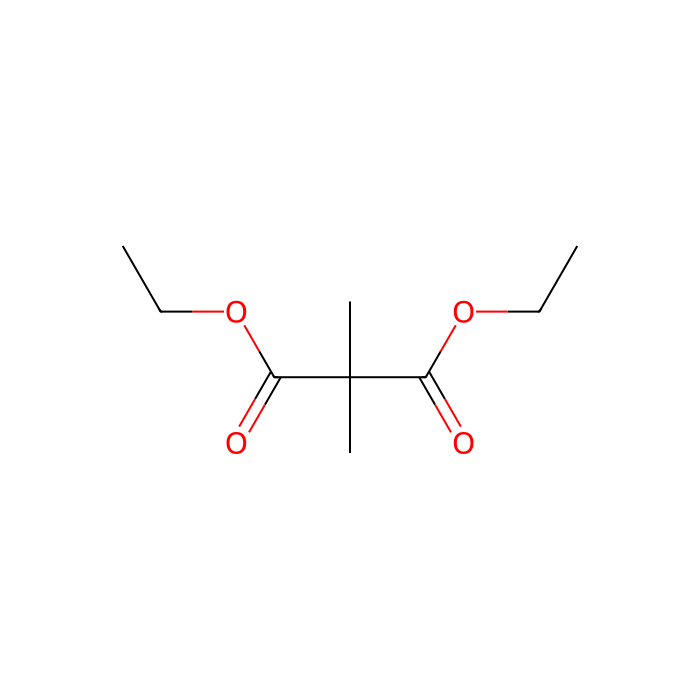
A compact, hindered malonate diester featuring a geminal dimethyl at the 2-position; widely used as a masked, doubly activated methine equivalent for quaternary carbon construction.
Storage condition: Room temperature; shipped under normal conditions
InChIKey (item-specific): Not specified for this item; refer to CoA/Spec Sheet.
SMILES (item-specific): Not specified for this item; refer to CoA/Spec Sheet.
Molecular formula / weight (item-specific): Not specified for this item; refer to CoA/Spec Sheet.
Literature identifiers and descriptors (for reference; verify against CoA before use)
Preferred name: Diethyl 2,2-dimethylmalonate
Molecular formula (literature): C9H16O4
Molecular weight (literature): ~188.22 g/mol
SMILES (literature): CCOC(=O)C(C)(C)C(=O)OCC
InChIKey (literature): Not provided here; consult primary databases (e.g., NIST, PubChem) for confirmation.
Structural features (general description)
Functional groups: Two ethyl ester groups (–CO2Et) flanking a quaternary carbon center bearing two methyl substituents (gem-dimethyl).
Skeleton: Symmetric malonate core; central carbonyl–carbonyl arrangement with a fully substituted (sp3) alpha carbon.
2D description in words: An α,α-disubstituted malonate where both carboxylates are ethyl esters and the α-carbon carries two methyl groups, giving a sterically hindered, non-enolizable quaternary center precursor upon alkylation.
Stereochemistry: None (achiral as supplied; can generate quaternary stereocenters under asymmetric conditions).
Synthetic Utility
Diethyl 2,2-dimethylmalonate is a robust platform for constructing sterically congested motifs through the classical malonic ester strategy, adapted to a gem-dimethyl environment.
Functional group logic
The two ester carbonyls activate the α-position toward deprotonation; gem-dimethyl substitution increases the base strength required, but resultant enolates are highly nucleophilic and provide quaternary carbon formation upon alkylation.
Transformations (literature/general)
α-Alkylation: Primary halides, benzyl/allyl electrophiles under LDA/KHMDS/NaH to give quaternary centers.
Hydrolysis/decarboxylation: Aqueous acid or base followed by thermal decarboxylation delivers tert-substituted carboxylic acids.
Conversion to ketones: Mixed Claisen/Weinreb-amide routes after selective transformations can yield tert-substituted ketones.
Michael additions: Addition of the enolate to activated olefins to install densely functionalized backbones.
Cross-coupling precursors: After suitable functionalization (e.g., to α-halo malonates), can enter Pd-catalyzed couplings.
Retrosynthetic value
Serves as a masked equivalent of a tertiary carbanion adjacent to a carboxylate/ketone progenitor, enabling late-stage introduction of steric bulk with high convergence.
Practical notes
Strong, non-nucleophilic bases and dry aprotic solvents are key. Use low temperatures to control enolate geometry and suppress side reactions.
Avoid secondary/tertiary electrophiles to minimize elimination and over-alkylation.
The ester handles allow phase and polarity tuning for purification (distillation or chromatography).
Target Specificity
This product is a small-molecule reagent and does not possess biological target specificity (no antigen/epitope, clone, or isotype). There are no item-specific targeting attributes.
Item-specific targeting data: Not applicable.
For biochemical targeting tools, refer to antibodies, ligands, or inhibitors designed for specific proteins or pathways.
Preguntas frecuentes
What is the purity of this product?
This product is supplied at ≥97% purity (chemical assay). Lot-specific values are stated on the Certificate of Analysis.
How should this product be stored?
Store at room temperature.
How is this product shipped?
This product ships under standard ambient conditions. No temperature-controlled packaging is required.
What are the CAS number, molecular formula and molecular weight?
The CAS Number is 1619-62-1, the molecular formula is C9H16O4, and the molecular weight is 188.22 g/mol. InChIKey UELKSYXXNGHTSE-UHFFFAOYSA-N.
What documentation is provided?
Available product documentation, including Certificates of Analysis (COA), Safety Data Sheets (SDS), and specification sheets, is shown in the product document area. Document availability and access follow the current site policy.
Utilizamos cookies para garantizar el correcto funcionamiento del sitio web y, cuando esté permitido, para mejorar su experiencia. Puede gestionar sus preferencias en cualquier momento en Configuración. Más información en nuestra Política de Cookies.
¿Quieres que te enviemos un mensaje cuando tengamos descuentos disponibles?
Recordármelo más tarde
¡Gracias! Por favor, revisa tu bandeja de entrada de correo electrónico para confirmar.
Products are supplied to verified businesses, institutions, and qualified professionals for research and development use only. Not for use in humans, animals, diagnosis, or therapy.
 F2222354
