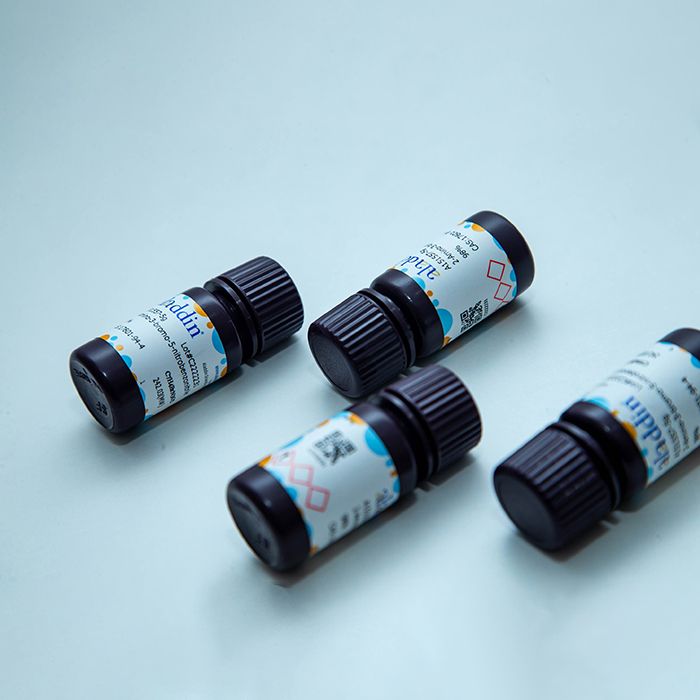
para flujos de trabajo cromatográficos y analíticos sensibles que requieren una interferencia mínima de la línea base.
🌡
Almacenamiento y envío
Room temperature Envío Normal. Consulte el COA específico del lote para conocer las especificaciones exactas.
📋
Documentos de calidad
SDS, COA, ficha técnica y hoja de especificaciones disponibles para descargar. COA específico del lote accesible mediante búsqueda por número de lote.
📚
Prueba documental
Citado en 0 publicaciones revisadas por pares sobre cromatografía, síntesis orgánica y reacciones de acoplamiento cruzado.
Descripción general
Product content:
D665967
Component
200 T
Storage
D665967A
Buffer PB
120 mL
RT
D665967B
Buffer PS
60 mL
RT
D665967C
Buffer PW (concentrate)
25 mL
RT
D665967D
Buffer EB
30 mL
RT
D665967E
Spin Columns DM with Collection Tubes
200 EA
RT
Product Introduction: This reagent kit adopts a new silicon-based membrane technology and reagent formula. Through a rapid and simple three-step process of binding, washing, and elution, 100 bp-10 kb DNA fragments can be purified and recovered from PCR products or enzyme reaction solutions (enzyme cutting, linking, probe labeling, etc.). Each adsorption column can adsorb up to 10 kb of DNA fragments μ G DNA, while minimizing impurities such as primers, oligonucleotides, enzymes, etc. The purified and recovered DNA has high purity and concentration, good integrity, and high recovery rate, and can be directly used for molecular biology experiments such as sequencing, linking and transformation, labeling, and in vitro transcription. Self prepared reagent: anhydrous ethanol.
Preparation and important precautions before the experiment: 1. All components can be stably stored in a dry, room temperature (15-30 ℃) environment for 1 year, and can be stored at 2-8 ℃ for longer periods of time. When the solution is stored at low temperature, it should be left at room temperature for a period of time before use, and then restored to room temperature before use. 2. This reagent kit can selectively recover all DNA fragments from the solution. If you need to selectively recover specific fragments while removing other fragments of different sizes, please choose our company's gel recovery reagent kit. 3.Before the first use, anhydrous ethanol should be added to the Buffer PW according to the instructions on the reagent bottle label. 4. Before use, please check if there is any crystallization or precipitation in the Buffer PB. If there is any crystallization or precipitation, you can take a water bath at 37 ℃ for a few minutes to restore clarity. 5. The recovery efficiency is related to the initial amount of DNA and the elution volume. The smaller the initial amount, the smaller the elution volume, and the lower the recovery rate. 6. All centrifugation steps can be performed at room temperature.
Operation steps: 1. Estimate the volume of DNA reaction solution, add 5 times the volume of Buffer PB, and mix thoroughly (without removing paraffin or mineral oil). Note:
1) If the DNA reaction system is 50 µ l (excluding paraffin oil volume), add 250 µ l Buffer PB. 2) After adding Buffer PB, check the pH value of the solution. If the pH value is greater than 7.5, add 10-30 to it μ 3 M sodium acetate (pH 5.0) was used to adjust the pH value to 5-7. 2. Column balance: Add 200 to the spin columns DM that have been loaded into the collection tube μ Centrifuge at 13000 rpm (~16200 × g) for 1 minute, discard the waste liquid in the collection tube, and place the adsorption column back into the collection tube. 3. Add the solution obtained in step 1 to the adsorption column that has been loaded into the collection tube, let it stand at room temperature for 1 minute, centrifuge at 13000 rpm for 30-60 seconds, discard the waste liquid in the collection tube, and place the adsorption column in the collection tube. Attention: The volume of the adsorption column is 750 µ l. If the sample volume is greater than 750 µ l, it can be added in batches. 4. Add 500 µ l of Buffer PW to the adsorption column (please check if anhydrous ethanol has been added before use), centrifuge at 13000 rpm for 30-60 seconds, discard the waste liquid in the collection tube, and place the adsorption column in the recovery tube. Note: If purified DNA is used for salt sensitivity experiments (such as flat end ligation experiments or direct sequencing), it is recommended to add Buffer PW and let it stand for 2-5 minutes before centrifugation. 5.13000 rpm for 1 minute and discard the waste liquid from the collection tube. Place the adsorption column at room temperature for a few minutes to thoroughly air dry. Note: The purpose of this step is to remove residual ethanol from the adsorption column, which can affect subsequent enzymatic reactions (such as enzyme digestion, PCR, etc.). To ensure that downstream experiments are not affected by residual ethanol, it is recommended to open the cover of the adsorption column and place it at room temperature for a few minutes to thoroughly dry the residual ethanol in the adsorbent material at the bottom. 6. Place the adsorption column into a new centrifuge tube (provided by oneself), add 30-50 µ l Buffer EB to the middle position of the adsorption membrane by hanging droplets, and let it stand at room temperature for 1 minute. Centrifuge at 13000 rpm for 1 minute and collect DNA solution- Store DNA at 20 ℃. Attention: 1) The pH value of the eluent has a significant impact on the elution efficiency. If water is used as the eluent, its pH value should be ensured to be between 7.0-8.5 (the pH value of water can be adjusted to this range using NaOH). 2) To improve the recovery of DNA, the solution obtained by centrifugation can be added back to the adsorption column, left at room temperature for 2 minutes, and centrifuged at 13000 rpm for 1 minute. 3) The elution volume should not be less than 30 μ l. A small volume will affect the recovery efficiency.
Almacenamiento y envío
Condiciones de almacenamiento de almacenamiento
Room temperature
Enviado en
Normal
Documentación
📋 Hoja de datos de seguridad (SDS)
Documento completo sobre peligros, manipulación, almacenamiento y cumplimiento normativo.
Utilizamos cookies para garantizar el correcto funcionamiento del sitio web y, cuando esté permitido, para mejorar su experiencia. Puede gestionar sus preferencias en cualquier momento en Configuración. Más información en nuestra Política de Cookies.
¿Quieres que te enviemos un mensaje cuando tengamos descuentos disponibles?
Recordármelo más tarde
¡Gracias! Por favor, revisa tu bandeja de entrada de correo electrónico para confirmar.
Products are supplied to verified businesses, institutions, and qualified professionals for research and development use only. Not for use in humans, animals, diagnosis, or therapy.