Dovitinib lactate - ≥99% , CAS No.692737-80-7

CAS: 692737-80-7 Cat. No.: D651722 Fórmula: C24H27FN6O4 Peso molecular: 482.52 PubChem CID: 135431668
Disponible para pedir
CALIDAD & PUREZA ≥99%
Synonyms
BCP04112 | Triptorelin (USAN/INN) | TKI258 | 4-AMINO-5-FLUORO-3-(6-(4-METHYLPIPERAZIN-1-YL)-1H-BENZO-[D]IMIDAZOL-2-YL)QUINOLIN-2(1H)-ONE 2-HYDROXYPROPANOATE | 4-Amino-5-fluoro-3-(6-(4-methylpiperazin-1-yl)-1H-benzo[d]imidazol-2-yl)quinolin-2(1H)-one 2-hyd
Storage
Store at 2-8°C,Desiccated
Shipped In
Wet ice
★
Talla
USA
Alemania (EU)*
Precio
Cantidad
5mg
D651722-5mg
Fabricado bajo pedido · 8–12 semanas

57,90US$

86,90US$
Guardar 29,00 US$ (33.37%)
10mg
D651722-10mg
Fabricado bajo pedido · 8–12 semanas

109,90US$

164,90US$
Guardar 55,00 US$ (33.35%)
50mg
D651722-50mg
Fabricado bajo pedido · 8–12 semanas

189,90US$

284,90US$
Guardar 95,00 US$ (33.35%)
100mg
D651722-100mg
Fabricado bajo pedido · 8–12 semanas

378,90US$

568,90US$
Guardar 190,00 US$ (33.40%)
200mg
D651722-200mg
Fabricado bajo pedido · 8–12 semanas

682,90US$

1.024,90US$
Guardar 342,00 US$ (33.37%)
500mg
D651722-500mg
Fabricado bajo pedido · 8–12 semanas

1.492,90US$

2.239,90US$
Guardar 747,00 US$ (33.35%)
Enter a quantity for the sizes you want to add.

Descripción general

Dovitinib lactate (TKI258 lactate) is a multi-targeted tyrosine kinase inhibitor with IC 50 s of 1, 2, 8/9, 10/13/8, 27/210 nM for FLT3 , c-Kit , FGFR1/3 , VEGFR1/2/3 and PDGFRα/β , respectively

In Vitro

Dovitinib potently inhibits the FGF-stimulated growth of WT and F384L-FGFR3-expressing B9 cells with IC 50 values of 25 nM. B9-MINV cells are resistant to the inhibitory activity of Dovitinib at concentrations up to 1 μM. Dovitinib inhibits cell proliferation of KMS11 (FGFR3-Y373C), OPM2 (FGFR3-K650E), and KMS18 (FGFR3-G384D) cells with IC 50 of values of 90 nM (KMS11 and OPM2) and 550 nM, respectively. Treatment of SK-HEP1 cells with dovitinib results in G2/M cell cycle arrest, inhibition of colony formation in soft agar and blockade of bFGF-induced cell migration. Dovitinib inhibits basal expression and FGF-induced phosphorylation of FGFR-1, FRS2-α and ERK1/2. MCE has not independently confirmed the accuracy of these methods. They are for reference only.

In Vivo

Dovitinib (10 mg/kg, 30 mg/kg, 60 mg/kg, p.o.) shows significant antitumor effect in the KMS11-bearing mice model, and the growth inhibition is 48%, 78.5%, and 94% in the 10 mg/kg, 30 mg/kg, and 60 mg/kg treatment arms, respectively, compared with the placebo-treated mice . Dovitinib demonstrates significant antitumor and antimetastatic activities in HCC xenograft models. Dovitinib potently inhibits tumor growth of six HCC lines. Inhibition of angiogenesis correlates with inactivation of FGFR/PDGFR-β/VEGFR-2 signaling pathways. Dovitinib also causes dephosphorylation of retinoblastoma, upregulation of p-histone H2A-X and p27, and downregulation of p-cdk-2 and cyclin B1, which results in a reduction in cellular proliferation and the induction of tumor cell apoptosis. MCE has not independently confirmed the accuracy of these methods. They are for reference only.

Cell Assay

To determine IC 50 for SK-HEP1 cells, cells are plated at a density of 2×10 4 cells per dish. After 48 h, cells are treated with 0, 0.01, 0.1, 1, 5, 10, 50, 100 μM dovitinib in DMEM containing 1% FBS for 24 h. Cell viability is determined with Cell Proliferation Assay. IC 50 is calculated by nonlinear regression analysis using GraphPad Prism software. MCE has not independently confirmed the accuracy of these methods. They are for reference only.

Animal administration

Mice: Six HCC lines (06-0606, 26-0808A, 26-1004, 25-0705A, 5-1318, 21-0208) are used to establish tumors in male SCID mice. or dose-esponse experiments, mice bearing the 06-0606 xenografts re orally given vehicle (5% dextrose) or two doses of dovitinib (50 and 75 mg/kg) daily for 14 days. For time-dependent inhibition of dovitinib targets, mice bearing 06-0606 tumors are given orally 200 μL of either vehicle (n=6) or 50 mg/kg/day of dovitinib (n=10) . aladdin has not independently confirmed the accuracy of these methods. They are for reference only.

Form:Solid

IC50& Target:FLT3 1 nM (IC 50 ) c-Kit 2 nM (IC 50 ) FGFR1 8 nM (IC 50 ) FGFR3 9 nM (IC 50 ) VEGFR1 1 nM (IC 50 ) VEGFR3 8 nM (IC 50 ) VEGFR2 13 nM (IC 50 ) PDGFRα 27 nM (IC 50 ) PDGFRβ 210 nM (IC 50 )

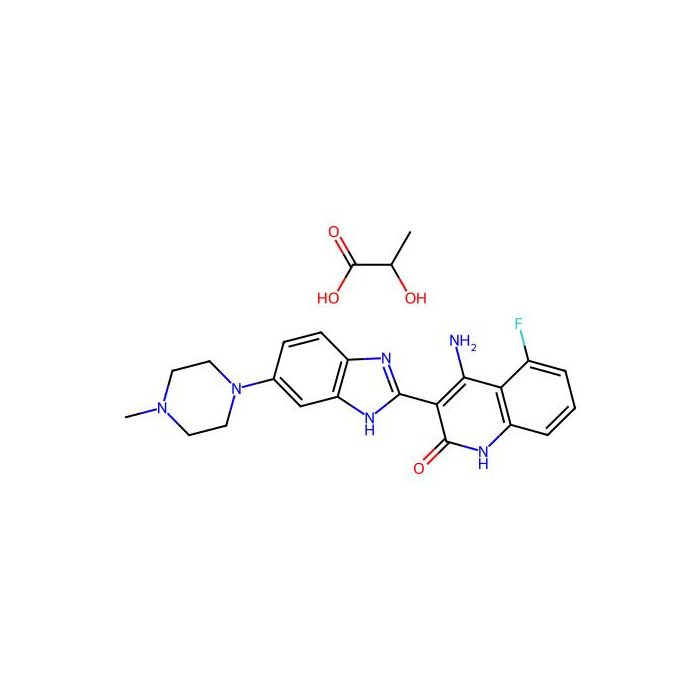
Especificaciones

Sinónimos
BCP04112 | Triptorelin (USAN/INN) | TKI258 | 4-AMINO-5-FLUORO-3-(6-(4-METHYLPIPERAZIN-1-YL)-1H-BENZO-[D]IMIDAZOL-2-YL)QUINOLIN-2(1H)-ONE 2-HYDROXYPROPANOATE | 4-Amino-5-fluoro-3-(6-(4-methylpiperazin-1-yl)-1H-benzo[d]imidazol-2-yl)quinolin-2(1H)-one 2-hyd
Especificaciones y pureza
≥99%
Mecanismos bioquímicos y fisiológicos
Dovitinib lactate (TKI258 lactate) is a multi-targeted tyrosine kinase inhibitor with IC 50 s of 1, 2, 8/9, 10/13/8, 27/210 nM for FLT3 , c-Kit , FGFR1/3 , VEGFR1/2/3 and PDGFRα/β , respectively.
Condiciones de almacenamiento de almacenamiento
Store at 2-8°C,Desiccated
Enviado en
Wet ice
Este producto requiere envío en cadena de frío. Los servicios terrestres y otros servicios económicos no están disponibles.
Tipo de acción
INHIBITOR
Pureza
≥99%
Nombres e identificadores
Sonrisas canónicas
CC(C(=O)O)O.CN1CCN(CC1)C2=CC3=C(C=C2)N=C(N3)C4=C(C5=C(C=CC=C5F)NC4=O)N
IUPAC Name
4-amino-5-fluoro-3-[6-(4-methylpiperazin-1-yl)-1H-benzimidazol-2-yl]-1H-quinolin-2-one;2-hydroxypropanoic acid
InChIKey
ZRHDKBOBHHFLBW-UHFFFAOYSA-N
INCHI
1S/C21H21FN6O.C3H6O3/c1-27-7-9-28(10-8-27)12-5-6-14-16(11-12)25-20(24-14)18-19(23)17-13(22)3-2-4-15(17)26-21(18)29;1-2(4)3(5)6/h2-6,11H,7-10H2,1H3,(H,24,25)(H3,23,26,29);2,4H,1H3,(H,5,6)
Isómeros SMILES
CC(C(=O)O)O.CN1CCN(CC1)C2=CC3=C(C=C2)N=C(N3)C4=C(C5=C(C=CC=C5F)NC4=O)N
PubChem CID
135431668
Peso molecular
482.52

Datos avanzados

Taxonomic Classification

Taxonomy Tree

KingdomOrganic compounds
SuperclassOrganoheterocyclic compounds
ClaseDiazinanes
SubclassPiperazines
Intermediate Tree Nodes Not available
Direct ParentN-arylpiperazines
Alternative Parents Hydroquinolones  Haloquinolines  4-aminoquinolines  Hydroquinolines  Benzimidazoles  Dialkylarylamines  Pyridinones  N-methylpiperazines  Aminopyridines and derivatives  Benzenoids  Aryl fluorides  Alpha hydroxy acids and derivatives  Vinylogous amides  Imidazoles  Heteroaromatic compounds  Trialkylamines  Secondary alcohols  Lactams  Monocarboxylic acids and derivatives  Carboxylic acids  Azacyclic compounds  Primary amines  Organopnictogen compounds  Organofluorides  Organic oxides  Hydrocarbon derivatives  Carbonyl compounds  
Molecular FrameworkNot available
Substituents N-arylpiperazine - 4-aminoquinoline - Haloquinoline - Dihydroquinolone - Aminoquinoline - Quinoline - Dihydroquinoline - Benzimidazole - Dialkylarylamine - Tertiary aliphatic/aromatic amine - N-alkylpiperazine - N-methylpiperazine - Pyridinone - Aminopyridine - Benzenoid - Pyridine - Hydroxy acid - Aryl halide - Aryl fluoride - Alpha-hydroxy acid - Heteroaromatic compound - Vinylogous amide - Imidazole - Azole - Tertiary aliphatic amine - Tertiary amine - Secondary alcohol - Lactam - Azacycle - Monocarboxylic acid or derivatives - Carboxylic acid - Carboxylic acid derivative - Organic nitrogen compound - Organic oxygen compound - Organopnictogen compound - Organic oxide - Hydrocarbon derivative - Primary amine - Organooxygen compound - Organonitrogen compound - Organofluoride - Organohalogen compound - Carbonyl group - Amine - Alcohol - Aromatic heteropolycyclic compound
DescripciónThis compound belongs to the class of organic compounds known as n-arylpiperazines. These are organic compounds containing a piperazine ring where the nitrogen ring atom carries an aryl group.
External Descriptors Not available
Estructura 3D
Modelo de Estructura Química Interactiva


Certificados (CoA, COO, BSE/TSE y tabla de análisis)
C of A & Other Certificates(BSE/TSE, COO):
Analytical Chart:
Propiedades químicas y físicas
SolubilidadDMSO : ≥ 30 mg/mL (62.17 mM)
Peso molecular482.500 g/mol
XLogP3
Hydrogen Bond Donor Count5
Hydrogen Bond Acceptor Count9
Rotatable Bond Count3
Exact Mass482.208 Da
Monoisotopic Mass482.208 Da
Topological Polar Surface Area148.000 Ų
Heavy Atom Count35
Formal Charge0
Complexity737.000
Isotope Atom Count0
Defined Atom Stereocenter Count0
Undefined Atom Stereocenter Count1
Defined Bond Stereocenter Count0
Undefined Bond Stereocenter Count0
The total count of all stereochemical bonds0
Covalently-Bonded Unit Count2
Calculadoras de soluciones
Reseñas

Reseñas de cliente

Application Protocols

Only protocols validated for the specific catalog item may be listed. None are provided for this entry.

  • Tested applications: Not specified for this item; refer to CoA/Spec Sheet.
  • Recommended working dilutions: Not specified for this item; determine empirically for your assay.
  • Positive controls/benchmarks: Not specified for this item; select based on your target/pathway of interest.

General suggestion: When deploying as a pathway probe, include vehicle controls, concentration–response curves, and orthogonal validation (e.g., genetic perturbation). Verify compound integrity by LC–MS before critical studies.

Biological Roles

Biological/biochemical context (literature, for research use only):

  • Mechanism focus: Dovitinib is described in the literature as a multi‑target receptor tyrosine kinase inhibitor with notable activity against FGFR family kinases, and reported interactions with VEGFR and PDGFR families. It is used to perturb signaling cascades downstream of these receptors in cellular models.
  • Cellular effects (research observations): Modulation of phosphorylation events (e.g., FGFR substrate proteins and MAPK/ERK pathway components) can be monitored following exposure, enabling pathway mapping and target‑engagement validation.
  • Selectivity considerations: Kinase inhibitors often display concentration‑dependent polypharmacology; profiling across recombinant kinase panels or chemoproteomic datasets is recommended to contextualize results.
  • ADME properties (general/literature): Lipophilicity and basicity consistent with ATP‑competitive kinase inhibitors; protein binding and efflux can influence apparent potency in cells. Precise parameters are compound‑ and system‑dependent and should be determined empirically.

Caveats:

  • No clinical or therapeutic claims are made. All observations should be interpreted within controlled laboratory settings with appropriate controls and orthogonal validation (e.g., genetic knockdown/knockout).
  • For this catalog item, item‑specific identity, purity, and salt stoichiometry should be confirmed via the CoA before initiating critical biological studies.
Buffer Applications

This compound is not a buffering agent and is not used to set or maintain pH. However, effective buffer handling is critical for its use in biochemical/cellular assays.

Practical guidance (general):

  • Stock preparation: Dissolve in DMSO to a convenient concentration; store aliquots frozen. Immediately before use, dilute into assay buffer (e.g., HEPES‑ or Tris‑based systems) with vigorous mixing to limit precipitation.
  • Final DMSO content: Many biochemical assays tolerate ≤0.1–0.5% v/v DMSO; confirm for your system. Maintain identical vehicle levels in controls and treated samples.
  • Surfactants: Inclusion of 0.01–0.05% nonionic surfactant (e.g., Tween‑20 or Pluronic F‑68) can improve compound dispersion and reduce adsorption to plastics; verify no assay interference.
  • Protein binding: Serum proteins and BSA can sequester lipophilic inhibitors; evaluate effects of serum concentration on apparent potency in cell culture.
  • pH considerations: The lactate salt provides the protonated base; avoid drastic pH shifts that could cause base–salt conversion and solubility changes during dilution.

If precise aqueous solubility is required, determine experimentally under your exact buffer composition and temperature.

Green Alternatives

As a bioactive reference compound, dovitinib lactate does not have a “greener substitute” in the same sense as commodity solvents or reagents. However, greener practices can be applied to its handling and use.

Greener handling strategies (general):

  • Minimize solvent use by preparing higher‑concentration DMSO stocks and performing accurate low‑volume dilutions.
  • Prefer DMSO over DMF or NMP for aqueous assay dilutions, given DMSO’s comparatively favorable hazard profile and biodegradability considerations.
  • Reduce, reuse, recycle: Consolidate analyses (e.g., LC–MS runs) to limit sample prep waste; segregate halogenated from non‑halogenated organic waste to facilitate compliant disposal.
  • Microplate assays: Use low-dead‑volume reservoirs and acoustic dispensing to decrease DMSO consumption.

Comparison (solvent perspective; general):

  • DMSO: Lower volatility, better biocompatibility at ≤0.5% v/v; widely accepted in screening.
  • DMF/NMP: Higher reproductive and systemic toxicity concerns; avoid unless specifically required for solubility, and confine to analytical use.
  • Aqueous formulations: Where feasible, exploit the lactate salt to increase water content in the working solution, lowering organic solvent burden while monitoring for precipitation.

Note: Any change in solvent system can affect solubility and biological readouts; revalidate assay performance after adopting greener conditions.

Pharmaceutical Uses

For formulation and process research context only (no therapeutic claims):

  • Role: Dovitinib lactate can serve as a reference standard or tool compound for preformulation studies, analytical method development (e.g., LC–MS quantitation), and excipient compatibility screens in discovery settings.
  • Salt form considerations: The lactate counter‑ion can influence hygroscopicity, crystallinity, and aqueous compatibility compared with the free base or other salts; confirm the solid form and hydration/solvation state by XRPD/DSC/TGA if these parameters impact your work.
  • Solubility enhancement strategies (research):
    • Co‑solvents (DMSO, PEG 400) and pH adjustments within acceptable ranges for nonclinical matrices.
    • Enabling systems such as cyclodextrins or lipid‑based vehicles for in vitro or preclinical exploratory studies, with appropriate controls for vehicle effects.
  • Analytical development: Establish stability‑indicating HPLC/UPLC methods; assess photostability and stress conditions (acid/base/oxidative) to define handling limits.

Pharmacopeial/compendial status: Not specified for this item; refer to CoA/Spec Sheet. Any use is restricted to research applications; not for human or veterinary use.

Physical Properties

Item-specific physicochemical specifications have not been provided for this catalog entry.

  • Appearance: Not specified for this item; refer to CoA/Spec Sheet.
  • Melting point: Not specified for this item; refer to CoA/Spec Sheet.
  • Boiling point: Not applicable to this solid salt; decomposition likely before boiling (general statement).
  • Density: Not specified for this item; refer to CoA/Spec Sheet.
  • Solubility (general/literature guidance):
    • DMSO: commonly used to prepare concentrated stock solutions of kinase inhibitors (up to 10–50 mM typical ranges in discovery labs, subject to compound-specific limits).
    • Aqueous media: lactate salts often show improved water compatibility versus free bases, but many kinase inhibitors remain sparingly soluble in pure water; co-solvent or surfactant may be required.
    • Alcohols (MeOH/EtOH) and DMF can aid dissolution if compatible with the intended assay.
  • logP/logD, pKa, refractive index: Not specified for this item; refer to CoA/Spec Sheet. Literature values for dovitinib (free base) indicate lipophilicity and basicity consistent with kinase-binding scaffolds, but exact numbers should be confirmed from primary sources.

Practical notes (general):

  • Warm to ambient and vortex/sonicate to facilitate dissolution; filter 0.22 µm to clarify assay stocks if needed.
  • Minimize aqueous exposure before dissolution to limit hygroscopic uptake and potential salt disproportionation.
Quality and Grades
  • Grade/Purity: Not specified for this item; refer to CoA/Spec Sheet.

Interpretation and context for this product category:

  • Bioactive library compounds such as dovitinib lactate are typically supplied at high chemical purity suitable for biochemical and cell‑based research. In the absence of a stated grade (e.g., “≥98% (HPLC)”), confirm the exact assay and analytical method on the lot‑specific Certificate of Analysis.
  • Analytical controls commonly used for this class (general information):
    • Identity: 1H/13C NMR, HRMS/ESI, and sometimes IR; salt form verified by titration or NMR (lactate resonances) when applicable.
    • Purity: HPLC/UPLC with UV or MS detection; residual solvent screening by GC.
    • Water content: Karl Fischer; for hygroscopic salts, verify immediately upon receipt if critical for your work.
  • Stabilizers: None indicated for this item. If stabilizers or formulating excipients are present, they will be listed on the CoA/Spec Sheet.
  • UV profile: Not specified for this item; refer to CoA/Spec Sheet. For kinase scaffolds, aromatic chromophores typically absorb in the near‑UV; verify cutoff if planning HPLC‑UV detection or photostability studies.

Recommendation: If your application is highly sensitive (e.g., quantitative kinase kinetics or LC–MS bioanalytical assay development), request the latest CoA and, where needed, a full analytical pack (chromatograms, spectra) for method suitability.

Reaction and Applications

This product is primarily intended as a bioactive small‑molecule research tool rather than as a synthetic reagent. Accordingly, its value lies in biochemical and cellular studies rather than in promoting or participating in general organic reactions.

Research applications (general/literature context):

  • Kinase pathway interrogation: Dovitinib is widely studied as a multi‑target receptor tyrosine kinase inhibitor, particularly affecting FGFR family signaling; it is often employed to probe pathway dependence, feedback, and crosstalk in cell lines and biochemical assays.
  • Target engagement and profiling: Used in kinase binding/enzymatic assays, thermal shift assays (DSF), CETSA, and chemoproteomics to map selectivity landscapes and off‑target interactions.
  • Phenotypic screening: Deployed in cell viability, migration, and signaling readouts to connect pathway modulation with phenotypes.

Practical tips:

  • Prepare single‑use aliquots of DMSO stocks to minimize freeze–thaw cycles and adsorption losses.
  • Preclear stocks by 0.22 µm filtration before sensitive biochemical assays to remove particulates.
  • Include appropriate vehicle controls (matching DMSO percentage) and, where possible, orthogonal inhibitors or genetic perturbations to validate on‑target effects.

Note: No synthetic or catalysis applications are typical for this compound; for reagent‑centric chemistry, consult other catalog sections (e.g., coupling reagents, bases, ligands).

Reaction Conditions

Conventional “reaction conditions” (temperature, catalysts, yields) are not applicable: dovitinib lactate is a reference bioactive compound, not a reagent. The most relevant conditions pertain to solution preparation and biological assay use.

Stock/assay preparation (general literature practice):

  • Stock in DMSO: Prepare at a concentration suitable for your dosing range (commonly 10–50 mM if solubility allows). Vortex and briefly sonicate to aid dissolution. Filter (0.22 µm) if needed.
  • Working solutions: Dilute into pre‑equilibrated assay buffers/media with rapid mixing to target final DMSO typically ≤0.1–0.5% v/v. Inspect for precipitation; maintain constant vehicle across conditions.
  • Temperature/light: Prepare and handle at ambient temperature; protect from strong light if photolability is suspected. Avoid prolonged warming once in aqueous media.
  • Stability checks: Verify short‑term stability in assay matrix (e.g., 2–24 h at 25–37°C, depending on assay) by LC–MS or UV to ensure consistent exposure.

Assay concentration ranges (general guidance):

  • Biochemical enzyme assays: Often screened over 10‑point serial dilutions spanning sub‑nanomolar to tens of micromolar, with top concentrations limited by solubility and assay tolerance.
  • Cell‑based assays: Typical ranges include low‑nanomolar to single‑digit micromolar, titrated to minimize off‑target effects. Optimize empirically.

These parameters are general; determine exact conditions experimentally for your system.

Safety and Handling

Safety information specific to this item has not been provided. Always consult the SDS for authoritative guidance.

  • GHS classification, pictograms, signal word, H‑statements: Not specified for this item; refer to SDS.
  • General laboratory precautions (good practice for bioactive small molecules):
    • Use in a certified chemical fume hood; avoid inhalation and skin/eye contact.
    • Wear appropriate PPE: lab coat, safety glasses, and chemically resistant gloves (e.g., nitrile). Consider double‑gloving for DMSO solutions due to enhanced dermal penetration.
    • Prevent environmental release; collect waste in halogenated/non‑halogenated organic containers as appropriate.
  • Handling notes:
    • Hygroscopicity: Many organic salts can absorb moisture; keep container tightly closed and desiccated as specified by the supplier.
    • Dust control: Handle solids gently to minimize airborne particulate; consider weighing onto antistatic weigh boats.
    • Solution handling: Prepare concentrated stocks in DMSO, then dilute into buffers immediately before use to limit precipitation.
  • Incompatibilities (general): Strong oxidizers, strong acids/bases may degrade the molecule; avoid prolonged exposure to light and elevated temperatures.
  • First aid (overview; defer to SDS):
    • Skin/eye contact: Rinse with water for ≥15 minutes; remove contaminated clothing; seek medical attention.
    • Inhalation: Move to fresh air; seek medical attention if symptoms occur.
    • Ingestion: Rinse mouth; do not induce vomiting; seek medical attention.

For research use only. Not for human or veterinary use.

Solvent Selection

Dovitinib lactate is a heteroaromatic, basic small molecule salt. Practical dissolution and assay compatibility are the primary drivers for solvent choice.

  • Polarity/miscibility (general behavior for this class):
    • Readily dissolves in polar aprotic organic solvents such as DMSO and DMF, which are standard for bioactive compound stocks.
    • Water compatibility improves for lactate salts versus free bases, but many kinase inhibitors still display limited solubility and can precipitate on aqueous dilution without co‑solvent.
  • Recommended practice (research use):
    • Prepare a concentrated stock in DMSO (e.g., 10–50 mM typical for screening; confirm solubility empirically).
    • For biological assays, dilute the DMSO stock into pre-warmed buffer/culture medium with constant mixing to a final DMSO content typically ≤0.1–0.5% v/v (as permitted by the assay system).
    • If precipitation occurs, consider small amounts of co‑solvent (e.g., 0.1–1% DMSO maintained in the working solution), pH adjustment within assay limits, or inclusion of non‑ionic surfactants (e.g., 0.01–0.05% Tween‑20) where biologically acceptable.

Comparison (general guidance):

  • DMSO vs DMF: DMSO is generally preferred in bioassays for lower volatility and better biocompatibility at low percentages; DMF may improve solubility for some scaffolds but is less biocompatible.
  • Alcohols (MeOH/EtOH): Useful for analytical sample prep but often limited in live-cell assays.

Always verify solubility, stability, and assay tolerance experimentally for your specific system.

Storage and Reconstitution

Storage conditions (as provided):

  • Store at 2–8°C, desiccated.
  • Shipped on wet ice.

Best practices (general, to complement the above):

  • Keep container tightly closed in a desiccator to limit moisture uptake. Allow vial to equilibrate to room temperature before opening to avoid condensation.
  • Protect from light if long‑term storage is anticipated; store in an amber vial or secondary light‑shielding container.

Reconstitution (general guidance for bioactive small molecules):

  • Solvent: Use anhydrous DMSO to prepare a concentrated stock (e.g., 10–50 mM if solubility permits). Record exact concentration.
  • Aliquoting: Dispense single‑use aliquots into low‑bind microtubes to minimize adsorption and freeze–thaw cycles.
  • Storage of solutions: Freeze aliquots at −20°C or −80°C in tightly sealed vials. Avoid repeated freeze–thaw; thaw at room temperature and vortex before use.
  • Aqueous working solutions: Prepare immediately before experiments; discard any precipitated or discolored solutions.

Specifications not provided for this item (refer to CoA/Spec Sheet if needed):

  • Exact solubility limits in DMSO/water, hygroscopicity metrics, and solution stability profiles.

For research use only. Not for human or veterinary use.

Structure and Identity

Dovitinib lactate is a small-molecule research compound supplied as the lactate salt of dovitinib (a multi-kinase inhibitor scaffold). For this catalog item, limited structure identifiers are provided.

  • SKU: D651722
  • Product name: Dovitinib lactate
  • CAS: 692737-80-7 (literature; resolves to the lactate salt)
  • InChIKey: 464487 (as provided in Product Data)
  • SMILES: Not specified for this item; refer to CoA/Spec Sheet.
  • Molecular formula: Not specified for this item; refer to CoA/Spec Sheet.
  • Molecular weight: Not specified for this item; refer to CoA/Spec Sheet.

Structural features (general/literature description):

  • The active cation (dovitinib) belongs to a heteroaromatic, nitrogen-containing scaffold class used to target receptor tyrosine kinases; it typically incorporates multiple fused or linked aromatic rings and basic nitrogen(s) capable of salt formation.
  • The lactate counter‑ion is the conjugate base of lactic acid (2‑hydroxypropionate), providing a single negatively charged carboxylate paired with the protonated basic center of the dovitinib cation.
  • Functional groups (general): aromatic/heteroaromatic rings, one or more tertiary/secondary amines (protonated in the salt), and heteroatoms (N/O) that support hydrogen bonding and kinase hinge-region binding in biochemical studies.
  • 2D description in words: a polyaromatic, N-rich core bearing substituents that tune kinase-binding affinity, paired ionically with the lactate anion; overall a crystalline organic salt suitable for DMSO stock preparation for screening applications.

Notes: Exact atom connectivity, stereochemistry (if any), and salt stoichiometry should be confirmed from the CoA/Spec Sheet for this specific lot.

Synthetic Utility

This product is a finished bioactive small molecule and is not typically used as a building block or reagent in organic synthesis.

Context for medicinal chemistry (general):

  • SAR exploration: The dovitinib scaffold can inspire analogue synthesis targeting kinase hinge binding and gatekeeper region interactions. Modifications commonly involve heteroaromatic substitutions, basic center tuning (pKa/logD), and solubilizing side chains or alternative salt forms.
  • Derivatization for probes: Functional handles (if present in a given analogue) may be leveraged to create biotinylated, fluorescent, or photoaffinity probes for target engagement studies, typically via linkers appended at positions that preserve kinase affinity.
  • Solid‑form engineering: Salt selection (e.g., lactate vs other counter‑ions) and cocrystal screening may be pursued to optimize physicochemical properties for in vitro work.

If your goal is reagent‑centric synthesis (e.g., coupling chemistry, catalysis development), this compound is not an efficient choice; consult dedicated reagents and building blocks designed for synthetic transformations.

Target Specificity

Only product‑data–verified target details may be listed here. For this catalog entry, no target or epitope information has been provided.

  • Target(s): Not specified for this item; refer to CoA/Spec Sheet.
  • Species reactivity/kinase panel data: Not specified for this item; refer to CoA/Spec Sheet.
  • Assay‑verified potency/selectivity: Not specified for this item; refer to CoA/Spec Sheet.

Note: Literature discusses dovitinib as a multi‑kinase inhibitor; however, item‑specific target data are not provided here by design. Consult primary references or perform in‑house profiling for your application.

¿Quieres que te enviemos un mensaje cuando tengamos descuentos disponibles?

Recordármelo más tarde

¡Gracias! Por favor, revisa tu bandeja de entrada de correo electrónico para confirmar.

¡Vaya! Las notificaciones están desactivadas.