Determine the necessary mass, volume, or concentration for preparing a solution.
| Activity Type | Relation | Activity value | Units | Action Type | Journal | PubMed Id | doi | Assay Aladdin ID |
|---|

≥99% for sensitive chromatographic and analytical workflows requiring minimal baseline interference.
Store at 2-8°C,Desiccated Ships Wet ice Check lot-specific COA for exact specifications.
SDS, COA, datasheet, and spec sheet available for download. Lot-specific COA accessible via lot number lookup.
Cited in 0 peer-reviewed publications across chromatography, organic synthesis, and cross-coupling reactions.
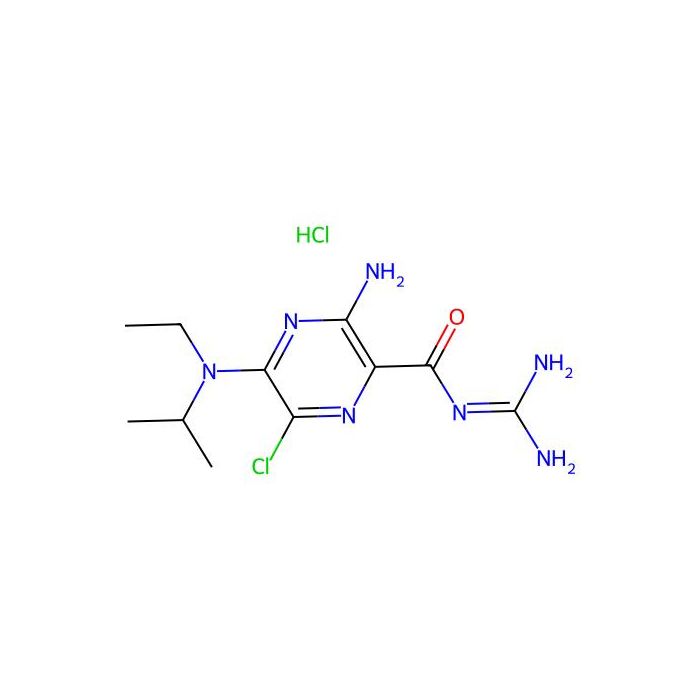
EIPA (L593754) hydrochloride is an orally active TRPP3 channel inhibitor with an IC 50 of 10.5 μM. EIPA hydrochloride also enhances autophagy by inhibiting Na + /H + -exchanger 3 ( NHE3 ). EIPA hydrochloride inhibits macropinocytosis as well. EIPA hydrochloride can be used in the research of inflammation and cancers, such as gastric cancer , colon carcinoma, pancreatic carcinoma.
In Vitro
EIPA hydrochloride (100 μM, 30 min) suppresses TRPP3-mediated Ca 2+ uptake in X. laevis oocytes. EIPA hydrochloride (10-100 μM) reversibly inhibits the basal Na + current (IC 50 : 19.5 μM). EIPA hydrochloride (300 μM, 6h) enhances autophagy through NHE3 (Na + /H + -exchanger 3) in IEC-18 cells. EIPA hydrochloride (20 μM, 2 h) blocks macropinocytosis-mediated uptake of CA-PZ massively entry in HT-29 cells and MIA PaCa-2 cells. EIPA hydrochloride (30 μM, 3h) attenuates Zinc/Kainate toxicity by decreasing Zn 2+ entry in cerebellar granule neurons . EIPA hydrochloride (5-100 μM, 48h) suppresses proliferation of MKN28 cells through up-regulation of p21 expression . EIPA hydrochloride (3 μM, 6 h) inhibits the LPS-induced increase in the level of COX-2 protein. MCE has not independently confirmed the accuracy of these methods. They are for reference only. Cell Proliferation Assay Cell Line: MKN28 cells Concentration: 5, 10, 25, 50, and 100 μM Incubation Time: 48 h Result: Inhibited cell proliferation in a dose- and time-dependent manner. Western Blot AnalysisCell Line: IEC-18 cells Concentration: 300 μM Incubation Time: 6 h Result: Increased total LC3-II protein levels and P62 flux. Increased ATG5, 7, 12 and P62 expression.
In Vivo
EIPA hydrochloride (Intravenous injection, 1 mg/kg) dose-dependently attenuates the I/R (Ischemia/reperfusion)-induced renal dysfunction in ddY strain mice . EIPA hydrochloride (oral administration, 10 mg/kg) inhibits LPS-induced inflammation in air pouch-type LPS-induced inflammation model. MCE has not independently confirmed the accuracy of these methods. They are for reference only. Animal Model: Male ddY strain mice Dosage: 1 mg/kg Administration: Intravenous injection Result: Attenuated histologic renal damage, and imprved the I/R-induced increases in renal ET-1 contents. Animal Model: Air pouch-type LPS-induced inflammation model Dosage: 10 mg/kg Administration: Oral administration Result: Inhibited the LPS-induced infiltration of leukocytes into the pouch. Inhibited the amount of PGE2 in the pouch fluid.
Form:Solid
Comprehensive hazard, handling, storage, and regulatory compliance document.
Download SDS →Lot-specific quality data. Enter your lot number to retrieve the exact COA.
Look up COA →Full quality attributes and acceptance criteria for this grade.
View spec sheet →Taxonomy Tree
| Kingdom | Organic compounds |
|---|---|
| Superclass | Organoheterocyclic compounds |
| Clase | Diazines |
| Subclass | Pyrazines |
| Intermediate Tree Nodes | Pyrazine carboxylic acids and derivatives |
| Direct Parent | Pyrazinecarboxamides |
| Alternative Parents | Dialkylarylamines Acylguanidines Aminopyrazines Aryl chlorides Imidolactams Vinylogous amides Heteroaromatic compounds Amino acids and derivatives Propargyl-type 1,3-dipolar organic compounds Azacyclic compounds Carboximidamides Hydrocarbon derivatives Hydrochlorides Organic oxides Organochlorides Organooxygen compounds Primary amines |
| Molecular Framework | Aromatic heteromonocyclic compounds |
| Substituents | Pyrazinecarboxamide - Dialkylarylamine - Aminopyrazine - Acylguanidine - Aryl chloride - Aryl halide - Imidolactam - Heteroaromatic compound - Vinylogous amide - Amino acid or derivatives - Tertiary amine - Guanidine - Organic 1,3-dipolar compound - Propargyl-type 1,3-dipolar organic compound - Carboximidamide - Azacycle - Carboxylic acid derivative - Hydrocarbon derivative - Organonitrogen compound - Organochloride - Organohalogen compound - Organooxygen compound - Primary amine - Amine - Organic oxygen compound - Organic oxide - Hydrochloride - Organic nitrogen compound - Aromatic heteromonocyclic compound |
| Descripción | This compound belongs to the class of organic compounds known as pyrazinecarboxamides. These are compounds containing a pyrazine ring which bears a carboxamide. |
| External Descriptors | Not available |
| Activity Type | Relation | Activity value | Units | Action Type | Journal | PubMed Id | doi | Assay Aladdin ID |
|---|
| Activity Type | Relation | Activity value | Units | Action Type | Journal | PubMed Id | doi | Assay Aladdin ID |
|---|
| Solubilidad | DMSO : 130 mg/mL (386.65 mM; Need ultrasonic) |
|---|---|
| Peso molecular | 336.220 g/mol |
| XLogP3 | |
| Hydrogen Bond Donor Count | 4 |
| Hydrogen Bond Acceptor Count | 5 |
| Rotatable Bond Count | 4 |
| Exact Mass | 335.103 Da |
| Monoisotopic Mass | 335.103 Da |
| Topological Polar Surface Area | 137.000 Ų |
| Heavy Atom Count | 21 |
| Formal Charge | 0 |
| Complexity | 372.000 |
| Isotope Atom Count | 0 |
| Defined Atom Stereocenter Count | 0 |
| Undefined Atom Stereocenter Count | 0 |
| Defined Bond Stereocenter Count | 0 |
| Undefined Bond Stereocenter Count | 0 |
| The total count of all stereochemical bonds | 0 |
| Covalently-Bonded Unit Count | 2 |