GRADE & PURITYMoligand™?Moligand™ — Aladdin's line of ligands and bioactive small molecules. Use for receptor, pathway, and binding studies needing defined small-molecule tools.≥95%
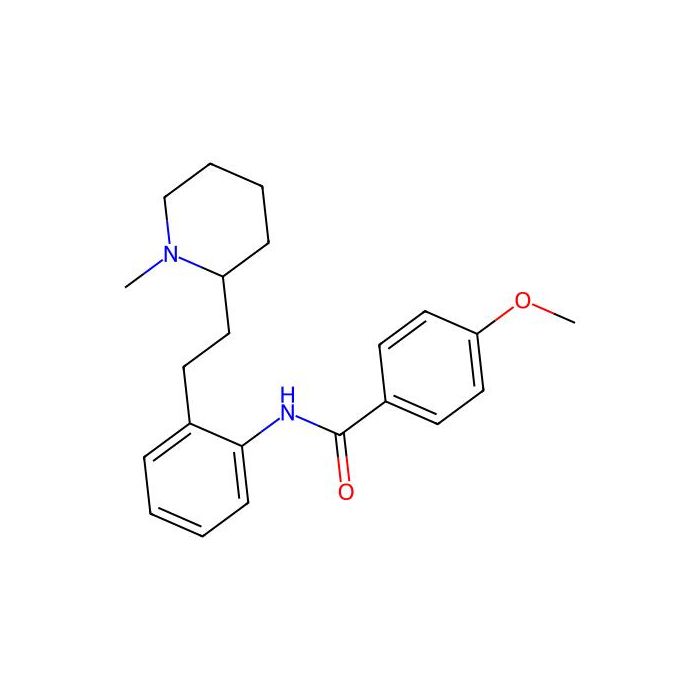
This compound belongs to the class of organic compounds known as benzanilides. These are aromatic compounds containing an anilide group in which the carboxamide group is substituted with a benzene ring. They have the general structure RNC(=O)R', where R,R'= benzene.
External Descriptors
piperidines - benzamides
1. Djoumbou Feunang Y, Eisner R, Knox C, Chepelev L, Hastings J, Owen G, Fahy E, Steinbeck C, Subramanian S, Bolton E, Greiner R, and Wishart DS. ClassyFire: Automated Chemical Classification With A Comprehensive, Computable Taxonomy. Journal of Cheminformatics, 2016, 8:61.
Encainide is a well-characterized small molecule in ion-channel pharmacology and cardiac electrophysiology research. It is commonly cited as a Class Ic antiarrhythmic scaffold that modulates cardiac sodium channels (Nav), slowing conduction by stabilizing the inactivated/open states (literature).
It serves as a reference chemotype for studying state-dependent channel block, use-dependence, and structure–activity relationships among aryl-amine antiarrhythmic agents.
In biochemical profiling, compounds of this class may interact with additional ion channel subtypes or off-targets at higher concentrations, providing a tool for polypharmacology mapping.
ADME-relevant features typically include basicity (facilitating protonation at physiological pH), moderate-to-high lipophilicity, and hepatic metabolism via oxidative pathways; these features can guide in vitro metabolism and transporter studies (literature, class-general).
Use limitations:
For research use only; not for diagnostic, therapeutic, or in vivo clinical use. Any biological findings should be verified across orthogonal assays and appropriate concentration ranges.
Buffer Applications
Not typically used as a buffering agent. Encainide has no role as a pH buffer system.
Practical handling in buffers (general):
To prepare aqueous working solutions, dissolve an aliquot from a DMSO or ethanol stock into the target buffer with vigorous mixing. If needed, slightly acidify the buffer (e.g., with acetate or HCl) to enhance solubility via amine protonation.
Filter sterilize (0.22 μm) for cell-based assays if compatible, and verify final solvent content is within assay tolerance.
Green Alternatives
Context: As a research small molecule, Encainide itself is not replaceable by a “greener” compound without changing experimental intent. However, greener practices can be applied to solvents and workflows used with Encainide.
Greener handling strategies (general):
Prefer lower-toxicity, greener solvents where feasible (e.g., ethanol over acetonitrile or DMF for sample preparation), provided solubility and method performance remain acceptable.
For aqueous formulations, increase buffered aqueous content and minimize DMSO carryover in biological assays (target ≤0.1–0.5% v/v final DMSO).
Use microscale preparations and pre-aliquoted vials to reduce waste and freeze–thaw cycles.
Implement closed-vial analytical injections (e.g., vial caps with septa) to minimize VOC emissions.
Illustrative comparison (solvent choice for stock solutions; general):
DMSO: excellent solubility; environmental/tox concerns moderate; use sparingly and dispose properly.
Ethanol: renewable feedstock, lower toxicity; may limit achievable concentration.
Acetonitrile: LC-friendly but higher environmental burden; reserve for critical analytical steps.
Waste minimization:
Consolidate compatible organic waste streams and label clearly (halogenated vs non-halogenated).
Validate stability to extend stock solution lifetime, reducing repeated preparations.
Pharmaceutical Uses
Context (formulation/manufacturing; no therapeutic claims):
Encainide is a historically known small-molecule active pharmaceutical ingredient (API) referenced in the medicinal chemistry and pharmaceutics literature. In research and development settings, it may be used as a reference standard for analytical method development, impurity profiling, and dissolution testing.
Preformulation studies (R&D) may assess polymorphism, salt selection (e.g., free base vs. hydrochloride), pKa, logP/logD, and excipient compatibility to inform dosage-form prototype design (literature, general practice for basic APIs).
Analytical roles include: system suitability marker for LC methods targeting basic, lipophilic APIs; calibration of mass spectrometric response in positive ESI; and recovery studies in sample preparation workflows.
Regulatory note:
No pharmacopeial monograph details are provided for this catalog item. Users should consult relevant compendia and validate fit-for-purpose methods.
Important: This Aladdin product is supplied strictly for research use only and is not intended for human or veterinary drug products.
Physical Properties
Item-specific specs (for this catalog lot):
Appearance: Not specified for this item; refer to CoA/Spec Sheet.
Molecular weight: Not specified for this item; refer to CoA/Spec Sheet.
Molecular formula: Not specified for this item; refer to CoA/Spec Sheet.
General/literature information (for Encainide; not item specifications):
Physical state: crystalline solid (typical for small aromatic amines; literature)
Solubility profile: free base forms of lipophilic tertiary amines are typically soluble in organic solvents (DMSO, DMF, methanol, ethanol, acetonitrile) and exhibit limited water solubility at neutral pH, with enhanced solubility in acidic aqueous media due to protonation (literature, general).
pKa (amine): tertiary amine antiarrhythmics often exhibit pKa in the ~8–10 range (literature, chemotype-general). Exact pKa for Encainide should be taken from primary references or measured.
LogP/logD: Class Ic antiarrhythmic scaffolds are generally lipophilic (literature, qualitative). Obtain quantitative values from a reference database if needed for modeling.
Melting point, boiling point, density, refractive index, UV cut-off: Not specified for this item; refer to CoA/Spec Sheet. If required for method development, consult peer-reviewed data or measure under your conditions.
Important: The above literature notes are for planning purposes only and must not be treated as acceptance criteria for this SKU. Always rely on the item’s CoA for specifications.
Quality and Grades
Grade/Purity: Moligand™
What Moligand™ signifies (general description of Aladdin offering):
Moligand™ products are research-grade small molecules curated for target engagement, screening, probe development, and medicinal chemistry workflows. Emphasis is placed on identity confirmation and suitability for biochemical/cellular assays.
Implications for this Encainide item:
Identity and suitability: Intended for research use in medicinal chemistry, SAR, analytical reference, and mechanism/target interrogation. Not for human or veterinary use.
UV/LC suitability: While many Moligand™ items are compatible with LC/UV analytical workflows, specific UV cutoffs, impurity profiles, and metal/peroxide limits are item-dependent and not stated here.
Item-specific specifications:
Purity: Not specified for this item; refer to CoA/Spec Sheet.
Stabilizers/inhibitors: Not specified for this item; refer to CoA/Spec Sheet.
Residual solvents/water/peroxides/metals/UV cutoff: Not specified for this item; refer to CoA/Spec Sheet.
Recommended QC practices (user side):
Verify identity by LC–MS and 1H NMR upon receipt for mission-critical work.
For quantitative studies, establish a working reference standard curve with independently characterized material.
Document storage under the recommended -20°C, inert atmosphere to maintain quality traceability.
Reaction and Applications
This product is primarily intended as a research-grade small molecule for biochemical, cellular, and analytical studies rather than as a general synthetic reagent.
Representative research applications (literature/general; expand from typical catalog use):
Reference standard in LC/LC–MS method development and stability-indicating assays for antiarrhythmic chemotypes.
Tool compound for ion-channel pharmacology, electrophysiology, and structure–activity relationship (SAR) exploration in vitro. Suitable for binding/functional assays, high-content screening, and chemoproteomics pilot studies.
Benchmark in permeability/metabolism assessments (e.g., PAMPA/Caco-2, microsomal stability, CYP interaction panels) to contextualize ADME behavior of related analogs.
Analytical and handling tips:
Prepare concentrated DMSO stocks (10–50 mM), aliquot, and store at -20°C under inert gas to minimize oxidation/hydrolysis.
For LC–MS, begin with 50:50 ACN:water + 0.1% FA; adjust gradient and ionization mode (positive ESI is typically favored for basic amines). Validate retention with authentic standard.
For electrophysiology, titrate compound slowly into buffer to avoid local supersaturation; confirm actual free concentration if high protein binding is suspected.
Note: No specific synthetic or catalytic applications are typical for Encainide; select purpose-made reagents for organic synthesis tasks.
Reaction Conditions
Not typically applicable. Encainide is a research small molecule rather than a general-purpose reagent or catalyst.
For derivatization/probe synthesis (if undertaken; general guidance):
Solvents: Anhydrous DMSO, DMF, dichloromethane, or acetonitrile, chosen per transformation and solubility.
Bases/acids: Use mild, non-nucleophilic bases (e.g., DIPEA) for amide couplings; avoid conditions that lead to over-alkylation or decomposition of tertiary amines.
Temperatures: 0–50°C for most functionalizations; monitor by LC–MS.
Purification: Silica gel chromatography with basic modifiers (e.g., 0.1–1% NEt3) can prevent amine tailing; reverse-phase preparative HPLC is often preferred for final polishing.
Yields/times: Highly variable; optimize on milligram scale first. No item-specific reaction performance is claimed here.
Always verify structure and purity of any modified derivatives by NMR and HRMS.
Safety and Handling
Item-specific hazard/GHS (for this SKU):
Signal word: Not specified for this item; refer to SDS.
H-Statements: Not specified for this item; refer to SDS.
GHS classification and pictograms: Not specified for this item; refer to SDS.
General safety guidance (not a substitute for SDS):
Potential hazards: Small-molecule amines and aromatic compounds may cause irritation to skin/eyes/respiratory tract; avoid inhalation and contact. Handle powders in a fume hood to minimize dust.
PPE: Use lab coat, safety glasses, and suitable chemically resistant gloves (e.g., nitrile). For weighing/powder handling, consider particulate respirator controls per institutional policy.
Storage incompatibilities: Keep away from strong oxidizers and strong acids/bases unless preparing salt solutions intentionally. Avoid prolonged exposure to air and moisture; product is supplied argon charged and should be protected from humidity.
First aid (overview): In case of contact, rinse affected area with water for ≥15 minutes. If inhaled, move to fresh air. If ingested or in case of exposure symptoms, seek medical attention. Provide SDS to responders.
Environmental precautions: Prevent release to the environment. Dispose of contents/container according to local regulations.
Note: This product is for research use only. Always consult the official SDS for authoritative hazard and response information before use.
Solvent Selection
Applicability: Encainide is a lipophilic, basic small molecule. Solvent choice is typically driven by intended use (analytical reference standard, in vitro assays, or formulation screening).
General guidance (literature/experience-based):
Preferred stock solvents for assay use: DMSO (anhydrous) is commonly used to prepare 10–50 mM stocks; also compatible: DMF, methanol, ethanol, acetonitrile.
Aqueous handling: As a tertiary amine, Encainide’s solubility generally increases in acidified aqueous buffers (e.g., 0.1 M HCl or acetate buffer) due to protonation. At neutral pH, expect limited intrinsic solubility; consider cosolvent or cyclodextrin approaches for higher concentrations.
Polarity/miscibility context: DMSO and DMF provide the broadest solubilizing power for aromatic amines; methanol/ethanol offer easier removal and greener profiles but may impose solubility limits.
Small comparison (general):
DMSO: maximal solubility, high bp, hygroscopic; ideal for small aliquots in cell/biochemical assays.
MeOH/EtOH: greener, volatile; suitable for analytical sample prep and some formulations.
ACN: LC-friendly, mid-polar; useful for calibration standards.
Practical tips:
Filter or centrifuge stocks to remove particulates before quantitative work.
Avoid water uptake in hygroscopic solvents; prepare under dry conditions.
For long incubations, confirm solvent compatibility with biological systems (e.g., final DMSO ≤0.1–0.5% v/v, assay-dependent).
Storage and Reconstitution
Item-specific instructions (from Product Data):
Storage conditions: Store at -20°C, argon charged.
Shipping: Shipped in ice chest + ice pads.
General handling and reconstitution advice:
Upon receipt, allow the sealed container to equilibrate to room temperature before opening to minimize moisture condensation.
Open under dry, inert atmosphere when possible. Reseal promptly and backfill with argon or nitrogen after each use.
For stock solutions, dissolve in anhydrous DMSO (typical 10–50 mM), aliquot into moisture-tight, low-bind vials, and store at -20°C. Protect from light if your methods suggest photolability.
Avoid repeated freeze–thaw cycles; thaw aliquots just before use. Discard aliquots showing precipitation, discoloration, or atypical chromatography.
Solid-state stability and solution stability (in various solvents) are Not specified for this item; refer to CoA/Spec Sheet. Perform a time-course LC–MS check if long-term storage of solutions is required.
Research use only: Not for human or veterinary use.
Structure and Identity
Product name: Encainide (CAS 66778-36-7)
CID: 48041 (literature)
InChIKey: 279380 (as provided in Product Data)
Molecular formula: Not specified for this item; refer to CoA/Spec Sheet.
Molecular weight: Not specified for this item; refer to CoA/Spec Sheet.
SMILES: Not specified for this item; refer to CoA/Spec Sheet.
Structural features (general, literature):
Encainide is a small, nitrogen-containing organic compound classified in medicinal chemistry as a Class Ic antiarrhythmic scaffold. Literature sources describe a tertiary amine-bearing framework with multiple aromatic/aryl-ether motifs and polarizable functional groups characteristic of membrane-active ion-channel ligands.
Typical features for this chemotype include: one basic amine center (often pKa in the physiologic range), at least one aryl ring, and heteroatom substituents that modulate lipophilicity and basicity.
2D description (general):
An aryl/diaryl core connected through short linkers to a tertiary amine; ether and/or amide linkages can be present depending on salt/form. The molecule is overall neutral in the free-base form and cationic as protonated species in water.
Notes:
Exact connectivity, stereochemistry (if any), and canonical descriptors for this specific catalog item are not specified; consult the CoA/SDS for definitive identifiers for the supplied form (base vs. salt).
Synthetic Utility
Encainide is not commonly employed as a synthetic building block or reagent. Its primary value in the laboratory is as a characterized small-molecule standard and as a tool compound for biological/biophysical studies.
If derivatization is desired for probe development (general considerations):
Functional handle selection: Tertiary amines can be quaternized, acylated (under carefully chosen conditions), or converted to amide-linked conjugates after prior deprotection/activation steps if applicable to the exact structure.
Tagging strategies: Installation of reporter groups (biotin, fluorophores) typically proceeds through linker strategies that avoid compromising the ion-channel binding pharmacophore; SAR scouting is advised to preserve activity.
Immobilization: For affinity matrices, spacer arms tethered through non-critical positions on the aryl or side-chain region are preferred; test binding retention by orthogonal assays.
Note: Because exact functional group placement and reactivity depend on the specific Encainide structure/form supplied, consult primary literature and perform small-scale feasibility experiments before committing to synthetic modifications.
Target Specificity
Item-specific biological target data (clone, epitope, isotype, species reactivity) are not applicable to small molecules and are not provided for this product.
General/literature note:
Encainide is frequently studied as a modulator of voltage-gated sodium channels (Nav) in cardiac electrophysiology research; however, no target specificity claims are made for this catalog item. Users should establish target engagement experimentally under their assay conditions.
Need help choosing the grade?
Our grade selection guide covers purity, stabilizer status, and application suitability for all variants in our catalog.
We use cookies to ensure the website functions properly and, where permitted, to improve your experience. You can manage your preferences at any time in Settings. Learn more in our Cookie Policy.
Shall we send you a message when we have discounts available?
Remind me later
Thank you! Please check your email inbox to confirm.
Products are supplied to verified businesses, institutions, and qualified professionals for research and development use only. Not for use in humans, animals, diagnosis, or therapy.

 H2604617