
Allele-specific PCR with L-DNA labeling
Allele-specific PCR with L-DNA labeling
L-DNA-labeled allele-specific PCR combines allele-specific PCR with L-DNA-labeled PCR.L-DNA-labeled PCR amplifies DNA with a sequence-determined L-DNA tag.L-DNA is the enantiomer of naturally-occurring D-DNA, which consists of L-2' deoxyribonucleic acid. Single-stranded L-DNA is complementary to L-DNA but not to D-DNA, and natural enzymes such as nuclease and polymerase do not work on L-DNA due to the chiral nature of the macromolecule. Because Taq DNA polymerase cannot be synthesized in the L-DNA template, the L-DNA-tagged primers produce a PCR product with L-DNA sticky ends after the PCR reaction, which can be used for SNP typing by surface plasmon resonance (SPR) imaging analysis and is suitable for high-throughput screening. Currently, there is one main method for L-DNA-tagged allele-specific PCR: L-DNA-tagged allele-specific PCR.
Principle
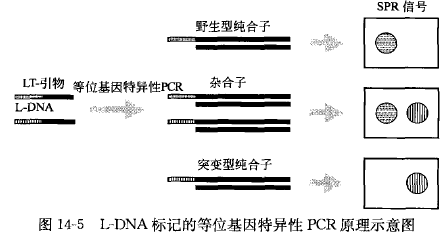
The basic principle of L-DNA-tagged allele-specific PCR is the same as that of allele-specific PCR, with two upstream primers, each containing a different allele at the 3' end, and a common downstream primer. The difference is that the 5' ends of the two upstream primers contain different L-DNA sequences. In Figure 14-5, the different shades at the 5' end of the primers indicate different L-DNA sequences, and the black portion represents the DNA paired with the target sequence. These primers react with different templates, such as wild-type homozygote, heterozygote, and mutant homozygote, and different amounts of L-DNA containing different L-DNA sequences are obtained. For example, wild-type homozygotes (WT homozygote), heterozygotes (heterozygote), and mutant homozygotes (MU homozygote) will result in different amounts of PCR products containing different L-DNAs, which are detected by combining them with complementary L-DNA sequences on the SPR chip.
Operation method
Allele-specific PCR with L-DNA labeling
Principle
The basic principle of L-DNA-tagged allele-specific PCR is the same as that of allele-specific PCR, with two upstream primers, each containing a different allele at the 3' end, and a common downstream primer. The difference is that the 5' ends of the two upstream primers contain different L-DNA sequences. In Figure 14-5, the different shades at the 5' end of the primers indicate different L-DNA sequences, and the black portion represents the DNA paired with the target sequence. These primers react with different templates, such as wild-type homozygote, heterozygote, and mutant homozygote, and different amounts of L-DNA containing different L-DNA sequences are obtained. For example, wild-type homozygotes (WT homozygote), heterozygotes (heterozygote), and mutant homozygotes (MU homozygote) will result in different amounts of PCR products containing different L-DNAs, which are detected by combining them with complementary L-DNA sequences on the SPR chip.
Materials and Instruments
Equipment: PCR amplifier, reagents and instruments for agarose gel polyacrylamide gel electrophoresis, SPR chip and related instruments (SPR-101 TOYOBO, Japan). Move The basic process of L-DNA-labeled allele-specific PCR can be divided into the following steps: Genomic DNA extracted using the kit.
Reagents:
① Template: genomic DNA or serum.
② dNTP mix: 2.5 mmol/L of each deoxyribonucleic acid.
③ Three specific primers: the concentration is 10 μmol/L. Two upstream primers contain L-DNA sequences at the 5' end, and the downstream primers are common DNA sequences.
The downstream primers are common DNA sequences. ④ L-DNA complementary sequences containing sulfur at the 3' end of different L-DNAs.
⑤ L-deoxyribose phosphoramidites (A, G, C, and T) for L-DNA synthesis.
⑥ TaqDNA polymerase and 10 × PCR buffer: 15 mmol/L MgCL
2
(6) TaqDNA polymerase and 10 × PCR buffer: 15 mmol/L MgCL 2, 500 mmol/L KCI, 100 mmol/L Tris-Cl, 0.1% (v/v) Triton X-100.
⑦ High-pressure sterilized deionized water.
Based on the known allelic mutations, the 3' ends of the primers are designed in such a way that the mutations are likely to occur. One forward primer can be fully complementary to the fragment of wild-type allele 1 (the 3' end does not match mutant allele 2), another forward primer is fully complementary to the fragment of mutant allele 2 (the 3' end does not match wild-type allele 1), and the reverse primer is designed to be in the more conserved region, and the amplified fragments are usually within 300 bp. The 5' end of each of the two forward primers contains a portion of the L-DNA sequence, which is about 20-30 bp long, and the portion of the sequence complementary to the template is about 20 bp long, and an internal mismatch is introduced at the penultimate base of the primer to prevent the amplification of the terminal mismatch primer, and the total length of the primer is 40-50 bp. Two sequences consisting entirely of L-DNA need to be synthesized and are identical to the sequences of the L-DNA on the primers. Two sequences composed entirely of L-DNA should be synthesized, which are complementary to the L-DNA sequences on the primers, and immobilized on the surface of the SPR chip.
3. Operation method
(1) Set up a 50 μl PCR reaction system and prepare at least two tubes of reaction solution. Add the following components to a 0.25 ml PCR tube.
Note: L1-MU indicates mutant allele-specific primers; L2-WT indicates wild-type allele-specific primers; RV indicates downstream primers.
If the PCR instrument does not have a thermal cap, add a drop of mineral oil (~50 μl) to the reaction solution. Place the PCR tube onto the PCR instrument.
(2) Setting the PCR reaction conditions

(3) Detection and analysis of PCR products: PCR products can be detected directly by PAGE electrophoresis (10% PAGE, indocyanine blue staining).
For high-throughput assays, a microarray assay based on the SPR instrument can be used. First, a microarray labeled with L-DNA is prepared. 200 μl of lmmol/L 8-amino-n-octanethiol dissolved in ethanol was added dropwise to the gold surface and reacted for 7 h. After being washed with ethanol and deionized water, the aminostilbene-modified surface was reacted for 2 h with 200 μl of 5 mg/ml MAL-PEG12-NHS ester, a heterologous, bifunctional linker that produces maleimide-modified surfaces. Ten drops of 20 μmol/L L-DNA were spotted onto the maleimide surface using an automated spotter. The maleimide-sulfur coupling reaction was performed overnight, and the chip surface was further reacted with 200 μl of 2 mg/ml PEG sulfur for 2 h to block the remaining maleimide groups, after which the chip surface was rinsed with phosphate buffer (10 mmol/L phosphate, 150 mmol/L NaCl, pH 7.2) and water.
The L-DNA-labeled gold microarrays were placed on the SPR imaging system, and the surface was washed with 10 mmol/L NaOH for 2 min and then washed with phosphate buffer (10 mmol/L phosphate, 150 mmol/L NaCl pH 7.2) for 5 min. Prior to the assay, the allele-specific PCR products of the two L-DNA markers were mixed and spiked onto the L-DNA SPR chip for SPR visualization. For SPR visualization, the chip was exposed to the PCR products for 10 min after 100 s of buffer addition at a flow rate of 10 μl/min, and the surface of the chip was rinsed with buffer for 5 min before imaging. All operations in this section were performed at 30 °C. The chip was washed with 0.5 mol/L NaOH for 3 min and was then reusable. SPR images and signal data were collected.
Caveat
① See Allele-specific PCR for precautions related to the PCR reaction. The principle of operation is the same for both reactions, so the precautions are also the same.The L-DNA sequence cannot affect the PCR amplification efficiency.③ When analyzing SPR images, the presence of unbound L1-MU or L2-WT may result in non-specific binding, so the background value should be subtracted from the analysis.
For more product details, please visit Aladdin Scientific website.