
C2-Symmetric Chiral BOX (Bis(oxazoline)) Ligands: How to Make Enantioselectivity (ee) Robust in Asymmetric Catalysis (Key Structural Points and Typical Applications)
C2-Symmetric Chiral BOX (Bis(oxazoline)) Ligands: How to Make Enantioselectivity (ee) Robust in Asymmetric Catalysis (Key Structural Points and Typical Applications)
1.A practical question: Why do many asymmetric reactions “work,” yet the ee is hard to keep stable?
In asymmetric catalysis research and process scale-up, the main difficulty is often not whether the reaction can proceed, but whether the selectivity and kinetic behavior can remain consistent across batches and across scales. This type of instability is commonly dominated by two factors:
1. ee (enantiomeric excess; a practical measure of enantioselectivity) is highly condition-sensitive: changing the metal salt counterion, the water content in the solvent, the stoichiometry, or the order/mode of addition can lead to pronounced fluctuations in ee and reaction rate.
2. Multiple catalytic species may coexist in the system: under different conditions, the same ligand–metal combination may form different coordination states (e.g., monomers vs dimers), causing the “actually operating active species” to switch—thereby amplifying batch-to-batch differences and process variability.
The BOX (bis(oxazoline)) ligand family is important because it offers a ligand scaffold that more readily builds a stable chiral environment and is convenient for systematic tuning: through N,N chelation, the metal center is “locked” into a reproducible coordination geometry, and C2 symmetry helps reduce competing reaction pathways. As a result, BOX ligands more often deliver high ee that is reproducible and easier to generalize across different substrates.
2.Basic definition: What is a C2-type axially symmetric chiral bis(oxazoline) (BOX) ligand?
2.1 Chemical definition of BOX
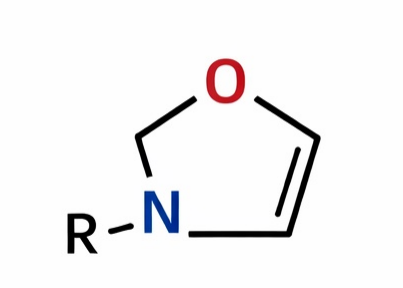
1. Oxazoline: a five-membered heterocycle containing N and O, in which the nitrogen atom often serves as a coordination donor.
2. Bis(oxazoline), BOX: a family of ligands in which two (typically 2-oxazoline) rings are connected by a spacer/linker. The most typical coordination mode is N,N bidentate chelation—the two oxazoline nitrogens bind to the same metal center, forming a stable chelate structure.
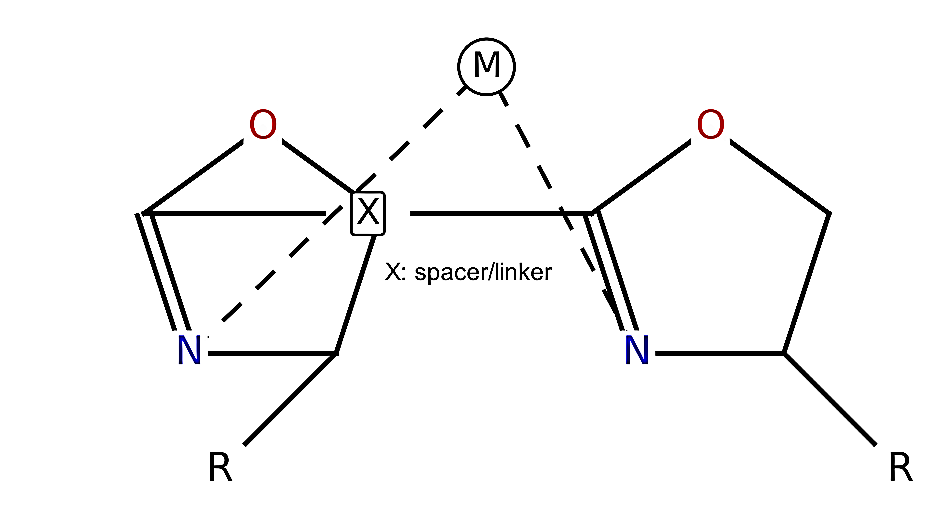
3. C2 twofold rotational symmetry (C2-symmetry): the ligand molecule (or its typical metal complex) possesses a C2 rotational axis; after a 180° rotation about this axis, it coincides with (is equivalent to) the original structure.
In asymmetric catalysis, C2 symmetry is important mainly because it often can:
a) Reduce the number of possible catalyst isomers/coordination forms (for example, making two equivalent donor sites truly “equivalent,” thereby lowering the chance of forming multiple isomeric complexes), so the system more closely operates as a “single dominant species.”
b) Reduce the number of possible transition states within the same reaction, focusing stereochemical induction onto fewer competing pathways—making it easier to obtain higher and more stable ee.
c) Because the two oxazoline rings in C2-BOX are symmetry-equivalent, this often helps make the chiral environment around the metal center more uniform and predictable, and reduces fluctuations arising from competition among pathways.
2.2 “What does the most common BOX look like?”
Across many classic systems, the most common motif is a linker with a one-carbon spacer. This often forms a six-membered metal chelate ring and brings the substituents on the oxazoline rings close to the metal center, enabling more direct steric control over the substrate’s approach face.
3.Structural features → key properties: Why can BOX help stabilize ee?
3.1 C2 symmetry: compressing the “number of possible transition states” to fewer
C2 symmetry often helps reduce the coexistence of catalyst isomers and nonequivalent binding modes, so stereochemical induction is concentrated into fewer competing pathways. However, this is not a hard rule—what happens in practice still depends on the metal salt form, counterion occupancy, and how the substrate binds/enters the coordination sphere. Under this more “convergent” catalyst-geometry background, the system is more likely to exhibit relatively stable ee trends and a reproducible selectivity window.
3.2 Chelation and conformational constraint: turning the metal center into a “more shape-fixed” chiral site
BOX–metal chelates typically impose strong conformational constraints; meanwhile, the chiral centers are located close to the donor nitrogens, enabling strongly directional control over the reactive space around the metal.
3.3 “Open sites” and substrate interaction: controlling selectivity while retaining catalytic activity
In many BOX systems, the metal:ligand = 1:1 BOX–metal complex is commonly used as the primary working model: BOX fixes the chiral environment via N,N chelation, while the metal center often still retains some space for binding and exchange with substrates/counterions/solvents—thereby balancing stereocontrol and catalytic activity.
But this is not a hard rule: depending on metal oxidation state, counterion identity, solvent coordination strength, and concentration, the system may show changes in coordination number, 2:1 complex formation, coexistence of dimers/aggregates, or strong counterion/solvent coordination that fills up the “open sites.” Once the dominant species and/or occupying ligands switch, the substrate binding mode and reaction pathways will change accordingly—manifesting as condition-sensitive ee and rate.
4.The three BOX “positions” most often modified: what each affects and how it shows up in results
Structural module (what you can modify) | Typical ways to vary it | Most direct property affected | What readers can observe in practice |
Substituents on the oxazoline rings (R) | Changing steric bulk/shape, e.g., tBu / iPr / Ph | Spatial distribution of the chiral pocket; how the substrate approaches and how the transition state is shielded | ee changes (up/down), and enantioselectivity inversion may occur; side-reaction fraction and regio-/diastereoselectivity may change accordingly |
Spacer / linker (spacer/linker) | One-carbon vs two-carbon link; more rigid backbones (aryl / fused-ring motifs, etc.) | Chelate-ring size; conformational rigidity; coordination geometry of the complex and the preferred form of the active species | Changes in rate and temperature sensitivity; changes in how sensitive ee is to perturbations (temperature / concentration / solvent) |
Metal center and coordination environment (counterion/salt) | Cu(I)/Cu(II)/Zn(II)/Fe(II/III)…; OTf⁻, PF6⁻, halides, etc. | Coordination number/geometry of the active species; occupancy of open sites; substrate binding mode | With the same BOX, switching the metal or counterion can significantly change rate and ee; this is a common root cause of “small condition changes → big outcome changes” |
Note: “A one-carbon spacer, a six-membered chelate ring, and substituents positioned close to the metal center” is one of the most common baseline forms in BOX systems—and one of the most frequently used starting points for building high ee.
5.Application map
5.1 Typical BOX application areas × the problems they address
Application area (reaction type) | Common metal centers (typical oxidation states) | Practical bottleneck (why it’s hard to make robust) | BOX’s core contribution (why it’s widely used) |
Asymmetric cyclopropanation (carbene transfer) | Cu(I), etc. | Very fast reactions with strong transition-state competition; selectivity is sensitive to sterics and the coordination environment (counterion/solvent/coordination number) | C2 symmetry + near-metal steric control helps reduce competing approach pathways; it more readily establishes a relatively consistent chiral coordination environment, improving ee reproducibility |
Asymmetric Diels–Alder and related Lewis-acid reactions | Lewis-acid metals such as Cu(II), Zn(II) | Substrate binding modes and counterion/solvent occupancy can change stereochemical induction; multiple complex forms may coexist | As a chiral Lewis-acid ligand, BOX stabilizes the substrate-binding geometry via N,N chelation plus tunable sterics, making stereochemical induction more focused and more predictable |
Asymmetric nitrene transfer (e.g., aziridination) and related additions | Cu, etc. (common) | Must balance activity and selectivity; shifts in active-species/complex form can amplify differences | BOX–metal complexes provide a chiral environment while retaining reactive sites; systematic tuning of R and the salt environment can optimize ee and the operating window |
6.How to make ee and rate “robust”: common fluctuation sources in BOX systems and the first parameters to lock down
Common source of fluctuation | What it affects (ee / rate) | Parameters to fix first |
Changes in active-species form (e.g., different monomer/dimer ratios) | Different species often correspond to different coordination geometries and reaction pathways; once the dominant species switches, the ee and rate profile can change accordingly | Fix the metal:ligand ratio; fix pre-complexation (pre-mixing) time and temperature; keep overall composition and concentration as consistent as possible |
Changes in coordination environment (different counterion/solvent/water occupancy) | Replacing open-site “occupants” changes substrate binding and transition states, affecting ee and rate | Fix the counterion of the metal salt; fix the solvent system and proportions; control water content (keep water sources consistent) |
Geometry differences driven by ligand framework (chelate-ring size; spacer rigidity) | Conformational constraint and substrate entry trajectories change, often shifting the selectivity window and temperature/concentration sensitivity | Under the same metal center + the same salt form (counterion), fix the spacer/linker type first, then tune the R substituents |
7.Product navigation table|How to choose among C2-BOX / BOX / PyBOX / BiOx: start from Table A/B/C based on your task (then compare sterics and linkers)
Research / experimental need | Which table to check first | Selection logic | Representative products in the table |
You want to “get the reaction working” fast and quickly find an ee/activity baseline: first time using the BOX family, not sure which linker/substituent class to pick | Table A: bridged C2-BOX | Bridged C2-BOX is the most common “general starting point”: the bridge (CH₂ vs CMe₂) plus 4-substituents (iPr/Ph/tBu) give a clear sterics/rigidity gradient—ideal for first-round screening and benchmarking | I121120 (R,R-tBu-CMe₂-BOX), R404605 (R,R-iPr-CMe₂-BOX), R1038705 (CH₂-PhBOX) |
With the same metal/substrate, ee is insufficient, selectivity is poor, or background reactions are high: you need a more “pre-formed” chiral pocket to amplify steric differences | Table B: rigid/extended-backbone BOX | When “standard BOX” does not give enough stereodifferentiation, a common strategy is to move to a more rigid backbone: IndaBOX/DBF-BOX often “hardens and deepens” the chiral environment to push higher ee or suppress background pathways (still requires small-scale validation) | A115671 (fused-ring IndaBOX), R281579 / S300633 (DBF-BOX enantiomers) |
Late-stage drift, poor reproducibility, suspected non-single metal species / unstable coordination: you want something that “grips the metal” more strongly and more readily forms a single dominant active species | Table C: PyBOX (tridentate) | PyBOX is N,N,N tridentate and is often used as an alternative platform to enhance coordination stability and suppress species drift; if you need a more stable coordination platform to improve durability and reproducibility, start by benchmarking PyBOX. Note: it may also reduce open sites, slow the rate, or change the mechanism—validate by small-scale comparisons under the same metal-salt form (oxidation state/counterion). | S115669 (iPr-PyBOX), B115667 (Ph-PyBOX), B299797 (tBu-PyBOX) |
BOX/PyBOX both look average; you want to change “bite geometry/linkage” to seek a breakthrough: still bis(oxazoline), but hoping a different geometry creates a new window | Table C: BiOx (direct 2,2′-linkage) | BiOx is a bis(oxazoline) with direct linkage and no bridge, giving a geometry different from BOX/PyBOX; when the system is highly sensitive to bite angle/coordination shape, BiOx is often an effective alternative platform to search for a better ee/activity combination | B587171 (R,R-Bn-BiOx), B299847 (S,S-Bn-BiOx) |
You already have a workable reaction, but want to systematize variables into an “interpretable control set”: you need a structural gradient for mechanistic/geometry attribution | Mainly Table A; add B/C if needed | The lowest-effort path for controls: first build a “sterics × bridge” matrix in Table A using iPr/Ph/tBu + CH₂/CMe₂; if differences are still small, introduce Table B (more rigid backbones) or Table C (stronger binding / different geometry) as second-layer variables | Table A: R404605/L115664/I121120/R1038705; Table B: A115671/DBF-BOX; Table C: PyBOX/BiOx |
You need to invert absolute configuration or run enantiomer checks: you need to switch product configuration within the same system | Find the paired enantiomer in the corresponding table (A or B or C) | Most BOX/PyBOX/DBF-BOX/BiOx entries come as enantiomeric pairs; the most robust approach is to switch (R,R) ↔ (S,S) within the same backbone and substituents, avoiding simultaneous introduction of extra structural variables | Table A: I121120 ↔ L115670; Table B: R281579 ↔ S300633; Table C: B587171 ↔ B299847 |
Practical tips:
1. If you want speed: start with Table A (bridged BOX) to establish a baseline of “it reacts and gives ee.”
2. If you want higher ee / cleaner profiles: move to Table B (more rigid backbones) to push the upper limit.
3. If you want better robustness / durability: switch to PyBOX in Table C; if you want a geometry change, then look at BiOx.
Table A | Bridged C2-BOX (CH₂ / CMe₂ / alkylidene bridges) — grouped by bridge type and substituents
Category | CAS No. | Aladdin Cat. No. | Name | Spec / Purity | Product features & applications |
C2-BOX | isopropylidene bridge CMe₂ (Isopropylidene-BOX) | 4-tBu | (R,R) | 131833-97-1 | (R,R)-(+)-2,2′-Isopropylidene bis(4-tert-butyl-2-oxazoline) | ≥98% | The “CMe₂ bridge + tBu” combination provides high steric bulk and a more well-defined chiral cavity, making it a common high-ee candidate; widely used in asymmetric catalysis with Cu(II)/Zn(II)/Ni(II), etc. (cyclopropanation, additions involving N/O electrophiles, Lewis-acid-type reactions) to suppress side reactions and improve stereoselectivity. | |
C2-BOX | isopropylidene bridge CMe₂ | 4-tBu | (S,S) | 131833-93-7 | (S,S)-(-)-2,2′-Isopropylidene bis(4-tert-butyl-2-oxazoline) | ≥98% | Used as the enantiomeric counterpart to (R,R) for rapid inversion of product absolute configuration; the high-steric tBu version is often used to push ee higher, suppress side reactions, and improve the selectivity window for “more demanding substrates.” | |
C2-BOX | isopropylidene bridge CMe₂ | 4-iPr | (R,R) | 150529-94-5 | (R,R)-2,2′-Isopropylidene bis(4-isopropyl-2-oxazoline) | ≥98% | iPr offers “moderate, relatively balanced” sterics, often serving as a BOX-family screening starting point or as a steric-gradient comparison versus tBu/Ph; suitable for compromise optimization across rate, solubility, and ee, commonly in coordination catalysis with Cu/Zn/Fe, etc. | |
C2-BOX | isopropylidene bridge CMe₂ | 4-iPr | (S,S) | 131833-92-6 | (S,S)-2,2′-Isopropylidene (4-isopropyl-2-oxazoline) | ≥95% | Enantiomeric complement of the moderate-steric version; useful for condition screening and mechanistic comparison (effects of sterics/configuration on rate and ee), often paired with Cu/Zn/Fe coordination centers. | |
C2-BOX | isopropylidene bridge CMe₂ | 4-Ph | (R,R) | 150529-93-4 | (R,R)-2,2′-Isopropylidene bis(4-phenyl-2-oxazoline) | ≥96% | The 4-phenyl substituent provides a “harder” aromatic sidewall and opportunities for π interactions; often used in asymmetric Lewis-acid/coordination catalysis involving aromatic substrates to enhance selectivity differentiation, and as a structure–selectivity comparison point versus iPr/tBu. | |
C2-BOX | isopropylidene bridge CMe₂ | 4-Ph | (S,S) | 131457-46-0 | (S,S)-2,2′-Isopropylidene bis(4-phenyl-2-oxazoline) | ≥97% | Enantiomeric counterpart of the aromatic-sidewall version; commonly a high-selectivity candidate for aromatic substrates or systems needing stronger steric/π differentiation, and together with iPr/tBu forms a “steric–rigidity gradient” screening set. | |
BOX | isopropylidene bridge (1-methylideneethyl) | 4,5-diphenyl (high sterics / strong steric confinement) | 157904-67-1 | (4R,4″R,5S,5″S)-2,2″-(1-methylideneethyl)bis[4,5-dihydro-4,5-diphenyloxazole] | ≥98%, ≥99% (ee) | “CMe₂ bridge + 4,5-diphenyl” represents a more extreme endpoint in both steric bulk and rigidity; often used in systems requiring very high ee or strong suppression of competing diastereomeric/side pathways (e.g., deep-optimization stages of Cu–BOX asymmetric reactions). The stated high ee is convenient for use as a high-selectivity reference material. | |
C2-BOX | methylene bridge CH₂ (Methylene-BOX) | 4-Ph | 150639-34-2 | (4R)-4-phenyl-2-[[(4R)-4-phenyl-4,5-dihydro-1,3-oxazol-2-yl]methyl]-4,5-dihydro-1,3-oxazole | ≥97% | A classic “methylene-bridged” BOX platform with slightly higher flexibility and high screening value; 4-phenyl provides combined π/steric tuning. Common in chiral Lewis-acid systems with Cu(II)/Zn(II), and in ee optimization/substrate expansion for radical or electrophilic addition-type asymmetric reactions. | |
C2-BOX | methylene bridge CH₂ | 4-tBu | (S,S) | 132098-54-5 | 2,2′-Methylene bis[(4S)-4-tert-butyl-2-oxazoline] | ≥96% | CH₂-bridged versions are typically “a bit looser” than CMe₂-bridged analogs and may offer a better activity–selectivity balance for some metal/substrate combinations; tBu provides high steric bulk, often used to increase ee, suppress side reactions, and improve batch-to-batch reproducibility (to be verified within the metal salt/solvent/temperature window). | |
C2-BOX | methylene bridge CH₂ | 4-Ph | (S,S) | 132098-59-0 | 2,2′-Methylene bis[(4S)-4-phenyl-2-oxazoline] | ≥97% | The CH₂ bridge + 4-Ph combination is often used for screening in asymmetric Lewis-acid/coordination catalysis involving aromatic substrates; can serve as a quick comparison point versus CMe₂-PhBOX and CH₂-tBuBOX to locate an optimal pocket shape using the two variables “bridge type/sterics.” | |
BOX | methylene bridge CH₂ | 4,5-diphenyl (high sterics / strong steric confinement) | 139021-82-2 | 2,2′-Methylene bis[(4R,5S)-4,5-diphenyl-2-oxazoline] | ≥97% | 4,5-diphenyl creates stronger steric enclosure and a “harder” pocket; often used when targeting high ee or suppressing competing pathways (e.g., certain Cu–BOX cyclopropanations, nitrene transfer, electrophilic additions). Also commonly used as a “high-steric limit point” for comparison with 4-monosubstituted BOX ligands. | |
C2-BOX | alkylidene bridge (3-pentylidene) | 4-iPr | 160191-65-1 | (4S,4′S)-(-)-2,2′-(3-pentylidene)bis(4-isopropyl-2-oxazoline) | ≥97% | The “alkylidene bridge” introduces a conformation/flexibility profile distinct from CH₂/CMe₂, making it useful as a bridge variable in screening; 4-iPr provides moderate sterics and is often used in Cu/Zn systems to balance activity and ee, especially when substrates are sensitive or when a gentler steric pressure is desired. |
Table B | Rigid / extended BOX scaffolds (IndaBOX / dibenzofuran-BOX)
Category | CAS No. | Aladdin Cat. No. | Name | Spec / Purity | Product features & applications |
Rigid fused-ring C2-BOX | fused scaffold to rigidify the pocket (IndaBOX / fused BOX types) | 180186-94-1 | (+)-2,2′-Methylene bis[(3aR,8aS)-3a,8a-dihydro-8H-indeno[1,2-d]oxazole] | ≥98% | A fused-ring scaffold markedly increases ligand rigidity and the degree of “pocket pre-organization”; commonly forms more stereocontrolling coordination environments with Cu/Zn/Ni/Fe, etc., and is used in asymmetric Lewis-acid catalysis and classic BOX reactions (e.g., cyclopropanation, Diels–Alder/Mukaiyama aldol, Henry/electrophile additions) to improve ee and substrate compatibility. | |
Extended rigid scaffold BOX | dibenzofuran-BOX (DBF-BOX) | (R,R) | 195433-00-2 | (4R,4′R)-2,2′-(4,6-dibenzofurandiyl)bis[4,5-dihydro-4-phenyl-2-oxazole] | ≥95% | The dibenzofuran scaffold further “hardens/deepens” the chiral environment and is often used where stronger stereodifferentiation is needed; with Cu/Zn/rare-earth metals, it may deliver higher ee/cleaner selectivity for challenging substrates or under more demanding temperature windows (depending on the metal and reaction type). | |
Extended rigid scaffold BOX | dibenzofuran-BOX (DBF-BOX) | (S,S) | 246040-77-7 | (4S,4′S)-2,2′-(4,6-dibenzofurandiyl)bis[4,5-dihydro-4-phenyl-2-oxazole] | ≥98% | Paired with the corresponding enantiomer to directly switch product absolute configuration; the rigid DBF scaffold is commonly used as a screening route to amplify stereodifferences, suppress background reactions, and increase ee (still requires small-scale, metal/substrate-matched comparisons). |
Table C | Tridentate PyBOX + alternative geometry BiOx (2,2′-directly linked bis(oxazoline))
Category | CAS No. | Aladdin Cat. No. | Name | Spec / Purity | Product features & applications |
PyBOX | 2,6-pyridine tridentate (stronger binding / more stable metal center) | 4-iPr | 118949-61-4 | (S,S)-2,6-bis(4-isopropyl-2-oxazolin-2-yl)pyridine | ≥99% | PyBOX is an N,N,N tridentate ligand and typically “grips” metal centers more strongly than BOX, helping to build more single, well-defined species; often used where higher coordination stability/durability is needed (e.g., asymmetric catalysis with Cu/Fe/rare-earth metals, and stereochemical control in some transition-metal systems). iPr provides mild sterics suitable for establishing baseline conditions first. | |
PyBOX | 2,6-pyridine tridentate | 4-Ph | 174500-20-0 | (S,S)-2,6-bis(4-phenyl-2-oxazolin-2-yl)pyridine | ≥98% | 4-Ph increases sidewall rigidity and stereodifferentiation; commonly used to push ee higher or address “flatter” substrate differences, and works well as a structure comparison point versus iPr/tBu within the PyBOX family. | |
PyBOX | 2,6-pyridine tridentate | 4-tBu | 118949-63-6 | 2,6-bis[(4S)-4-tert-butyloxazolin-2-yl]pyridine | ≥98% | tBu-PyBOX imposes higher steric restriction around the metal center and is often used to “drive” stereodifferentiation stronger; suitable when background reactivity is high or competing coordination/side reactions are significant—leveraging more stable tridentate binding plus higher sterics to pursue higher ee/cleaner selectivity (still to be matched to the metal salt and substrate). | |
BiOx | 2,2′-directly linked bis(oxazoline) (no bridge / shorter linkage) | 4-Bn | (R,R) | 141362-76-7 | 2,2′-bis[(4R)-4-benzyl-2-oxazoline] | ≥97%, ≥99% (ee) | The “directly linked” type (no CH₂/CMe₂ bridge) provides a different bite geometry and rigidity; benzyl balances sterics and solubility, and is often used in asymmetric coordination-catalysis screening when better organic-phase compatibility is desired or when tuning the “soft/hard” character of the chiral cavity. It is complementary to conventional BOX/PyBOX options. | |
BiOx | 2,2′-directly linked bis(oxazoline) (no bridge / shorter linkage) | 4-Bn | (S,S) | 133463-88-4 | 2,2′-bis[(4S)-4-benzyl-2-oxazoline] | ≥98% | Used as the enantiomeric counterpart to (R,R) for configuration switching; benzyl often gives better solubility and “flexible steric bulk,” making it a useful geometric alternative when BOX ligands perform only moderately—offering opportunities to improve ee under different bite angles/coordination geometries. |
For more related articles, please see below:
108 SadPhos, Find Your Own Chiral Phosphine Ligands/Catalysts
N-Heterocyclic Carbene (NHC) Ligands