Effect of gibberellin on the induced synthesis of alpha-starch
Effect of gibberellin on the induced synthesis of alpha-starch
Master the method of determining amylase activity by using gibberellin (GA3)-induced degradation of starch by synthetic a-amylase to diminish the blue-purple color reaction of starch when exposed to iodine. Deepen the induction of gibberellin. Recognize the physiological properties of amylase synthesis.
Principle
During seed germination, the starch stored in the endosperm undergoes hydrolysis to produce reducing sugars. It is now clear that gibberellin is the chemical messenger that induces the synthesis of a-amylase in the dextrin layer cells of barley. When the seed swells, gibberellin is first secreted by the embryo and released into the dextrin layer cells of the endosperm to induce the synthesis of a-amylase. The newly synthesized a-amylase enters the endosperm and catalyzes the hydrolysis of starch stored in the endosperm to form short-chain dextrin and a small amount of maltose and glucose to provide energy for seed germination and seedling growth.
The addition of GA3 can replace the role of gibberellin secreted by the embryo and induce the synthesis of a-amylase in the endosperm dextrin layer cells. Within a certain concentration range, the amount of GA- added is directly proportional to the synthesized a-amylase activity. The amylase activity can be tested according to the reaction property of starch showing blue-purple color when it meets iodine. In this experiment, GA3 was used to induce the a-amylase synthesized in seeds and degrade the starch so that the blue-purple color disappeared to determine the effect of GA3 on a-amylase.
Operation method
Effect of gibberellin on the induced synthesis of alpha-starch
Principle
During seed germination, the starch stored in the endosperm undergoes hydrolysis to produce reducing sugars. It is now clear that gibberellin is the chemical messenger that induces the synthesis of a-amylase in the dextrin layer cells of barley. When the seed swells, gibberellin is first secreted by the embryo and released into the dextrin layer cells of the endosperm to induce the synthesis of a-amylase. The newly synthesized a-amylase enters the endosperm and catalyzes the hydrolysis of starch stored in the endosperm to form short-chain dextrin and a small amount of maltose and glucose to provide energy for seed germination and seedling growth. The addition of GA3 can replace the role of gibberellin secreted by the embryo and induce the synthesis of a-amylase in the endosperm dextrin layer cells. Within a certain concentration range, the amount of GA- added is directly proportional to the synthesized a-amylase activity. The amylase activity can be tested according to the reaction property of starch showing blue-purple color when it meets iodine. In this experiment, GA3 was used to induce the a-amylase synthesized in seeds and degrade the starch so that the blue-purple color disappeared to determine the effect of GA3 on a-amylase.
Materials and Instruments
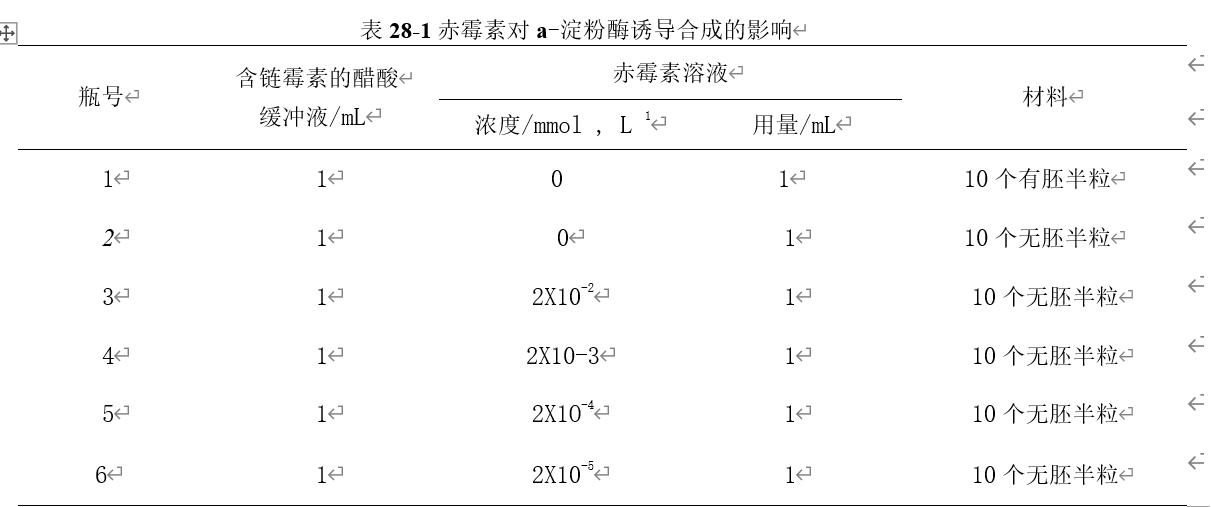
Material: barley (or wheat) seeds. Move (i) Preparation of standard curve 1. Use starch phosphate solution (containing starch 1000 L-1 ) as the master batch and dilute it to 0 μg - L-1, 10 μg - L-1, 50 μg - L-1, 100 μg - L-1, 150 μg - L-1, 200 μg - L-1 with distilled water. 10 μg - L-1, 50 μg - L-1, 100 μg - L-1, 150 μg - L-1, 200 μg - L-1, 250 μg - L-1, 300 μg - L-1 starch phosphate solution. 2. Take 9 test tubes and separate the starch phosphate solution (containing starch 1000 - L-1) into the standard curve. 2. 9 test tubes were filled with 2 mL of each of the above starch phosphate solutions at different concentrations, and then 2 mL of I2-KI solution and 5 mL of evaporated water were added, and shaken well. 3. Colorimetry was performed at 580 nm. Take 0 concentration as blank to correct the zero point of the instrument, and read out the absorbance values of each concentration accurately. 4. 4. Take the different concentrations of starch as the horizontal coordinate and the absorbance value as the vertical coordinate to draw the standard curve. (II) Material Cultivation 1. Select 50 barley seeds of uniform size, cut each seed into two halves with a razor blade, so that it will become half of the non-embryo and half of the embryo. 2. 2. Put the embryo-free and embryo half seeds into the newly prepared 1% sodium hypochlorite solution for 15 min, take them out and rinse them with sterile water for several times, and then reserve them. (iii) Induction of amylase 1. Take 6 vials of penicillin and number them. 2. 2. Add various solutions and materials according to Table 28-1. 3. 3. incubate the above vials at 25 °C for 24 h (preferably with oscillation, if not, the vials must be shaken frequently). (iv) Determination of amylase activity 1. 0.2 mL of culture solution should be sucked from each vial, and added into test tubes containing 8 mL of amylopectin phosphate solution (containing 1,000 μg L-1 of starch), shaken well, and kept warm for 10 mino at 30 °C. 2. 0.2 mL of culture solution should be added into each test tube. 2. Add 2 mL of L2-KI solution and 5 mL of evaporated water into each test tube and shake well. 3. 3. Perform colorimetry at 580 nm, determine the absorbance, adjust the zero point of the instrument should be the same solution with the standard curve. Read out the absorbance value of each solution accurately, and then check the content of starch in each solution from the standard curve. 4. 4. Express the amylase activity in terms of the amount of starch decomposed per unit volume of enzyme solution per unit time (mg - mL-1 - min-1 ). (v) Experimental results The relationship between gibberellin concentration and a-amylase activity was analyzed by plotting the logarithm of gibberellin concentration as the horizontal coordinate and a-amylase activity as the vertical coordinate. Caveat When cutting seeds crosswise, be sure to make the germ-free half completely germ-free so that the presence of the embryo does not bias the results. For more product details, please visit Aladdin Scientific website.
Reagent: 1% sodium hypochlorite solution;
Starch phosphate solution: 1 g of soluble starch and KH
2
PO
4
16 g, dissolved in distilled pyramid water and then volume to 1000 mL; 2×10
-5
mol-L
-1
Gibberellin solution: 6.8 mg of gibberellin was dissolved in a small amount of 95% acetic acid, and the concentration was 2×10 -5 mol - L -1 by adding vaporized water to 100 mL.
The concentration is 2×10⁻⁵ mol - L -1
mol - L
-1
The concentration was 2×10 -5 mol - L -1, and then diluted to 2×10 -5 mol - L -1.
then diluted to 2×10 -5 mol - L -1, then diluted to 2×10 -5
mol-L
L-1
L-1, 2 × 10⁻⁵ mol-L-1, 2 × 10⁻⁵ mol-L-1, 2 × 10⁻⁵ mol-L-1
L-1, 2×10⁻⁵ mol - L-1, 2×10⁻⁵ mol - L-1
mol-L
L-1
L -1 , 2X10
L-1, 2X10 -8 mol - L-1, 2X10 -8 mol - L-1
mol-L-1
L-1, 2X10⁻⁸ mol - L-1, 2X10⁻⁸ mol - L-1
0.5 mmol・L
-1
Acetic acid buffer (pH 4. 8): 1 mg of streptomycin per mL of buffer;
I
2
-KI solution: 0.6 g KI and 0.06 g I
2
were dissolved in 1000 mL of 0.05 mol - L
-1
HCl.
Equipment: spectrophotometer, thermostat, test tubes, penicillin vials, pipettes, beakers
inlay, single sided blade, test tube rack, etc.