Measurement of polyphenol oxidase (PPO) activity
Measurement of polyphenol oxidase (PPO) activity
Polyphenol oxidase (PP0) is widely present in plant tissues, and can oxidize phenolic substances to Da substances, but this reaction does not occur frequently in normal tissues, but can occur if the tissues are damaged, such as the browning of apples and eggplant wounds. In addition, polyphenol oxidase activity is significantly elevated when plants are susceptible to disease. Therefore, the determination of phenolic content and polyphenol oxidase activity is a frequently used indicator in the physiological study of plant resistance. The purpose of this experiment is to learn the method, principle and operation technique of polyphenol oxidase activity.
Principle
Polyphenol oxidase catalyzes the oxidation of phenolic compounds such as catechol to Da, and the resulting product (Da) has a maximum absorption peak at 525 nm, and its absorbance value is positively correlated with the amount of the product generated, so the activity of polyphenol oxidase can be determined accordingly.
Operation method
Measurement of polyphenol oxidase (PPO) activity
Principle
Polyphenol oxidase catalyzes the oxidation of phenolic compounds such as catechol to Da, and the resulting product (Da) has a maximum absorption peak at 525 nm, and its absorbance value is positively correlated with the amount of the product generated, so the activity of polyphenol oxidase can be determined accordingly.
Materials and Instruments
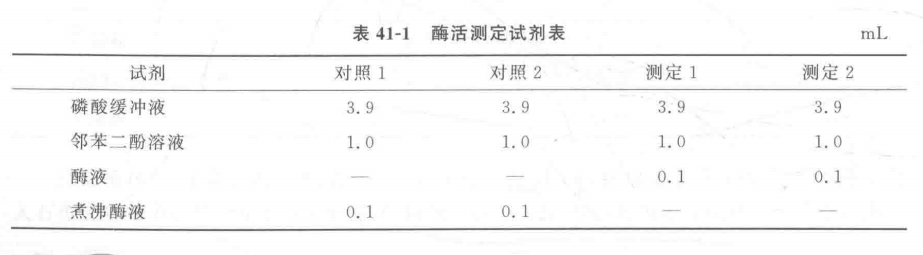
Material: potato tubers etc. Move The basic procedure for the determination of polyphenol oxidase (PPO) activity can be divided into the following steps: 1. Extraction of enzyme solution: Take 5 g of washed and peeled potato tubers, chop them and put them into a mortar. Add appropriate amount of phosphate buffer and grind into homogenate. Transfer all the homogenate into a centrifuge tube and centrifuge at 3,000 r - min-1 for 10 min, and transfer the supernatant into a 25 mL volumetric flask. The precipitate was extracted twice with 5 mL of phosphate buffer, and the supernatant was added into a volumetric flask, and the volume was fixed to the scale. Store at low temperature. 2. Determination of enzyme activity: Take 4 test tubes (2 control, 2 measurement) and add reagents according to Table 41-1. Hold the water bath at 37°C for 10 min, and add 2 mL of 20% trichloroacetic acid to terminate the enzyme reaction immediately after the time. The reaction solution was centrifuged at 4,000 r -min for 10 min, the supernatant was collected and diluted appropriately, and its absorbance was measured at 525 nm. 3. Calculation of results: The polyphenol oxidase activity unit (U) was defined as the amount of enzyme required to change the absorbance value by 0.01 within 1 min of 1 g of fresh sample. Where: △ A - change in absorbance value during the reaction time; W-fresh weight of experimental material, g; t - reaction time, min; D - dilution times. Caveat Do not bruise or rub plant samples before handling. For more product details, please visit Aladdin Scientific website.
Reagent: 0.5 mol - L
-1
pH 5.5 phosphate buffer, 0.1 mol - L
-1
catechol solution, 20% trichloroacetic acid.
Equipment: spectrophotometer, centrifuge, mortar, volumetric flasks, test tubes, etc.