RNA interference-based knockdown technology in animals
RNA interference-based knockdown technology in animals
RNAi is a type of gene silencing that occurs through in vivo shearing to form small (~21 nt) double-stranded RNAs in which the antisense strand is complementary to the transcript of the target gene, resulting in a double-stranded structure that mediates sustained degradation of the target gene. RNAi-mediated gene silencing is more rapid, cost-effective and efficient than gene knockdown, and it is widely used in functional genome studies and is well suited for studying homologous genes in a wide range of organisms.
Principle
The principle of RNAi-based knock-down technology is to use a type II promoter to transcribe a long, reverse-complementary fragment, which is transcribed to form a long, hairpin-structured transcript that undergoes intracellular RNA processing to form a short, double-stranded, interfering RNA. These vectors all culminate in the formation of a RISC, followed by the shearing or degradation of the tissue mRNA, thereby silencing the target gene.
Operation method
RNA interference-based knockdown of PKD2 in mice
Principle
The principle of RNAi-based knock-down technology is to use a type II promoter to transcribe a long, reverse-complementary fragment, which is transcribed to form a long, hairpin-structured transcript that undergoes intracellular RNA processing to form a short, double-stranded, interfering RNA; a single type II promoter to initiate the reverse-complementary target siRNA sequence to form a hairpin structure, which is then sheared to form a double-stranded siRNA; two type II promoters to initiate short RNA annealing to form short, double-stranded RNA; and expression of miRNA to form short, single-stranded, knock-downable RNA in vivo. These vectors all culminate in the formation of a RISC, followed by the shearing or degradation of the tissue mRNA, thereby silencing the target gene.
Materials and Instruments
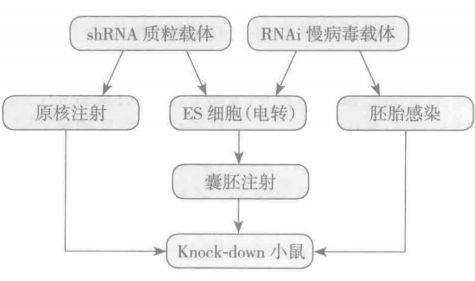
Equipment: Move I. Screening of RNA interference targets (i) Finding mRNA sequences or sequence accession numbers (ii) Using free online tools to design RNAi target sequences. Construction of RNA interference vectors (A) pSico oligonucleotide design According to the method provided in the first part, we can find a suitable target sequence of CD8, take 19mer: GCTACAACTACTACATGAC as an example. Then the forward primer can be designed as: 5'-TGCTACAACTACTACATGACT-TCAAGAGAGAGTCATGTAGTAGTTGTAGCTTTTTTG The reverse primer is: 5'-GTTACAAAAAAGCTACAACTACTACAT- GACTCTCTTGAAGTCATGTAGTAGTAGTTGTAGCA This ensures that the 5' will be the end when annealed and the 3' will be the sticky end after XhoI cleavage. (ii) Cloning oligonucleotides into pSico vector 1. Order primers: When ordering primers, you need to 5' phosphorylation, PAGE purification. Dilute to 100 μmol/L with water. 2. Anneal 3. Ligation and transformation: Ligate according to the digestion system, incubate at room temperature for 3 hours, then add 2 μl of ligase, followed by bacterial transformation. 4. Identification of positive clones: Sac II-Not I (pSico) or Xho I-Xba I (pSicoR) double digestion was used to identify positive clones. The positive fragment was 50 bp larger than the empty one (660 for pSico and 710 for pSicoR; 350 for pSicoR and 400 bp for pSicoR). 5. Sequencing Verification It is advisable to sequence the constructed vector to confirm that the vector conforms to the design. When sequencing, please note that this vector will form a hairpin structure, so please use special sequencing. Establishment of knock-down interference models The shRNA plasmid vector was produced, linearized and then directly injected into the fertilized eggs of mice, similar to the preparation of ordinary transgenic mice. Detection of interference effects and phenotypic analysis (a) Detecting the mRNA level in mice: Northern blot, qRT-PCR, in situ hybridization, and even microarray technology can be used to detect the expression level of target genes at the mRNA level. (ii) Use Western blot, IF, ELISA, FACS, etc. to test the effect of interference. Caveat The role of RNAi is highly sequence-dependent, and while the mechanisms are not yet fully understood, there are currently some principles that can make our design of RNAi efficient. These are as follows:1. The cDNA targeting region of the target gene must be located 50-100 nt downstream of the initiation codon (ATG). 2. Look for the sequence motif of AA(N19)TT or r NA(N21), or NAR(N17)YNN. where N stands for any nucleotide, R for purine (A, G), and Y for pyrimidine (C, U).Avoid targeting to introns because RNAi works only in the cytoplasm and not in the nucleus.Avoid sequences with a G + C content greater than 50%.Avoid 4 or more consecutive nucleotide repeats. 6. Avoid untranslated regions of genes even if RNAi targeting to non-coding regions can successfully induce gene silencing. Unless you need to inhibit the expression of the endogenous target gene and then express the mutant or tagged fusion gene, so that it is different from the endogenous gene and designed to the untranslated region site. For more product details, please visit Aladdin Scientific website.
Disposable sterile gloves, surgical forceps, syringes, pipette guns, tips, PCR instrument, water bath, centrifuge, electrophoresis machine;
Materials:
Mouse, gonadotropin, DNA polymerase, restriction endonuclease, ligase, agarose, electrophoresis buffer.