
Technical articles
Structural Features, Interfacial Reactions, and Application Selection Logic of Ureido Silanes
Structural Features, Interfacial Reactions, and Application Selection Logic of Ureido Silanes
Introduction
Ureido silanes are a class of silane coupling agents that contain both a ureido organic end group and a hydrolyzable alkoxysilane end group. To understand this class of materials, it is essential to consider molecular structure, interfacial reaction processes, and practical application selection together: one end can form bonds with inorganic surfaces such as glass, metal oxide layers, and mineral fillers after hydrolysis and condensation, while the other end can influence interfacial compatibility and adhesion with resins, adhesives, primers, and composite systems through polar interactions and hydrogen bonding. Common representative products mainly include 3-ureidopropyltrimethoxysilane, 3-ureidopropyltriethoxysilane, and their solvent-free or alcoholic solution forms.
1. What Are Ureido Silanes
Ureido silanes are a class of bifunctional organosilanes. Their molecules contain both a hydrolyzable alkoxysilane end group and a ureido organic end group, so they can participate both in bond formation on inorganic surfaces and in interfacial interactions on the organic-system side.
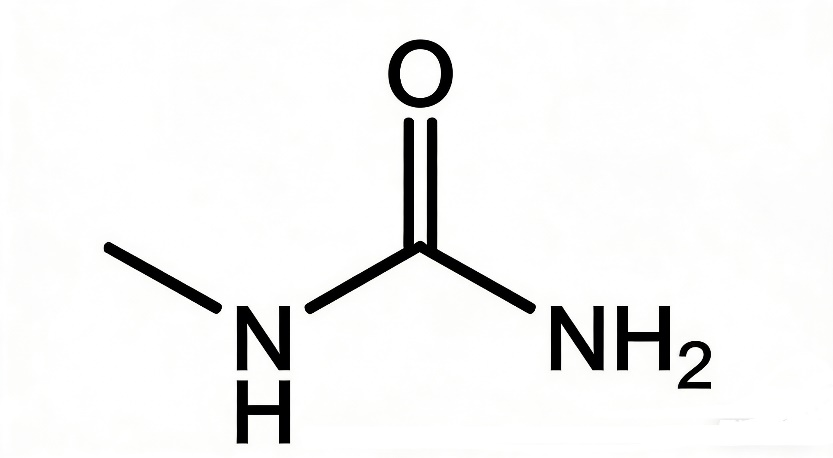
The key structural feature of these molecules lies in the distinct role played by each end. The alkoxysilane end is usually written as Si(OR)₃. Upon contact with water, it first hydrolyzes to form silanols, then continues to condense, and forms linkages with hydroxyl groups on surfaces such as glass, silica, metal oxide layers, and mineral fillers. The ureido end contains one carbonyl group and two nitrogen atoms. The N-H groups can serve as hydrogen-bond donors, while the carbonyl oxygen can serve as a hydrogen-bond acceptor. As a result, this end is strongly polar and can readily generate interfacial interactions with resins, adhesives, primers, and other polar organic systems.
2. Structural Units and Interfacial Roles of Ureido Silanes
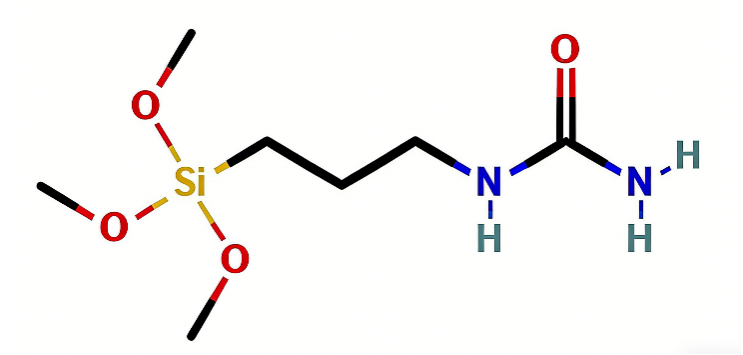
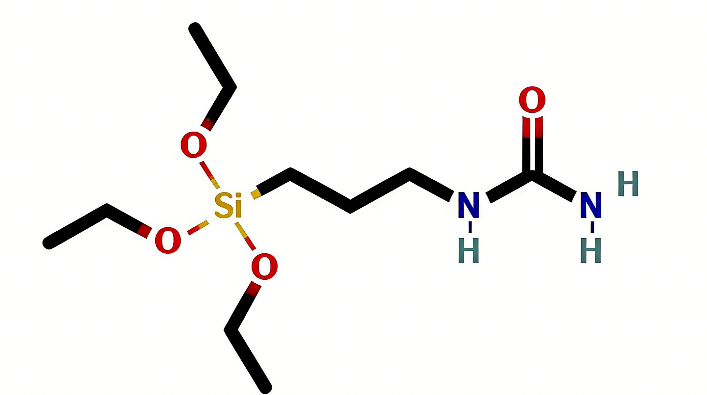
The interfacial behavior of ureido silanes is mainly determined by three structural elements: the hydrolyzable trialkoxysilane end, the propyl chain linking the two ends, and the ureido end containing a carbonyl group and N-H groups. The trialkoxysilane end determines whether stable bonding can be formed with an inorganic surface, the propyl chain affects the spatial separation between the two ends, and the ureido end governs interfacial interactions with polar organic systems.
Structural Unit | Main Characteristics of the Structural Unit | Main Role in the Interfacial Process |
Trialkoxysilane end | Usually Si(OR)₃, where R is commonly methyl or ethyl | Under aqueous conditions, it first hydrolyzes to form silanols, then can continue to condense and form linkages with inorganic surfaces such as glass, metal oxide layers, and mineral fillers |
Propyl linking chain | A three-carbon chain connecting the silane end and the ureido end | Provides a certain spatial separation and flexibility between the inorganic-interacting end and the organic-interacting end, affecting molecular arrangement at the interface and the interaction distance |
Ureido end | Contains a carbonyl group and N-H groups, has strong polarity, and can participate in hydrogen bonding | Helps enhance interfacial compatibility and adhesion with resins, adhesives, primers, and other polar organic systems |
Taking ureidopropyltrimethoxysilane and ureidopropyltriethoxysilane as examples, their structural formulas are shown below to help illustrate the structural characteristics of ureido silanes:
3. Reaction Processes and Evaluation Points to Watch in Use
When ureido silanes are introduced into a formulation or a surface-treatment system, the first things to examine are the hydrolysis of the alkoxysilane end and the subsequent condensation, followed by how these changes affect treatment-solution stability, interfacial layer formation, and the usable time after preparation. The main differences between methoxy and ethoxy types are also reflected in hydrolysis rate and the type of alcohol released.
Process or Evaluation Point | Triggering Condition or Influencing Factor | Main Change | What to Check First in Use |
Alkoxy hydrolysis | Presence of water or moisture | The alkoxy groups first hydrolyze to form silanols and release the corresponding alcohol | Methoxy types release methanol, while ethoxy types release ethanol; this affects how well the system can tolerate the released alcohol and also influences product selection. |
Further silanol condensation | Standing after hydrolysis, or the presence of reactive hydroxyl groups on the surface | Silanols can continue to condense to form siloxane structures and can also form linkages with inorganic surfaces | The treatment solution continues to change; if left standing too long, further condensation may occur, which in turn affects the usable time after preparation and the state of the interfacial layer. |
Difference between methoxy and ethoxy types | Different alkoxy groups | Methoxy groups generally hydrolyze faster, while ethoxy groups are relatively slower | “When other conditions are similar, methoxy types can usually be evaluated first as the faster-hydrolyzing route; when methanol release is a concern, or when a somewhat broader usable time after preparation of the treatment solution is desired, ethoxy types can be evaluated first. |
Stability in aqueous systems | Affected by concentration, pH, system composition, and standing conditions | Stability time can differ significantly across different systems | The stability time of a single product under specific conditions should not be extrapolated as a universal rule for all aqueous ureido silane systems. According to publicly available data from Momentive, the hydrolysis product of A-1524 CF is generally stable for more than 72 hours in water at 1 wt.% and pH 4; this is only data under specific conditions. |
Whether the substrate surface is suitable for bonding | Depends on surface hydroxyl groups, surface chemistry, and the type of inorganic surface | Determines whether the silane end can form a stable interfacial linkage | The first step is to determine whether the surface is suitable for bonding through the silane end, and then assess whether the ureido end can further improve adhesion and compatibility. |
4. Categories, Characteristics, and Selection Points of Ureido Silanes
Classification Basis | Category | Main Characteristics | Main Role | When to Prioritize This Category |
By structural framework | Single-ended ureidopropyl trialkoxysilanes | One end is a hydrolyzable trialkoxysilane and the other end is a ureido group; this category best represents the basic structure of ureido silanes | Used for interfacial bonding between inorganic materials and organic polymers; can serve as adhesion promoters and as surface modifiers | When the focus is on interfacial bonding between glass, metals, fillers, reinforcing materials, and resins, this category can be considered first. |
By alkoxy type | Methoxy type | Generally hydrolyzes faster and releases methanol upon hydrolysis; solvent-free or 100% active commercial products are also common | Commonly used in routes requiring relatively rapid hydrolysis, and can also be evaluated for suitability in some reactive formulation systems | When onset speed is of greater concern, or when direct incorporation into reactive formulations is desired, methoxy types can be evaluated first. |
By alkoxy type | Ethoxy type | Usually hydrolyzes relatively more slowly and releases ethanol upon hydrolysis; commercial products are often alcoholic solutions | Suitable for surface treatment, primers, and systems requiring a certain operating window | When methanol release is a concern, or when a somewhat broader treatment-solution and application window is desired, ethoxy types can be evaluated first. |
By supply form | Solvent-free or 100% active type | Contains no alcohol or other diluent solvent and has a high content of active component | Convenient for direct addition to high-solids or reactive systems and reduces the influence of added solvent on the formulation | When the formulation is sensitive to additional solvent, or when direct addition into a reactive polymer system is planned, this category can be prioritized. |
By supply form | Alcoholic solution type | Commonly about 50% active component in methanol or methanol/ethanol solutions | Commonly used to prepare treatment solutions and primer solutions, and also used in filler surface treatment and coating systems | When ureido silanes are to be formulated into treatment solutions or primer solutions, or when the system itself can tolerate an alcoholic medium, this category can be considered first. |
By application focus | Adhesion-promoting type | Emphasizes interfacial bonding between inorganic surfaces and organic systems | Used to improve adhesion in adhesives, primers, sealants, and coating systems | When the main problem is insufficient adhesion, reduced wet adhesion, or unstable interfaces, evaluation can begin from the perspective of an adhesion promoter. |
By application focus | Surface modification and filler treatment type | Emphasizes treatment of inorganic materials such as fillers, glass fibers, and pigments, as well as improved dispersion | Used for filler surface treatment, glass fiber treatment, composite interfacial improvement, and coating systems | When the focus is on filler dispersion, glass fiber treatment, or interfacial transfer in composites, evaluation can begin from the perspective of a surface modifier. |
5. Main Applications of Ureido Silanes
Main Application | Main Role | When to Prioritize Attention |
Adhesives and sealants | Improve adhesion and interfacial stability between inorganic substrates and organic formulations; this is one of the most important applications of ureido silanes. | When the substrate is glass, metal, or a mineral surface, and the main problem is insufficient adhesion, unstable interfaces, or decreased bonding after moisture exposure. |
Primers, base coats, coatings, and varnishes | Used as an adhesion-promoting component or primer component to improve coating adhesion to substrates. | When an interfacial layer must first be established on an inorganic surface before subsequent coating or bonding steps. |
Surface treatment of inorganic fillers, pigments, and mineral particles | Used as a coupling agent for modification of fillers, pigments, and inorganic particles, improving their dispersion in organic binders and plastics and helping enhance properties such as flexural strength, tensile strength, and modulus. | When the focus is on filler dispersion, interfacial layer construction, and improvement of the mechanical properties of composites. |
Glass fibers, glass fiber fabrics, and their composites | Used in glass fiber sizings or finishing systems to enhance interfacial bonding between glass fibers and resins. | When improvement is needed in interfacial transfer and composite performance between glass-fiber-reinforced materials and resin matrices. |
Resin formulation additives | Can be incorporated into related formulations such as phenolic, epoxy, urea-melamine, and polyurethane systems, and can also be used in some polar resin-related systems to improve interfacial bonding between inorganic and organic phases. | When the formulation contains inorganic fillers, fibers, or metal surfaces and improved resin adhesion or interfacial compatibility is required. |
Foundry resins, foundry sand, and abrasive bonding systems | Used as a resin additive to improve interfacial interactions between inorganic particles and organic bonding systems. | When the application scenario involves foundry resins, foundry sand bonding systems, or abrasive binders. |
Resin binders for thermal insulation materials | Can be used in resin-bonding systems for insulation materials such as glass wool and mineral wool to improve interfacial bonding between fibers and resins. | When the formulation belongs to a resin-bonding system involving fibrous inorganic materials. |
6. Representative Chemicals of Ureido Silanes and Related Reference Silanes for Structural Comparison, Interfacial Behavior, and Application Evaluation
Classification | CAS No. | Aladdin Catalog No. | Name | Specification or Purity | Product Features and Applications |
Single-ended ureido silane (methoxy type) | 23843-64-3 | 1-[3-(Trimethoxysilyl)propyl]urea | ≥97% | Combines a single-ended ureido group with trimethoxysilane; suitable for examining the hydrolysis-condensation behavior, adhesion promotion, and interfacial bonding of ureido silanes on surfaces such as glass, metal oxide layers, and siliceous fillers. It can also be used together with amino silanes to compare the influence of the ureido end group on interfacial behavior in polar resins, primers, and composite systems. | |
Monoamine reference amino silane (ethoxy type) | 919-30-2 | (3-Aminopropyl)triethoxysilane | ≥98% | A monoamine-ended, triethoxy-route silane suitable for comparison with ureidopropyltriethoxysilane to examine differences between free amine ends and ureido ends in adhesion promotion, treatment-solution stability, and resin interfacial behavior. It is also commonly used for coupling and surface amination on glass fibers, inorganic fillers, and oxide surfaces. | |
Monoamine reference amino silane (methoxy type) | 13822-56-5 | (3-Aminopropyl)trimethoxysilane | ≥97% | A monoamine-ended, trimethoxy-route silane suitable for parallel comparison with methoxy-type ureido silanes to observe how changing the organic end group from amine to ureido affects interfacial bonding, formulation performance, and adhesion behavior. It is also used for surface modification of glass, silica, oxide fillers, and resin systems. | |
Polyamine reference amino silane (methoxy type) | 1760-24-3 | N-[3-(Trimethoxysilyl)propyl]ethylenediamine | ≥95% | Combines a diamine structure with trimethoxysilane; suitable for comparison with single-ended ureido silanes to examine differences in surface site density, interfacial polarity, and condensed-layer construction brought by polyamine ends. It can also be used to introduce diamine sites onto oxide surfaces for studying subsequent surface grafting, adsorption, and interfacial reaction behavior. | |
Bis-urea bridged silane (methoxy type) | 18418-53-6 | Urea, N,N'-bis[3-(trimethoxysilyl)propyl]- | ≥95% | Contains trimethoxysilane groups at both molecular ends with a urea bridge in the middle; suitable for studying two-ended hydrolysis-condensation, formation of surface crosslinked layers, and bridging effects between fillers or fibers. In inorganic filler, glass fiber, and coating interfaces, it can be used to examine how networked interfacial layers affect adhesion, post-moisture interfacial stability, and changes in mechanical performance. | |
Single-ended ureido silane (ethoxy solution type) | 23779-32-0 | N-(Triethoxysilylpropyl)urea | 40.0 - 50.0 % in methanol | A methanolic solution form of a single-ended ureido ethoxy silane, suitable for examining the hydrolysis-condensation behavior of the ethoxy route in primer solutions, surface-treatment solutions, and formulations, as well as differences from methoxy-type ureido silanes in the type of alcohol released, usable time after preparation, and mode of use. It can also be used to study interfacial adhesion in glass fibers, mineral fillers, and coating systems. |
Note: The above are representative Aladdin products. For more product specifications, search by “product name/CAS/catalog number” on the Aladdin website.
References
[1] Shin-Etsu Chemical Co., Ltd. Silane Coupling Agents.
[2] Wacker Chemie AG. Silanes for Powerful Connections.
[3] Wacker Chemie AG. GENIOSIL® UPTM.
[4] Evonik Operations GmbH. Dynasylan® 2201 EQ. Technical Data Sheet. 2024-12-30.
[5] Momentive Performance Materials Inc. Silquest™ A-1524 Silane. Marketing Bulletin.
[6] Momentive Performance Materials Inc. Silquest A-1524 CF Silane. Technical Data Sheet.
[7] Shin-Etsu Chemical Co., Ltd. KBE-585A. Shin-Etsu Silicone Selection Guide.
[8] Shin-Etsu Chemical Co., Ltd. KBM-585. Shin-Etsu Silicone Selection Guide.
[9] Gelest, Inc. Silane Coupling Agents.
For more related articles, see below: