
Three Main Differences Between AEBSF and PMSF Protease Inhibitors
Three Main Differences Between AEBSF and PMSF Protease Inhibitors
Serine proteases are widespread inside and outside cells and play key roles in proteolysis, signal transduction, and apoptosis. In protein extraction and purification, endogenous or exogenous serine proteases can rapidly cleave target proteins if left unchecked, severely compromising sample quality. Selecting an appropriate serine protease inhibitor is therefore a foundational step in establishing a stable protein-preparation workflow.
AEBSF and PMSF are two of the most frequently used irreversible serine protease inhibitors in laboratories. Both permanently inactivate proteases by covalently modifying the active site, but they differ markedly in aqueous stability, toxicity and safety, and “side effects” on protein systems. These differences determine which is better suited to different experimental scenarios.
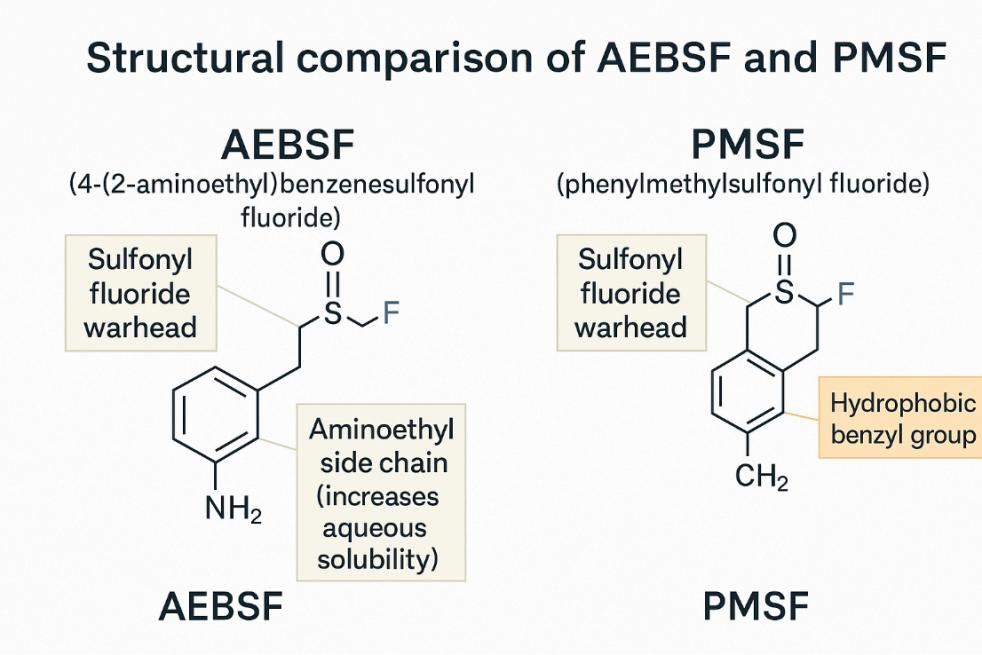
Positioning of Protease Inhibitors and of AEBSF/PMSF
Protease inhibitors can be categorized in multiple ways. One axis is the protease class targeted: serine protease inhibitors, cysteine protease inhibitors, aspartic protease inhibitors, and metalloprotease inhibitors, etc. Another axis is reversible versus irreversible inhibition.
Reversible inhibitors block activity transiently via noncovalent interactions; once the inhibitor is removed or conditions change, protease activity can recover—useful when only short-term suppression is needed. Irreversible inhibitors covalently modify the active site so the protease remains inactive throughout the experiment; these are commonly used for cell lysis, long incubations, or contexts where reactivation is undesirable.
Both AEBSF and PMSF are irreversible serine protease inhibitors and strongly inhibit many serine proteases, including proteinase K. Thus, when serine proteases must be thoroughly inactivated, either can serve as a tool compound.
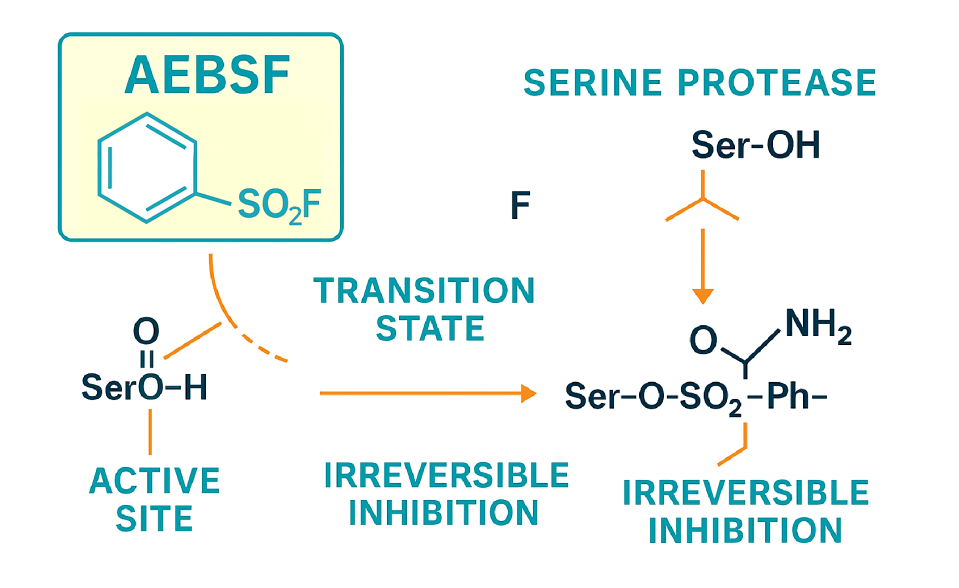
Figure 1 AEBSF inhibition mechanism
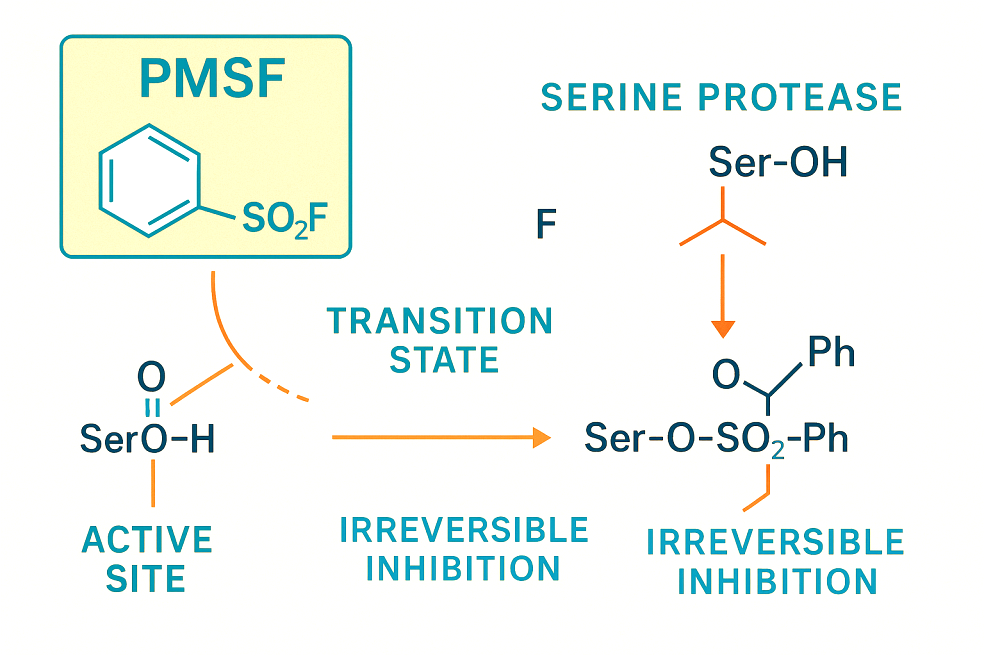
Figure 2 PMSF inhibition mechanism
Difference 1: Stability in Aqueous Solution
The most obvious difference is their stability in water. AEBSF is relatively stable in aqueous solution and hydrolyzes more slowly, making it suitable for use over a period after preparing the working solution. By contrast, PMSF hydrolyzes readily in water and its activity drops quickly over time.
Direct consequences include:
1) If procedures are lengthy or the inhibitor must be present throughout, AEBSF more readily maintains an effective concentration;
2) Despite its instability, PMSF reacts rapidly shortly after addition, suiting it to swift inhibition at the moment of lysis or mixing; it is therefore typically “prepared fresh,” first dissolved in an organic solvent and only diluted into the aqueous phase shortly before use.
In practice, adjusting pH can modestly improve PMSF stability, but its inherent hydrolytic lability remains. From a stability perspective, AEBSF fits systems requiring sustained inhibition, whereas PMSF functions more like a “rapid-acting” inhibitor.
Difference 2: Toxicity and Safety Considerations
Another key difference is toxicity and safety. PMSF has higher toxicity and irritancy to personnel and the environment, and its degradation can generate toxic byproducts. Enhanced PPE is usually required—strict use of gloves and eye protection—and careful handling during solution preparation and waste disposal.
AEBSF can also irritate skin and eyes, but under normal use with proper protection its overall toxicity is generally considered lower than PMSF’s, and its degradation products pose comparatively less risk. Thus, in labs with stringent safety requirements or in settings of frequent/large-scale inhibitor use, AEBSF more often becomes the first choice.
Importantly, both are hazardous chemicals—neither is “harmless.” The difference lies in risk level. Safety protocols should not be relaxed but tailored in intensity and waste management to the inhibitor used.
Difference 3: Action Characteristics and Impacts on Protein Systems
For their primary function—serine protease inhibition—both perform well. However, their breadth of reactivity and “collateral effects” on systems are not identical.
At higher concentrations, AEBSF can, in addition to reacting with active-site serine residues, modify certain protein tyrosine, lysine, histidine residues, and N-terminal amines. This means that if used too concentrated—or if the target protein is particularly sensitive to such modifications—charge state or conformation may change, potentially affecting functional assays or fine-structure studies. Reports indicate that within recommended ranges most proteins show no notable nonspecific modification, but exceptions exist and should be screened via literature and pilot tests.
PMSF’s reactivity is comparatively more focused on active-site serine; its “spectrum” is somewhat narrower than AEBSF’s, but due to its chemistry and handling, its effective time window is shorter and it depends more on organic solvents and environmental conditions.
From a use-case standpoint:
1)If the system is finely tuned, highly sensitive to structural modifications, and robust safety and handling procedures are acceptable, researchers may flexibly choose after fully understanding the target protein’s properties;
2)If the priority is preventing large-scale degradation during lysis and purification and subtle modifications are not a concern, AEBSF or PMSF at recommended conditions are both workable.
Selection Recommendations by Scenario
Situations favoring AEBSF
1)The inhibitor must persist in an aqueous system for an extended period (e.g., long post-lysis incubations or multi-step purifications);
2)The lab emphasizes safety and seeks to reduce use of highly toxic reagents;
3)The system contains components sensitive to organic solvents;
4)Minor potential off-target modifications are tolerable, or major risks have been ruled out by pilot tests.
Situations favoring PMSF
1)Only rapid inhibition at the moment of lysis or for a short period is needed;
2)Subsequent steps finish quickly and do not rely on prolonged inhibitor presence;
3)Potential modification of particular residues (e.g., Tyr, Lys, N-termini) should be minimized, and suitable safety/PPE and waste protocols are already in place.
AEBSF and PMSF are classic irreversible serine protease inhibitors that help protect protein samples from degradation. Their essential differences are not about “which is stronger,” but about stability, toxicity, and potential system impacts—hence their suitability for different use cases. By comparing mechanism, stability, and safety, and aligning with the target protein’s features and downstream needs, researchers can choose more rationally between AEBSF and PMSF—and even deploy both at different stages of a project—to achieve a workflow that balances sample quality, safety, and operational convenience.
Aladdin: https://www.aladdinsci.com/