
Technical articles
Vinyl Silanes and Related Vinyl Functional Silanes: From Structural Features and Interfacial Action to Classification and Selection
Vinyl Silanes and Related Vinyl Functional Silanes: From Structural Features and Interfacial Action to Classification and Selection
1. What Are Vinyl Silane Coupling Agents
Vinyl silane coupling agents are a class of organosilanes that contain both a vinyl organic end and a hydrolyzable silicon end, and they belong to the broader family of silane coupling agents. In their molecular structure, the vinyl group is located at the organic end and retains the potential to enter grafting, copolymerization, or crosslinking systems. The silicon end bears hydrolyzable groups such as methoxy and ethoxy, which can hydrolyze in the presence of water and then further bond to the surfaces of glass, silica, metal oxides, and some mineral fillers. Common representative structures include vinyltrimethoxysilane, triethoxyvinylsilane, and related compounds.
2. Structural Features of Vinyl Silane Coupling Agents
Structural Feature | Details | Structural Variations and Their Effects |
Simultaneous presence of a vinyl organic end and a hydrolyzable silicon end | The molecule contains both a vinyl group and a hydrolyzable silyl group, making it a bifunctional organosilane. | One end retains a reactive site for the organic phase, while the other provides the basis for bonding at inorganic interfaces. |
Vinyl group located at the organic end | The vinyl group is present as an unsaturated double bond and is the characteristic organic-end feature that distinguishes this class of silanes from other functional silanes such as amino, epoxy, and methacryloxy silanes. | Differences in the organic-end functional group determine the type of subsequent reactions the silane can participate in within the organic phase. |
Hydrolyzable groups at the silicon end | The silicon end is typically bonded to hydrolyzable groups such as methoxy and ethoxy, which can form silanols upon contact with water. | The type and number of hydrolyzable groups affect subsequent hydrolysis and condensation behavior. |
Different types of hydrolyzable groups | Common types include methoxy, ethoxy, and other alkoxy groups such as isopropoxy and tris(2-methoxyethoxy). | Different alkoxy groups influence hydrolysis and condensation behavior; methoxy types are usually faster, while ethoxy types are usually slower. |
Different numbers of hydrolyzable groups | Structures include trialkoxy types as well as dialkoxy types. | Dialkoxy types generally tend to form condensation structures with lower crosslink density and a more linear character, whereas trialkoxy types more readily form more highly crosslinked condensation networks. |
Typical core frameworks are relatively concentrated | Common representative structures include vinyltrimethoxysilane, triethoxyvinylsilane, and other vinyl alkoxysilanes. | Trialkoxy structures are the most common basic framework, while other types are largely variations built on this foundation. |
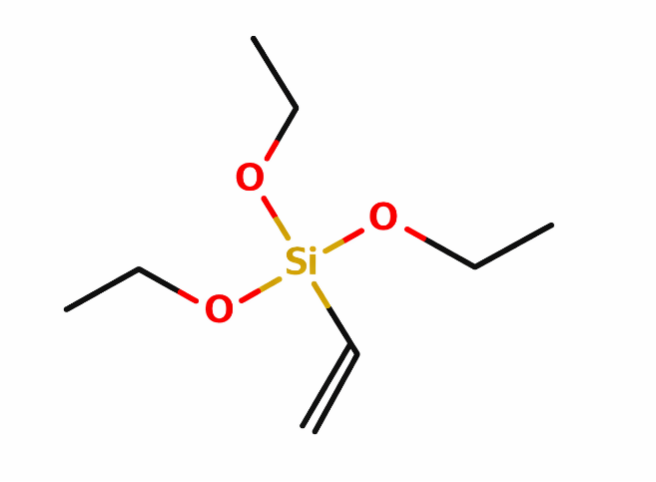
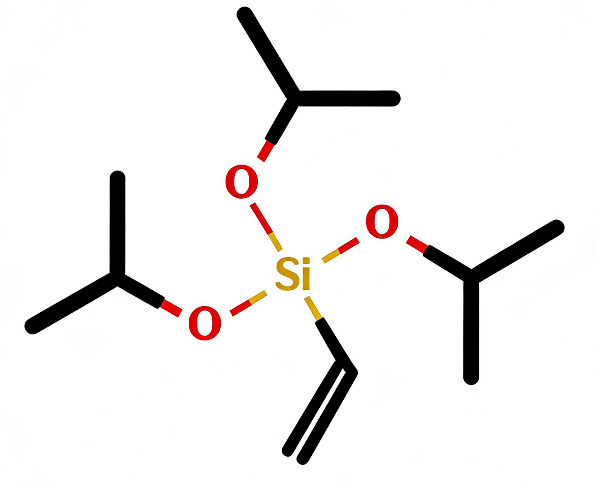
Taking triethoxyvinylsilane (CAS 78-08-0) and triisopropoxy(vinyl)silane (CAS 18023-33-1) as examples, their structural formulas are shown in the figure below. They illustrate the basic structural features of vinyl silanes: a vinyl group at one end and alkoxy groups at the other.
3. Classification of Vinyl Silane Coupling Agents and Related Vinyl Functional Silanes
Category | Category Features | Typical Applications | Representative Compound |
Methoxy-type trialkoxy vinyl silanes | The silicon end bears three methoxy groups. Trialkoxy structures are highly reactive and hydrolyze relatively quickly. | Moisture crosslinking after peroxide grafting onto polyethylene; interfacial coupling between mineral fillers or glass fiber and resins; polymer dispersion modification; water scavenging in sealant systems. | Vinyltrimethoxysilane. |
Ethoxy-type trialkoxy vinyl silanes | The silicon end bears three ethoxy groups. Hydrolysis is slower, formulation stability after incorporation is relatively better, and ethanol is released as the hydrolysis by-product. | Coupling in filled polymer systems; moisture-crosslinkable polyethylene; wire and cable insulation and jacketing materials; wet-adhesion modification in dispersions; water scavenging in sealant systems. | Triethoxyvinylsilane. |
Tris(2-methoxyethoxy)-type vinyl silanes | The silicon end bears three 2-methoxyethoxy groups. The molecule still retains both a vinyl organic end and a hydrolyzable silicon end, and belongs to vinyl silanes with a special alkoxy structure. | Reinforced mineral filler systems; polymer dispersion modification; improved adhesion to metal, glass, and ceramic surfaces; surface treatment of inorganic pigments. | Vinyltris(2-methoxyethoxy)silane. |
Acetoxy condensation-curing crosslinking vinyl silanes | The silicon end bears acetoxy groups and belongs to acetic-acid-releasing condensation-curing crosslinkers. Their main use is in one-component moisture-curing silicones rather than in the conventional filler-coupling line. | Acetoxy one-component room-temperature-curing silicones, sealants, and adhesives; formulations requiring relatively fast moisture cure and strong adhesion to substrates. | Triacetoxy(vinyl)silane. |
Isopropenoxy neutral condensation-curing crosslinking vinyl silanes | The silicon end bears isopropenoxy groups and belongs to neutral condensation-curing crosslinkers. Acetone is the by-product. | Neutral fast moisture-curing silicones; one-component room-temperature-curing systems; vapor-phase derivatization. | Vinyltris(isopropenoxy)silane. |
Ketoxime neutral condensation-curing crosslinking vinyl silanes | The silicon end bears ketoxime groups and belongs to the ketoxime crosslinker family. Their main application is in neutral condensation-curing silicone systems. | Neutral-curing sealants, potting compounds, and room-temperature-curing silicone rubber formulations. | Vinyltris(methylethylketoxime)silane. |
4. Comparative Table of Four Representative Vinyl Silane Products
Classification | CAS No. | Name | Structural Features | Main Advantages | Main Application Areas |
Methoxy-type trialkoxy vinyl silanes | 2768-02-7 | Vinyltrimethoxysilane | Composed of a vinyl group and a trimethoxysilyl end, it is a typical trialkoxy vinyl silane and contains both a reactive vinyl group and a hydrolyzable trimethoxysilyl end. | Methoxy types hydrolyze relatively quickly, and trialkoxy structures are highly reactive. They can bond to inorganic surfaces and can also enter polymer grafting and subsequent moisture-crosslinking systems under peroxide initiation. | Polyethylene moisture crosslinking; interfacial coupling between mineral fillers and resins; surface modification of glass, metals, and ceramics; polymer dispersion modification; water scavenging in sealant systems. |
Ethoxy-type trialkoxy vinyl silanes | 78-08-0 | Triethoxyvinylsilane | Composed of a vinyl group and a triethoxysilyl end, it is one of the most common core frameworks among vinyl silanes and contains both a reactive vinyl group and a hydrolyzable triethoxysilyl end. | Hydrolysis is slower than for methoxy types, and formulation stability is relatively better, while still retaining the interfacial reactivity and moisture-crosslinking capability of trialkoxy structures. | Polyethylene moisture crosslinking; coupling in filled polymer systems; wire and cable insulation and jacketing materials; improved adhesion to glass, metals, and ceramics; polymer dispersion modification; water scavenging in sealant systems. |
Tris(2-methoxyethoxy)-type vinyl silanes | 1067-53-4 | Vinyltris(2-methoxyethoxy)silane | Composed of a vinyl group and a tris(2-methoxyethoxy)silyl end. It still belongs to the trialkoxy vinyl silane family, but the silicon end is not the conventional methoxy or ethoxy type, but the 2-methoxyethoxy type. | It retains the dual-reactive structure of a vinyl organic end and a hydrolyzable silicon end, making it suitable for filler systems, polymer dispersions, and adhesion modification on inorganic surfaces. | Adhesion promotion and surface modification in mineral-filled reinforced polymers; polymer dispersion modification; improved adhesion of organic coatings to metals, glass, and ceramics; surface treatment of inorganic pigments. |
Isopropoxy-type trialkoxy vinyl silanes | 18023-33-1 | Triisopropoxy(vinyl)silane | Composed of a vinyl group and a triisopropoxysilyl end, it belongs to the isopropoxy-type trialkoxy vinyl silane family. Public information clearly defines both its structure and product name. | The larger steric hindrance of isopropoxy groups leads to relatively slower hydrolysis and highlights the differences in hydrolysis and condensation behavior caused by larger alkoxy substitution in vinyl silanes. | Can be used in free-radical-curing waterborne resin systems and can also serve as an adhesion promoter in vinyl acetate/ethylene emulsion systems; it is also suitable as a structural comparison representative for different alkoxy substitution effects. |
5. Main Applications of Vinyl Silane Coupling Agents, the Problems They Address, and Representative Products
Main Application | Representative Products | Practical Problems Addressed | Mechanism of Action |
Polyethylene moisture crosslinking | Vinyltrimethoxysilane; triethoxyvinylsilane | The material must first be processed by thermoplastic extrusion and then form a crosslinked structure during subsequent use in order to improve heat resistance, chemical resistance, abrasion resistance, and crack resistance. | During extrusion, peroxide initiation first grafts the vinyl silane onto the polyethylene chain; under water-bath, steam, or ambient moisture conditions, the alkoxy groups on silicon then hydrolyze and condense, connecting the polymer chains through siloxane bonds. |
Interfacial coupling between mineral fillers or glass fiber and resins | Vinyltrimethoxysilane; triethoxyvinylsilane; vinyltris(2-methoxyethoxy)silane | Poor filler-resin interfacial bonding, non-uniform dispersion, high melt viscosity, and deterioration of mechanical and electrical properties after moisture uptake. | The silicon end first hydrolyzes to form silanols, which then bond to hydroxyl groups on the filler surface. The resulting silane layer makes the filler surface more compatible with the polymer matrix, thereby improving dispersion, lowering melt viscosity, and reducing performance loss after water absorption. |
Surface treatment and adhesion promotion for inorganic substrates such as glass, metals, and ceramics | Vinyltrimethoxysilane; triethoxyvinylsilane; vinyltris(2-methoxyethoxy)silane | Insufficient adhesion of coatings or polymers to inorganic substrate surfaces, especially instability of the interface under humid conditions. | The silicon end forms a bonding layer with surfaces such as glass, metal oxides, and ceramics; the vinyl end retains an organic reactive site, which can participate in subsequent polymer reactions or enhance interfacial compatibility under suitable conditions, thereby improving adhesion and moisture resistance. |
Polymer dispersion modification | Vinyltrimethoxysilane; triethoxyvinylsilane | Insufficient adhesion of dispersions under wet conditions and inadequate stability of wet scrub resistance. | Introduced into the dispersion system as a comonomer or modifying component, it improves wet adhesion and wet scrub resistance after film formation. |
Water scavenging in sealant systems | Vinyltrimethoxysilane; triethoxyvinylsilane | Trace moisture in the formulation can prematurely trigger moisture cure or hydrolysis, leading to reduced storage stability, pre-thickening before use, or premature curing. | Both vinyltrimethoxysilane and triethoxyvinylsilane react relatively quickly with water and preferentially consume trace moisture in the system, thereby protecting moisture-curing polymers and reducing premature reaction during storage. |
6. Precautions When Using Vinyl Silane Coupling Agents
6.1 Confirm whether the substrate surface conditions are suitable.
Vinyl silane coupling agents must first rely on hydrolysis at the silicon end and then bond with hydroxyl groups on the surfaces of glass, metal oxides, silica, or mineral fillers. If the surface is contaminated with oil or other impurities, or if the number of available hydroxyl groups is insufficient, a stable interfacial layer will not form easily.
6.2 Distinguish the specific mode of use.
Vinyl silanes can be used for inorganic surface treatment and can also be used as internal additives, for grafting, or for moisture crosslinking in polymer systems. In surface treatment, the key lies in bonding between the silicon end and the substrate surface; in polymer systems, it is also necessary to consider whether the vinyl end can enter grafting, copolymerization, or crosslinking pathways.
6.3 Control moisture, solution preparation time, and storage conditions.
Vinyl silanes begin to hydrolyze after contact with water or moisture, accompanied by changes in properties and the formation of alcohol by-products. During use, prolonged exposure to air should be avoided as much as possible. Prepared treatment solutions should not be stored for long periods, and materials should be promptly sealed after use and kept protected from moisture during storage.
6.4 Arrange process conditions according to the alkoxy type.
Methoxy types usually hydrolyze relatively quickly, while ethoxy types are usually slower; dialkoxy and trialkoxy structures also differ in post-hydrolysis stability and condensation behavior. In use, formulation stability, reaction rate, and subsequent curing behavior should all be judged in light of the silicon-end structure.
6.5 Provide appropriate drying or curing steps after treatment.
The function of silanes does not stop at the hydrolysis stage. Subsequent condensation is also required to form a stable interfacial layer. If suitable drying, curing, or dewatering steps are lacking after treatment, the stability of the interfacial layer will be affected. Dosage should not be increased blindly either, because excessive use makes self-condensation or the formation of thicker deposits more likely.
6.6 Pay attention to the by-products corresponding to different hydrolyzable groups and their effects on the system.
Different vinyl functional silanes release different by-products upon exposure to moisture. Vinyltris(2-methoxyethoxy)silane releases 2-methoxyethanol; acetoxy types generate acidic by-products; isopropenoxy types produce acetone; and ketoxime types produce methyl ethyl ketoxime. When selecting these materials, formulation compatibility, application environment, and safety management requirements should all be considered.
7. Classification of Vinyl Silanes and Related Representative Chemicals, with Product Features
Classification | CAS No. | Aladdin Catalog No. | Name | Specification or Purity | Product Features and Applications |
Conventional trialkoxy vinyl silanes | 2768-02-7 | Vinyltrimethoxysilane | ≥98%(GC) | A typical trimethoxy vinyl silane that can be used for polyethylene moisture crosslinking, surface treatment of glass fiber and mineral fillers, and studies on adhesion and moisture resistance in polymer dispersions, coatings, and sealant materials. | |
Conventional trialkoxy vinyl silanes | 78-08-0 | Triethoxyvinylsilane(TEVS) | ≥97% | A typical triethoxy vinyl silane that can be used for interfacial treatment between mineral fillers and polyolefins or elastomers, as well as for polyethylene moisture crosslinking and certain polymer modification studies; its hydrolysis by-product is ethanol. | |
Monomethyl-substituted dialkoxy vinyl silanes | 16753-62-1 | Dimethoxymethylvinylsilane | ≥97% | A monomethyl-substituted dimethoxy vinyl silane that can serve as a vinyl-containing organosilicon intermediate and can also be used in studies on water scavenging and microparticle surface modification in moisture-curing silane-modified systems. | |
Monomethyl-substituted dialkoxy vinyl silanes | 5507-44-8 | Diethoxymethylvinylsilane | ≥97%(GC) | A monomethyl-substituted diethoxy vinyl silane that can serve as a vinyl-containing organosilicon intermediate and as a structural representative of dialkoxy vinyl silanes; it can also be used in certain organosilicon synthesis studies and silica surface modification studies. | |
Tris(2-methoxyethoxy)-type trialkoxy vinyl silanes | 1067-53-4 | Vinyltris(2-methoxyethoxy)silane | ≥96%(GC) | A tris(2-methoxyethoxy)-type vinyl silane that can be used to examine hydrolysis and condensation behavior different from that of conventional methoxy- and ethoxy-type silanes; attention should be paid to the 2-methoxyethanol-related by-product released upon decomposition in the presence of moisture. | |
Isopropoxy-type trialkoxy vinyl silanes | 18023-33-1 | Triisopropoxy(vinyl)silane | ≥97% | An isopropoxy-type vinyl silane that can be used to compare hydrolysis and condensation behavior under larger alkoxy substitution; it can be used in free-radical-curing waterborne resin systems and can also serve as an adhesion promoter for vinyl acetate/ethylene emulsion systems. | |
Vinyl silane crosslinkers for condensation curing | 4130-08-9 | Triacetoxy(vinyl)silane | Industrial grade | An acetoxy-type vinyl silane crosslinker mainly used in studies on condensation-curing silicone formulations; attention should be paid to the effects of acidic by-products generated after acetoxy hydrolysis. | |
Vinyl silane crosslinkers for condensation curing | 15332-99-7 | VinylTri(isopropenoxy)silane | ≥95% | An isopropenoxy-type vinyl silane commonly used in studies on crosslinkers for neutral condensation-curing silicones; the by-product is acetone, and it can also be used in related vapor-phase derivatization experiments. | |
Vinyl silane crosslinkers for condensation curing | 2224-33-1 | Vinyltris(methylethylketoxime)silane (mixture of isomers) | ≥90% | A ketoxime-type vinyl silane commonly used in studies related to neutral condensation-curing silicones, sealants, and potting compounds; its by-product is butanone oxime. |
Note: The products above are representative Aladdin products. More product specifications can be searched on the Aladdin website using the product name, CAS number, or catalog number.
References
[1] Plueddemann EP. Silane Coupling Agents. 2nd ed. New York: Springer New York; 1991. doi:10.1007/978-1-4899-2070-6.
[2] Arkles B, Steinmetz JR, Zazyczny J, Mehta P. Factors Contributing to the Stability of Alkoxysilanes in Aqueous Solution. Journal of Adhesion Science and Technology. 1992;6(1):193-206. doi:10.1163/156856192X00133.
[3] Shin-Etsu Chemical Co., Ltd. Silane Coupling Agents.
[4] Shin-Etsu Silicones. Comprehensive Product Data Guide (For North and South America). Akron, OH: Shin-Etsu Silicones of America, Inc.; 2017.
[5] Evonik Operations GmbH. Dynasylan® VTMO: Technical Data Sheet. Essen: Evonik Operations GmbH; 2025.
[6] Evonik Operations GmbH. Dynasylan® VTEO: Technical Data Sheet. Essen: Evonik Operations GmbH; 2025.
[7] Evonik Operations GmbH. Dynasylan® VTMOEO: Technical Data Sheet. Essen: Evonik Operations GmbH; 2025.
[8] Arkles B, Maddox A, Singh M, Zazyczny J, Matisons J. Silane Coupling Agents: Connecting Across Boundaries. 3rd ed. Morrisville, PA: Gelest, Inc.; 2014.
For more related articles, see below: