
Determine the necessary mass, volume, or concentration for preparing a solution.
| Activity Type | Activity Value -log(M) | Mechanism of Action | Activity Reference | Publications (PubMed IDs) |
|---|
Moligand™, 10mM in DMSO Moligand™ for sensitive chromatographic and analytical workflows requiring minimal baseline interference.
Store at -80°C Ships Dry ice packs + Cold packs Check lot-specific COA for exact specifications.
SDS, COA, datasheet, and spec sheet available for download. Lot-specific COA accessible via lot number lookup.
Cited in 0 peer-reviewed publications across chromatography, organic synthesis, and cross-coupling reactions.
Information
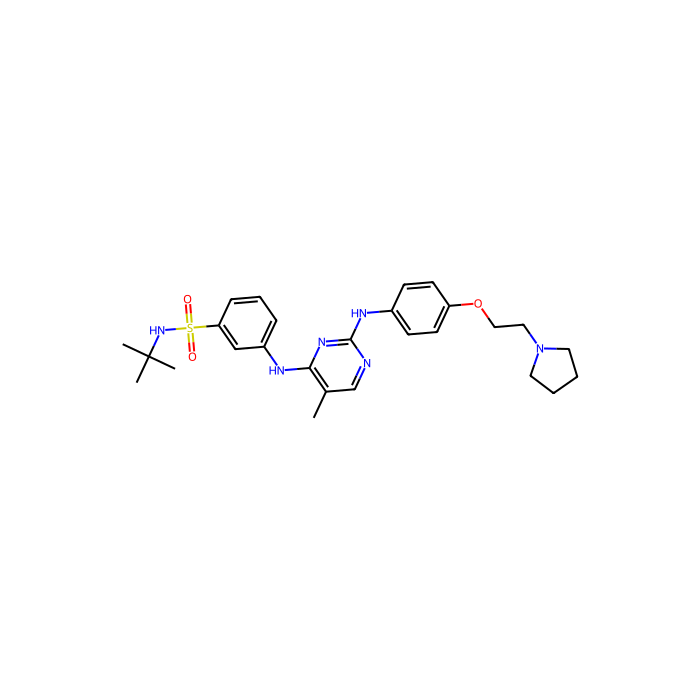
Fedratinib (SAR302503, TG101348) is a selective inhibitor ofJAK2withIC50of 3 nM in cell-free assays, 35- and 334-fold more selective for JAK2 versus JAK1 and JAK3. Fedratinib also inhibitsFMS-like tyrosine kinase 3 (FLT3)andRET (c-RET)with IC50 of 15 nM a
In vitro
TG-101348 also significantly inhibits JAK2 V617F, Flt3, and Ret with IC50 of 3 nM, 15 nM, and 48 nM, respectively. TG101348 has an IC50 ~300-fold higher for the closely related JAK3 and is a less potent inhibitor of the JAK1 and TYK2 family members. TG101348 inhibits proliferation of a human erythroblast leukemia (HEL) cell line that harbors the JAK2V617F mutation, as well as a murine pro-B cell line expressing human JAK2V617F (Ba/F3 JAK2V617F), with IC50 of 305 nM and 270 nM, respectively. TG-101348 also inhibits proliferation of parental Ba/F3 cells to a comparable level, with IC50 of ~420 nM. TG101348 treatment reduces STAT5 phosphorylation at concentrations that parallel the concentrations required to inhibit cell proliferation. TG101348 induces apoptosis in both HEL and Ba/F3 JAK2V617F cells in a dose-dependent manner. TG101348 does not show proapoptotic activity in control normal human dermal fibroblasts at concentrations up to 10 μM, and the antiproliferative IC50 against fibroblasts is >5 μM. TG101348 treatment decreases GATA-1 expression, which is associated with erythroid-skewing of JAK2V617F+ progenitor differentiation, and inhibits STAT5 as well as GATA S310 phosphorylation. TG101348 inhibits the proliferation of HMC-1.1 (KITV560G) cells, with somewhat lower potency than HMC-1.2 (KITD816V, KITV560G) cells, with IC50 of 740 nM and 407 nM, respectively.
In vivo
TG101348 has potential for efficacious treatment of JAK2V617F-associated myeloproliferative diseases (MPD). In treated animals, there is a statistically significant reduction in hematocrit and leukocyte count, a dose-dependent reduction/elimination of extramedullary hematopoiesis, and, at least in some instances, evidence for attenuation of myelofibrosis, correlated with surrogate endpoints, including reduction/elimination of JAK2V617F disease burden, suppression of endogenous erythroid colony formation, and in vivo inhibition of JAK-STAT signal transduction. There are no apparent toxicities and no effect on T cell number. Oral administration of TG101348 (120 mg/kg) significantly inhibits PV progenitor erythroid differentiation in vivo.
Cell Data
cell lines:
Concentrations:Dissolved in DMSO, final concentrations ~10 μM
Incubation Time:72 hours
Powder Purity:≥97%
| ALogP | 4.8 |
|---|
| Isómeros SMILES | CC1=CN=C(N=C1NC2=CC(=CC=C2)S(=O)(=O)NC(C)(C)C)NC3=CC=C(C=C3)OCCN4CCCC4 |
|---|---|
| PubChem CID | 16722836 |
| Peso molecular | 524.68 |
Comprehensive hazard, handling, storage, and regulatory compliance document.
Download SDS →Lot-specific quality data. Enter your lot number to retrieve the exact COA.
Look up COA →Full quality attributes and acceptance criteria for this grade.
View spec sheet →| Activity Type | Activity Value -log(M) | Mechanism of Action | Activity Reference | Publications (PubMed IDs) |
|---|
| Activity Type | Activity Value -log(M) | Mechanism of Action | Activity Reference | Publications (PubMed IDs) |
|---|
| Activity Type | Activity Value -log(M) | Mechanism of Action | Activity Reference | Publications (PubMed IDs) |
|---|
| Activity Type | Activity Value -log(M) | Mechanism of Action | Activity Reference | Publications (PubMed IDs) |
|---|
| Activity Type | Activity Value -log(M) | Mechanism of Action | Activity Reference | Publications (PubMed IDs) |
|---|
| Activity Type | Activity Value -log(M) | Mechanism of Action | Activity Reference | Publications (PubMed IDs) |
|---|
| Activity Type | Activity Value -log(M) | Mechanism of Action | Activity Reference | Publications (PubMed IDs) |
|---|
| Activity Type | Activity Value -log(M) | Mechanism of Action | Activity Reference | Publications (PubMed IDs) |
|---|
| Activity Type | Activity Value -log(M) | Mechanism of Action | Activity Reference | Publications (PubMed IDs) |
|---|
| Activity Type | Activity Value -log(M) | Mechanism of Action | Activity Reference | Publications (PubMed IDs) |
|---|
| Activity Type | Activity Value -log(M) | Mechanism of Action | Activity Reference | Publications (PubMed IDs) |
|---|
| Activity Type | Activity Value -log(M) | Mechanism of Action | Activity Reference | Publications (PubMed IDs) |
|---|
| Activity Type | Activity Value -log(M) | Mechanism of Action | Activity Reference | Publications (PubMed IDs) |
|---|
| Activity Type | Activity Value -log(M) | Mechanism of Action | Activity Reference | Publications (PubMed IDs) |
|---|
| Activity Type | Activity Value -log(M) | Mechanism of Action | Activity Reference | Publications (PubMed IDs) |
|---|
| Solubilidad | Solubility (25°C) In vitro DMSO: 44 mg/mL (197.86 mM); |
|---|
Our grade selection guide covers purity, stabilizer status, and application suitability for all variants in our catalog.
View Moligand™ grade guide →