
Determine the necessary mass, volume, or concentration for preparing a solution.
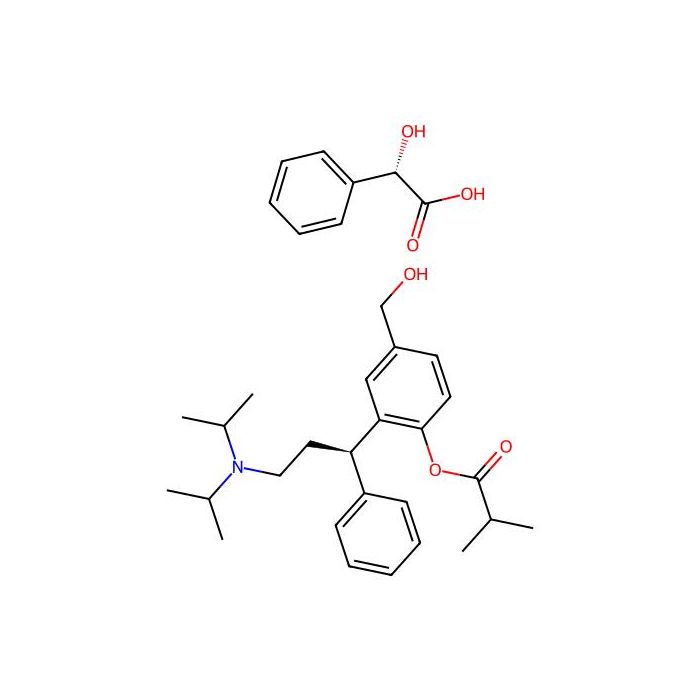
Fesoterodine L-mandelate - ≥98% , CAS No.1206695-46-6
Disponible para pedir
GRADE & PURITY ≥98%
Storage
Store at 2-8°C,Desiccated
Shipped In
Wet ice
≥98% for sensitive chromatographic and analytical workflows requiring minimal baseline interference.
Store at 2-8°C,Desiccated Ships Wet ice Check lot-specific COA for exact specifications.
SDS, COA, datasheet, and spec sheet available for download. Lot-specific COA accessible via lot number lookup.
Cited in 0 peer-reviewed publications across chromatography, organic synthesis, and cross-coupling reactions.
Fesoterodine L-mandelate is an orally active, nonsubtype selective, competitive muscarinic receptor (mAChR) antagonist with pK i values of 8.0, 7.7, 7.4, 7.3, 7.5 for M1, M2, M3, M4, M5 receptors, respectively. Fesoterodine L-mandelate is used for the overactive bladder (OAB)
In Vitro
Fesoterodine L-mandelate decreases micturition frequency, urgency severity and urgency incontinence episodes and increases the volume voided with each micturition. After oral administration, Fesoterodine L-mandelate is rapidly and extensively hydrolysed in plasma by nonspecific esterases to Desfesoterodine (5-hydroxymethyl tolterodine; SPM 7605; HY-76569; an active metabolite of Fesoterodine). MCE has not independently confirmed the accuracy of these methods. They are for reference only.
In Vivo
Fesoterodine L-mandelate (0.01-1 mg/kg; IV) reduces the micturition pressure and increases bladder capacity and ICIs (intercontraction intervas) at the lowest dose tested of 0.01 mg/kg. MCE has not independently confirmed the accuracy of these methods. They are for reference only. Animal Model: Bladders from female Sprague-Dawley rats (225-275 g)Dosage: 0.01, 0.1 and 1 mg/kg Administration: IV Result: Reduced the micturition pressure and increased bladder capacity and ICIs at the lowest dose tested of 0.01 mg/kg.
Form:Solid
IC50& Target:pKi: 8.0 (M1), 7.7 (M2), 7.4 (M3), 7.3 (M4) and 7.5 (M5)
| Sonrisas canónicas | CC(C)C(=O)OC1=C(C=C(C=C1)CO)C(CCN(C(C)C)C(C)C)C2=CC=CC=C2.C1=CC=C(C=C1)C(C(=O)O)O |
|---|---|
| IUPAC Name | [2-[(1R)-3-[di(propan-2-yl)amino]-1-phenylpropyl]-4-(hydroxymethyl)phenyl] 2-methylpropanoate;(2S)-2-hydroxy-2-phenylacetic acid |
| InChIKey | BUMCIEARGQDQNL-SXTNJFIWSA-N |
| INCHI | 1S/C26H37NO3.C8H8O3/c1-18(2)26(29)30-25-13-12-21(17-28)16-24(25)23(22-10-8-7-9-11-22)14-15-27(19(3)4)20(5)6;9-7(8(10)11)6-4-2-1-3-5-6/h7-13,16,18-20,23,28H,14-15,17H2,1-6H3;1-5,7,9H,(H,10,11)/t23-;7-/m10/s1 |
| Isómeros SMILES | CC(C)C(=O)OC1=C(C=C(C=C1)CO)[C@H](CCN(C(C)C)C(C)C)C2=CC=CC=C2.C1=CC=C(C=C1)[C@@H](C(=O)O)O |
| PubChem CID | 44232509 |
| Peso molecular | 563.72 |
Comprehensive hazard, handling, storage, and regulatory compliance document.
Download SDS →Lot-specific quality data. Enter your lot number to retrieve the exact COA.
Look up COA →Full quality attributes and acceptance criteria for this grade.
View spec sheet →Taxonomy Tree
| Kingdom | Organic compounds |
|---|---|
| Superclass | Benzenoids |
| Clase | Benzene and substituted derivatives |
| Subclass | Diphenylmethanes |
| Intermediate Tree Nodes | Not available |
| Direct Parent | Diphenylmethanes |
| Alternative Parents | Phenol esters Benzyl alcohols Phenoxy compounds Aralkylamines Alpha hydroxy acids and derivatives Amino acids and derivatives Trialkylamines Carboxylic acid esters Secondary alcohols Monocarboxylic acids and derivatives Carboxylic acids Organic oxides Hydrocarbon derivatives Carbonyl compounds Aromatic alcohols Primary alcohols |
| Molecular Framework | Not available |
| Substituents | Diphenylmethane - Phenol ester - Phenoxy compound - Benzyl alcohol - Aralkylamine - Alpha-hydroxy acid - Hydroxy acid - Amino acid or derivatives - Carboxylic acid ester - Tertiary aliphatic amine - Tertiary amine - Secondary alcohol - Carboxylic acid derivative - Carboxylic acid - Monocarboxylic acid or derivatives - Alcohol - Organonitrogen compound - Organooxygen compound - Primary alcohol - Aromatic alcohol - Hydrocarbon derivative - Carbonyl group - Organic oxide - Organic oxygen compound - Amine - Organic nitrogen compound - Aromatic homomonocyclic compound |
| Descripción | This compound belongs to the class of organic compounds known as diphenylmethanes. These are compounds containing a diphenylmethane moiety, which consists of a methane wherein two hydrogen atoms are replaced by two phenyl groups. |
| External Descriptors | Not available |
| Solubilidad | DMSO : 100 mg/mL (177.39 mM; Need ultrasonic) |
|---|---|
| Peso molecular | 563.700 g/mol |
| XLogP3 | |
| Hydrogen Bond Donor Count | 3 |
| Hydrogen Bond Acceptor Count | 7 |
| Rotatable Bond Count | 13 |
| Exact Mass | 563.325 Da |
| Monoisotopic Mass | 563.325 Da |
| Topological Polar Surface Area | 107.000 Ų |
| Heavy Atom Count | 41 |
| Formal Charge | 0 |
| Complexity | 629.000 |
| Isotope Atom Count | 0 |
| Defined Atom Stereocenter Count | 2 |
| Undefined Atom Stereocenter Count | 0 |
| Defined Bond Stereocenter Count | 0 |
| Undefined Bond Stereocenter Count | 0 |
| The total count of all stereochemical bonds | 0 |
| Covalently-Bonded Unit Count | 2 |