Determine the necessary mass, volume, or concentration for preparing a solution.
≥99% for sensitive chromatographic and analytical workflows requiring minimal baseline interference.
Protected from light,Argon charged,Desiccated,Store at -80°C Ships Dry ice packs + Cold packs Check lot-specific COA for exact specifications.
SDS, COA, datasheet, and spec sheet available for download. Lot-specific COA accessible via lot number lookup.
Cited in 0 peer-reviewed publications across chromatography, organic synthesis, and cross-coupling reactions.
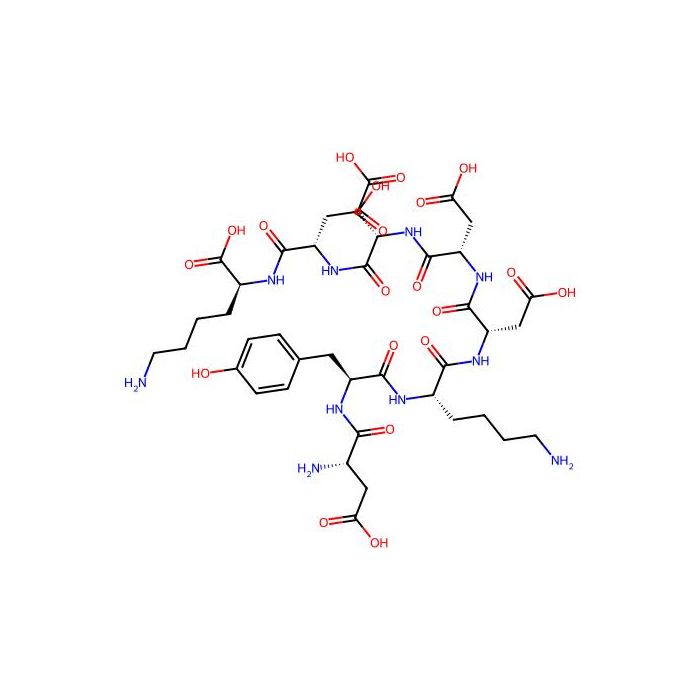
FLAG peptide is an eight amino acids peptide (Asp-Tyr-Lys-Asp-Asp-Asp-Asp-Lys) with an enterokinase-cleavage site; designed for antibody-mediated identification and purification of recombinant proteins.
In Vitro
Fusion protein technology has become an important tool for solving numerous problems linked to recombinant protein production. The properties of the additional tag facilitate identification and provide a one-step purification procedure of the fusion protein by passing cell extracts or supernatants through columns of an appropriate matrix. FLAG peptide allows elution under non-denaturing conditions. Several antibodies against FLAG peptide have been developed. One antibody, M1, binds the peptide in the presence of bivalent metal cations, preferably Ca 2+ . Elution is effected by chelating agents. Another strategy is competitive elution with excess of free FLAGe peptide. Antibodies M2 and M5 are applied in this procedure. The Flag-tag is first described as a calcium-dependent epitope of a monoclonal antibody. It is a highly acidic octapeptide which can be N-terminally fused to the protein of interest. As a very hydrophilic peptide the Flag–tag has a high surface probability. Flag-fusion proteins can be captured by an immunoaffinity column in the presence of Ca 2+ and eluted byEDTA at low concentrations, neutral pH and thus, nearly physiological conditions. MCE has not independently confirmed the accuracy of these methods. They are for reference only.
Form:Solid
| Sonrisas canónicas | C1=CC(=CC=C1CC(C(=O)NC(CCCCN)C(=O)NC(CC(=O)O)C(=O)NC(CC(=O)O)C(=O)NC(CC(=O)O)C(=O)NC(CC(=O)O)C(=O)NC(CCCCN)C(=O)O)NC(=O)C(CC(=O)O)N)O |
|---|---|
| IUPAC Name | (2S)-6-amino-2-[[(2S)-2-[[(2S)-2-[[(2S)-2-[[(2S)-2-[[(2S)-6-amino-2-[[(2S)-2-[[(2S)-2-amino-3-carboxypropanoyl]amino]-3-(4-hydroxyphenyl)propanoyl]amino]hexanoyl]amino]-3-carboxypropanoyl]amino]-3-carboxypropanoyl]amino]-3-carboxypropanoyl]amino]-3-carboxypropanoyl]amino]hexanoic acid |
| InChIKey | XZWYTXMRWQJBGX-VXBMVYAYSA-N |
| INCHI | 1S/C41H60N10O20/c42-11-3-1-5-22(45-36(65)24(13-19-7-9-20(52)10-8-19)47-34(63)21(44)14-29(53)54)35(64)48-26(16-31(57)58)38(67)50-28(18-33(61)62)40(69)51-27(17-32(59)60)39(68)49-25(15-30(55)56)37(66)46-23(41(70)71)6-2-4-12-43/h7-10,21-28,52H,1-6,11-18,42-44H2,(H,45,65)(H,46,66)(H,47,63)(H,48,64)(H,49,68)(H,50,67)(H,51,69)(H,53,54)(H,55,56)(H,57,58)(H,59,60)(H,61,62)(H,70,71)/t21-,22-,23-,24-,25-,26-,27-,28-/m0/s1 |
| Isómeros SMILES | C1=CC(=CC=C1C[C@@H](C(=O)N[C@@H](CCCCN)C(=O)N[C@@H](CC(=O)O)C(=O)N[C@@H](CC(=O)O)C(=O)N[C@@H](CC(=O)O)C(=O)N[C@@H](CC(=O)O)C(=O)N[C@@H](CCCCN)C(=O)O)NC(=O)[C@H](CC(=O)O)N)O |
| PubChem CID | 9854670 |
| Peso molecular | 1013 |
Comprehensive hazard, handling, storage, and regulatory compliance document.
Download SDS →Lot-specific quality data. Enter your lot number to retrieve the exact COA.
Look up COA →Full quality attributes and acceptance criteria for this grade.
View spec sheet →Taxonomy Tree
| Kingdom | Organic compounds |
|---|---|
| Superclass | Organic acids and derivatives |
| Clase | Carboxylic acids and derivatives |
| Subclass | Amino acids, peptides, and analogues |
| Intermediate Tree Nodes | Peptides |
| Direct Parent | Oligopeptides |
| Alternative Parents | Hexacarboxylic acids and derivatives Tyrosine and derivatives Phenylalanine and derivatives Aspartic acid and derivatives N-acyl-L-alpha-amino acids Alpha amino acid amides Amphetamines and derivatives Hydroxy fatty acids 1-hydroxy-2-unsubstituted benzenoids Amino fatty acids N-acyl amines Amino acids Secondary carboxylic acid amides Carboxylic acids Hydrocarbon derivatives Carbonyl compounds Organic oxides Monoalkylamines |
| Molecular Framework | Aromatic homomonocyclic compounds |
| Substituents | Alpha-oligopeptide - Hexacarboxylic acid or derivatives - Tyrosine or derivatives - Phenylalanine or derivatives - Aspartic acid or derivatives - N-acyl-alpha-amino acid - N-acyl-alpha amino acid or derivatives - N-acyl-l-alpha-amino acid - Alpha-amino acid amide - Alpha-amino acid or derivatives - N-substituted-alpha-amino acid - Amphetamine or derivatives - 1-hydroxy-2-unsubstituted benzenoid - Hydroxy fatty acid - Amino fatty acid - Phenol - Fatty acyl - Benzenoid - N-acyl-amine - Fatty amide - Monocyclic benzene moiety - Amino acid - Amino acid or derivatives - Carboxamide group - Secondary carboxylic acid amide - Carboxylic acid - Organic nitrogen compound - Primary aliphatic amine - Carbonyl group - Organonitrogen compound - Organooxygen compound - Primary amine - Hydrocarbon derivative - Amine - Organic oxide - Organic oxygen compound - Aromatic homomonocyclic compound |
| Descripción | This compound belongs to the class of organic compounds known as oligopeptides. These are organic compounds containing a sequence of between three and ten alpha-amino acids joined by peptide bonds. |
| External Descriptors | Not available |
| Solubilidad | H2O : 100 mg/mL (98.72 mM; Need ultrasonic) |
|---|---|
| Peso molecular | 1013.000 g/mol |
| XLogP3 | -12.900 |
| Hydrogen Bond Donor Count | 17 |
| Hydrogen Bond Acceptor Count | 23 |
| Rotatable Bond Count | 35 |
| Exact Mass | 1012.4 Da |
| Monoisotopic Mass | 1012.4 Da |
| Topological Polar Surface Area | 526.000 Ų |
| Heavy Atom Count | 71 |
| Formal Charge | 0 |
| Complexity | 1910.000 |
| Isotope Atom Count | 0 |
| Defined Atom Stereocenter Count | 8 |
| Undefined Atom Stereocenter Count | 0 |
| Defined Bond Stereocenter Count | 0 |
| Undefined Bond Stereocenter Count | 0 |
| The total count of all stereochemical bonds | 0 |
| Covalently-Bonded Unit Count | 1 |