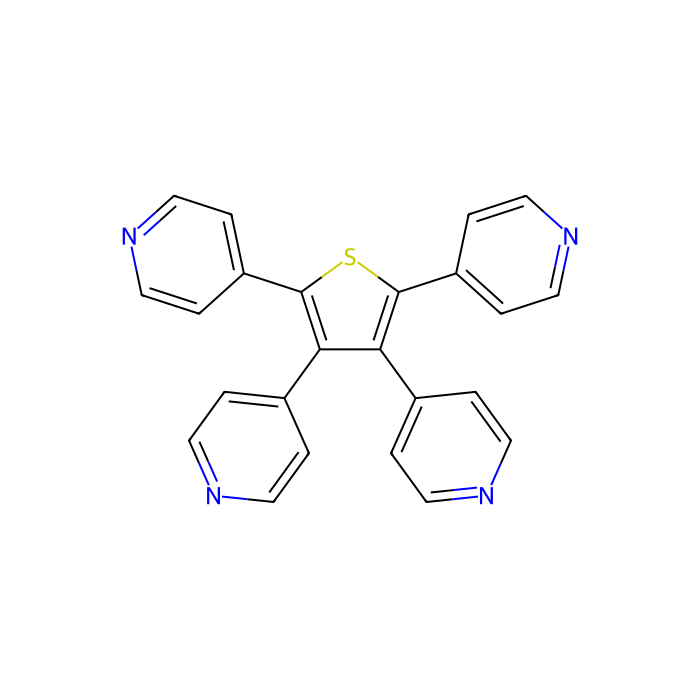
GANT58 - ≥98% , CAS No.64048-12-0

CAS: 64048-12-0 Cat. No.: G275375 Fórmula: C24H16N4S Peso molecular: 392.48
Disponible para pedir
GRADE & PURITY ≥98%
Synonyms
2,3,4,5-TETRA-(4-PYRIDYL)THIOPHENE | 2,3,4,5-tetra-(4-pyridyl)-thiophene | 2,3,4,5-tetra(4-pyridyl)thiophene | CHEBI:94284 | 4-(3,4,5-tri(pyridin-4-yl)thiophen-2-yl)pyridine | GANT58,NSC75503 | 4-(2,4,5-tripyridin-4-ylthiophen-3-yl)pyridine | GANT58, >=98
Storage
Store at -20°C
Shipped In
Ice chest + Ice pads
★
Size
USA
Alemania (EU)*
Price
Qty
10mg
G275375-10mg
2 Disponible
—

9,90US$

14,90US$
Guardar 5,00 US$ (33.56%)
25mg
G275375-25mg
3 Disponible
—

13,90US$

20,90US$
Guardar 7,00 US$ (33.49%)
50mg
G275375-50mg
3 Disponible
—

23,90US$

35,90US$
Guardar 12,00 US$ (33.43%)
100mg
G275375-100mg
2 Disponible
—

36,90US$

55,90US$
Guardar 19,00 US$ (33.99%)
250mg
G275375-250mg
3 Disponible
—

80,90US$

121,90US$
Guardar 41,00 US$ (33.63%)
1g
G275375-1g
Fabricado bajo pedido · 8–12 semanas

264,90US$

397,90US$
Guardar 133,00 US$ (33.43%)
Enter a quantity for the sizes you want to add.
🧪
Why this grade

≥98% for sensitive chromatographic and analytical workflows requiring minimal baseline interference.

🌡

Storage & shipping

Store at -20°C Ships Ice chest + Ice pads Check lot-specific COA for exact specifications.

📋

Quality documents

SDS, COA, datasheet, and spec sheet available for download. Lot-specific COA accessible via lot number lookup.

📚

Literature proof

Cited in 0 peer-reviewed publications across chromatography, organic synthesis, and cross-coupling reactions.

Descripción general

Store at +4°C. The product can be stored for up to 12 months.

Specifications

Sinónimos
2,3,4,5-TETRA-(4-PYRIDYL)THIOPHENE | 2,3,4,5-tetra-(4-pyridyl)-thiophene | 2,3,4,5-tetra(4-pyridyl)thiophene | CHEBI:94284 | 4-(3,4,5-tri(pyridin-4-yl)thiophen-2-yl)pyridine | GANT58,NSC75503 | 4-(2,4,5-tripyridin-4-ylthiophen-3-yl)pyridine | GANT58, >=98
Especificaciones y pureza
≥98%
Mecanismos bioquímicos y fisiológicos
Inhibits Hh signaling downstream of smo and sufu. IC 50 = 5 μM for glioma associated oncogene expression in MEFs.GANT58 is a Hedgehog signaling pathway inhibitor. GANT58 inhibits the hedgehog signaling pathway downstream of Smo. GANT58 inhibits Gli transc
Condiciones de almacenamiento de almacenamiento
Store at -20°C
Enviado en
Ice chest + Ice pads
Este producto requiere envío en cadena de frío. Los servicios terrestres y otros servicios económicos no están disponibles.
Tipo de acción
ANTAGONIST
Nota
Wherever possible, you should prepare and use solutions on the same day. However, if you need to make up stock solutions in advance, we recommend that you store the solution as aliquots in tightly sealed vials at -20°C. Generally, these will be useable for up to one month. Before use, and prior to opening the vial we recommend that you allow your product to equilibrate to room temperature for at least 1 hour. Need more advice on solubility, usage and handling? Please visit our frequently asked questions (FAQ) page for more details.
Pureza
≥98%
Nombres e identificadores
Pubchem Sid
Pubchem Sid Url
https://pubchem.ncbi.nlm.nih.gov/substance/504758134
Sonrisas canónicas
C1=CN=CC=C1C2=C(SC(=C2C3=CC=NC=C3)C4=CC=NC=C4)C5=CC=NC=C5
IUPAC Name
4-(2,4,5-tripyridin-4-ylthiophen-3-yl)pyridine
InChIKey
USWLOKMMUTWFMD-UHFFFAOYSA-N
INCHI
1S/C24H16N4S/c1-9-25-10-2-17(1)21-22(18-3-11-26-12-4-18)24(20-7-15-28-16-8-20)29-23(21)19-5-13-27-14-6-19/h1-16H
Isómeros SMILES
C1=CN=CC=C1C2=C(SC(=C2C3=CC=NC=C3)C4=CC=NC=C4)C5=CC=NC=C5
Peso molecular
392.48
Reaxy-Rn
47834
Reaxys-RN_link_address
https://www.reaxys.com/reaxys/secured/hopinto.do?context=S&query=IDE.XRN=47834&ln=

Documentation

📋 Safety Data Sheet (SDS)

Comprehensive hazard, handling, storage, and regulatory compliance document.

Download SDS →

✅ Certificate of Analysis (COA)

Lot-specific quality data. Enter your lot number to retrieve the exact COA.

Look up COA →

📊 Datasheet

Quick-reference summary of product specifications and applications.

View datasheet →

🔬 Specification Sheet

Full quality attributes and acceptance criteria for this grade.

View spec sheet →

Advanced Data

Taxonomic Classification

Taxonomy Tree

KingdomOrganic compounds
SuperclassOrganoheterocyclic compounds
ClasePyridines and derivatives
SubclassNot available
Intermediate Tree Nodes Not available
Direct ParentPyridines and derivatives
Alternative Parents Thiophenes  Heteroaromatic compounds  Azacyclic compounds  Organopnictogen compounds  Organonitrogen compounds  Hydrocarbon derivatives  
Molecular FrameworkAromatic heteromonocyclic compounds
Substituents Pyridine - Heteroaromatic compound - Thiophene - Azacycle - Organic nitrogen compound - Organopnictogen compound - Hydrocarbon derivative - Organonitrogen compound - Aromatic heteromonocyclic compound
DescripciónThis compound belongs to the class of organic compounds known as pyridines and derivatives. These are compounds containing a pyridine ring, which is a six-member aromatic heterocycle which consists of one nitrogen atom and five carbon atoms.
External Descriptors Not available
Estructura 3D
Modelo de Estructura Química Interactiva


Objetivos asociados (humanos)
CYP3A4 Tclin Cytochrome P450 3A4 (1 Activities)
Activity TypeActivity Value -log(M)Mechanism of ActionActivity ReferencePublications (PubMed IDs)
CYP2D6 Tclin Cytochrome P450 2D6 (33882 Activities)
Activity TypeRelationActivity valueUnitsAction TypeJournalPubMed IddoiAssay Aladdin ID
CYP1A2 Tchem Cytochrome P450 1A2 (26471 Activities)
Activity TypeRelationActivity valueUnitsAction TypeJournalPubMed IddoiAssay Aladdin ID
PIN1 Tchem Peptidyl-prolyl cis-trans isomerase NIMA-interacting 1 (36611 Activities)
Activity TypeRelationActivity valueUnitsAction TypeJournalPubMed IddoiAssay Aladdin ID
CYP2C9 Tchem Cytochrome P450 2C9 (32119 Activities)
Activity TypeRelationActivity valueUnitsAction TypeJournalPubMed IddoiAssay Aladdin ID
CYP2C19 Tchem Cytochrome P450 2C19 (29246 Activities)
Activity TypeRelationActivity valueUnitsAction TypeJournalPubMed IddoiAssay Aladdin ID
CYP3A4 Tclin Cytochrome P450 3A4 (53859 Activities)
Activity TypeRelationActivity valueUnitsAction TypeJournalPubMed IddoiAssay Aladdin ID
A498 (42825 Activities)
Activity TypeRelationActivity valueUnitsAction TypeJournalPubMed IddoiAssay Aladdin ID
ACHN (49357 Activities)
Activity TypeRelationActivity valueUnitsAction TypeJournalPubMed IddoiAssay Aladdin ID
CAKI-1 (44928 Activities)
Activity TypeRelationActivity valueUnitsAction TypeJournalPubMed IddoiAssay Aladdin ID
COLO 205 (50209 Activities)
Activity TypeRelationActivity valueUnitsAction TypeJournalPubMed IddoiAssay Aladdin ID
DU-145 (51482 Activities)
Activity TypeRelationActivity valueUnitsAction TypeJournalPubMed IddoiAssay Aladdin ID
HT-29 (80576 Activities)
Activity TypeRelationActivity valueUnitsAction TypeJournalPubMed IddoiAssay Aladdin ID
K562 (73714 Activities)
Activity TypeRelationActivity valueUnitsAction TypeJournalPubMed IddoiAssay Aladdin ID
KM12 (47707 Activities)
Activity TypeRelationActivity valueUnitsAction TypeJournalPubMed IddoiAssay Aladdin ID
M14 (47487 Activities)
Activity TypeRelationActivity valueUnitsAction TypeJournalPubMed IddoiAssay Aladdin ID
MCF7 (126967 Activities)
Activity TypeRelationActivity valueUnitsAction TypeJournalPubMed IddoiAssay Aladdin ID
MOLT-4 (49676 Activities)
Activity TypeRelationActivity valueUnitsAction TypeJournalPubMed IddoiAssay Aladdin ID
OVCAR-3 (48710 Activities)
Activity TypeRelationActivity valueUnitsAction TypeJournalPubMed IddoiAssay Aladdin ID
OVCAR-4 (44535 Activities)
Activity TypeRelationActivity valueUnitsAction TypeJournalPubMed IddoiAssay Aladdin ID
OVCAR-5 (45555 Activities)
Activity TypeRelationActivity valueUnitsAction TypeJournalPubMed IddoiAssay Aladdin ID
OVCAR-8 (47708 Activities)
Activity TypeRelationActivity valueUnitsAction TypeJournalPubMed IddoiAssay Aladdin ID
PANC-1 (6144 Activities)
Activity TypeRelationActivity valueUnitsAction TypeJournalPubMed IddoiAssay Aladdin ID
PC-3 (62116 Activities)
Activity TypeRelationActivity valueUnitsAction TypeJournalPubMed IddoiAssay Aladdin ID
RPMI-8226 (44974 Activities)
Activity TypeRelationActivity valueUnitsAction TypeJournalPubMed IddoiAssay Aladdin ID
RXF 393 (41971 Activities)
Activity TypeRelationActivity valueUnitsAction TypeJournalPubMed IddoiAssay Aladdin ID
SF-295 (48000 Activities)
Activity TypeRelationActivity valueUnitsAction TypeJournalPubMed IddoiAssay Aladdin ID
SK-MEL-2 (46422 Activities)
Activity TypeRelationActivity valueUnitsAction TypeJournalPubMed IddoiAssay Aladdin ID
SK-MEL-28 (48833 Activities)
Activity TypeRelationActivity valueUnitsAction TypeJournalPubMed IddoiAssay Aladdin ID
SK-MEL-5 (47095 Activities)
Activity TypeRelationActivity valueUnitsAction TypeJournalPubMed IddoiAssay Aladdin ID
SK-OV-3 (52876 Activities)
Activity TypeRelationActivity valueUnitsAction TypeJournalPubMed IddoiAssay Aladdin ID
SN12C (47755 Activities)
Activity TypeRelationActivity valueUnitsAction TypeJournalPubMed IddoiAssay Aladdin ID
SNB-19 (46794 Activities)
Activity TypeRelationActivity valueUnitsAction TypeJournalPubMed IddoiAssay Aladdin ID
TK-10 (45540 Activities)
Activity TypeRelationActivity valueUnitsAction TypeJournalPubMed IddoiAssay Aladdin ID
U-251 (51189 Activities)
Activity TypeRelationActivity valueUnitsAction TypeJournalPubMed IddoiAssay Aladdin ID
UACC-257 (46019 Activities)
Activity TypeRelationActivity valueUnitsAction TypeJournalPubMed IddoiAssay Aladdin ID
UACC-62 (47335 Activities)
Activity TypeRelationActivity valueUnitsAction TypeJournalPubMed IddoiAssay Aladdin ID
UO-31 (46270 Activities)
Activity TypeRelationActivity valueUnitsAction TypeJournalPubMed IddoiAssay Aladdin ID
786-0 (47912 Activities)
Activity TypeRelationActivity valueUnitsAction TypeJournalPubMed IddoiAssay Aladdin ID
A549 (127892 Activities)
Activity TypeRelationActivity valueUnitsAction TypeJournalPubMed IddoiAssay Aladdin ID
NCI/ADR-RES (33767 Activities)
Activity TypeRelationActivity valueUnitsAction TypeJournalPubMed IddoiAssay Aladdin ID
T47D (39041 Activities)
Activity TypeRelationActivity valueUnitsAction TypeJournalPubMed IddoiAssay Aladdin ID
EKVX (44102 Activities)
Activity TypeRelationActivity valueUnitsAction TypeJournalPubMed IddoiAssay Aladdin ID
NCI-H322M (45589 Activities)
Activity TypeRelationActivity valueUnitsAction TypeJournalPubMed IddoiAssay Aladdin ID
HCC 2998 (41480 Activities)
Activity TypeRelationActivity valueUnitsAction TypeJournalPubMed IddoiAssay Aladdin ID
HCT-116 (91556 Activities)
Activity TypeRelationActivity valueUnitsAction TypeJournalPubMed IddoiAssay Aladdin ID
HEK293 (82097 Activities)
Activity TypeRelationActivity valueUnitsAction TypeJournalPubMed IddoiAssay Aladdin ID
HOP-92 (41141 Activities)
Activity TypeRelationActivity valueUnitsAction TypeJournalPubMed IddoiAssay Aladdin ID
Hs-578T (29457 Activities)
Activity TypeRelationActivity valueUnitsAction TypeJournalPubMed IddoiAssay Aladdin ID
HepG2 (196354 Activities)
Activity TypeRelationActivity valueUnitsAction TypeJournalPubMed IddoiAssay Aladdin ID
NCI-H460 (60772 Activities)
Activity TypeRelationActivity valueUnitsAction TypeJournalPubMed IddoiAssay Aladdin ID
Objetivos asociados (no humanos)
Hdac6 Histone deacetylase 6 (222 Activities)
Activity TypeRelationActivity valueUnitsAction TypeJournalPubMed IddoiAssay Aladdin ID
Plasmodium falciparum (966862 Activities)
Activity TypeRelationActivity valueUnitsAction TypeJournalPubMed IddoiAssay Aladdin ID
MEF (1005 Activities)
Activity TypeRelationActivity valueUnitsAction TypeJournalPubMed IddoiAssay Aladdin ID
NIH3T3 (5395 Activities)
Activity TypeRelationActivity valueUnitsAction TypeJournalPubMed IddoiAssay Aladdin ID
Shh Sonic hedgehog protein (356 Activities)
Activity TypeRelationActivity valueUnitsAction TypeJournalPubMed IddoiAssay Aladdin ID
rep Replicase polyprotein 1ab (378 Activities)
Activity TypeRelationActivity valueUnitsAction TypeJournalPubMed IddoiAssay Aladdin ID
Mapt Microtubule-associated protein tau (6 Activities)
Activity TypeRelationActivity valueUnitsAction TypeJournalPubMed IddoiAssay Aladdin ID
Nfe2l2 Nuclear factor erythroid 2-related factor 2 (214 Activities)
Activity TypeRelationActivity valueUnitsAction TypeJournalPubMed IddoiAssay Aladdin ID
SARS-CoV-2 (38078 Activities)
Activity TypeRelationActivity valueUnitsAction TypeJournalPubMed IddoiAssay Aladdin ID
Mecanismos de acción
Certificados (CoA, COO, BSE/TSE y tabla de análisis)
C of A & Other Certificates(BSE/TSE, COO):
Analytical Chart:

Find and download the COA for your product by matching the lot number on the packaging.

7 results found

Lot NumberCertificate TypeFechaArticulo
A2219365Certificate of AnalysisAug 04, 2026 G275375
A2219367Certificate of AnalysisAug 04, 2026 G275375
A2219668Certificate of AnalysisAug 04, 2026 G275375
A2219669Certificate of AnalysisAug 04, 2026 G275375
A2219670Certificate of AnalysisAug 04, 2026 G275375
A2219675Certificate of AnalysisAug 04, 2026 G275375
C2617120Certificate of AnalysisMar 27, 2026 G275375
Propiedades químicas y físicas
SolubilidadSoluble in DMSO to 25 mM (with warming) and in ethanol to 25 mM (with warming);≥27.65 mg/mL in DMSO; insoluble in H2O; ≥5.02 mg/mL in EtOH with gentle warming and ultrasonic
Peso molecular392.500 g/mol
XLogP33.900
Hydrogen Bond Donor Count0
Hydrogen Bond Acceptor Count5
Rotatable Bond Count4
Exact Mass392.11 Da
Monoisotopic Mass392.11 Da
Topological Polar Surface Area79.800 Ų
Heavy Atom Count29
Formal Charge0
Complexity449.000
Isotope Atom Count0
Defined Atom Stereocenter Count0
Undefined Atom Stereocenter Count0
Defined Bond Stereocenter Count0
Undefined Bond Stereocenter Count0
The total count of all stereochemical bonds0
Covalently-Bonded Unit Count1
Calculadoras de soluciones
Reseñas

Reseñas de cliente

Application Protocols

No tested applications or protocols are provided in the Product Data for this item.

  • Item-specific protocols

    • Not specified for this item; refer to CoA/Spec Sheet.
  • General guidance (non-item-specific)

    • Establish dose–response curves in your assay system with proper vehicle controls.
    • Confirm solubility and stability of prepared stocks over the experimental timeframe (HPLC/LC–MS).
    • Document solvent composition, incubation time, and cell density (for cellular assays) to ensure reproducibility.

Researchers should develop and validate protocols suited to their specific models and instrumentation.

Biological Roles
  • Scope

    • The Product Data do not specify biological targets, mechanisms, or pathways for this item. The following statements are general guidance on how small-molecule screening compounds are used in biological research and are not item-specific claims.
  • General context for small-molecule tools (literature)

    • Bioactive tool compounds are employed to modulate cellular pathways in vitro to interrogate signaling cascades, transcriptional networks, and phenotypic outcomes. They are typically validated in mechanistic assays, with potency, selectivity, and off-target profiles characterized in the literature.
    • Experimental considerations include vehicle controls (e.g., DMSO), dose–response design, exposure time, and monitoring of cytotoxicity to distinguish on-target effects from nonspecific stress responses.
  • Good practices

    • Confirm identity and purity prior to biological use (HPLC/LC–MS).
    • Verify solubility under assay conditions to avoid precipitation artifacts.
    • Use orthogonal assays (biochemical vs cellular) to substantiate mechanistic conclusions.

Note: No medical, diagnostic, or therapeutic use is intended. For research use only (from Product Data). For target- or pathway-specific roles of GANT58, consult primary literature and the CoA/Spec Sheet.

Buffer Applications

This item is not a buffering agent and has no specified role in buffer systems.

  • Applicability

    • Not typically used to establish or maintain pH. No pKa/pH range or buffer recipes are provided.
  • Practical note

    • When dosing into biological buffers, track the final percentage of organic cosolvent (e.g., DMSO) to maintain stable pH and osmolarity. Perform compatibility tests to ensure no precipitation or adsorption to plastics.

For buffer composition and stability with this compound, refer to assay-specific validation and the CoA/Spec Sheet.

Green Alternatives

While green chemistry typically addresses solvents and reagents, bioactive screening compounds like this item place the environmental impact mostly on solvent selection, waste minimization, and energy use.

  • Greener solvent choices (general guidance)

    • Prefer water or buffered aqueous media with minimal DMSO where feasible.
    • If organic cosolvent is required, consider ethanol or 2-propanol over chlorinated solvents; ensure assay compatibility.
    • Avoid DMF/NMP unless necessary due to reproductive toxicity and difficult waste handling.
  • Operational choices

    • Prepare concentrated stocks to minimize solvent volume while maintaining accurate dosing.
    • Use microplate formats to reduce per-experiment waste; segregate halogenated from non-halogenated waste.
    • Store at -20°C efficiently (sealed vials, desiccant, light protection if required) to prolong shelf life and reduce repeat synthesis/purchase.
  • Example comparison (general)

    • DMSO vs ethanol as cosolvent: DMSO offers broader solvency and stability; ethanol is preferable from a green perspective but may limit achievable stock concentration and can affect membrane assays at higher percentages.

Ultimately, consult your EHS policies to balance assay performance with greener practices.

Pharmaceutical Uses

No pharmaceutical excipient or manufacturing role is specified for this item in the Product Data.

  • Scope

    • Provided strictly for research use (from Product Data). Not for human or veterinary use. No pharmacopeial monograph, dosage form guidance, or GMP status is indicated.
  • General considerations (non-item-specific)

    • When screening compounds are used in preformulation research, common vehicles include DMSO, PEG-containing systems, or cyclodextrins for solubilization in vitro. Any such use must be established by the researcher and is outside the scope of this catalog entry.

Consult CoA/Spec Sheet for any additional handling or form information relevant to formulation research.

Physical Properties

Item-specific physical constants have not been provided in the Product Data.

  • Item-specific (from Product Data)

    • Appearance: Not specified for this item; refer to CoA/Spec Sheet.
    • Molecular Weight: Not specified for this item; refer to CoA/Spec Sheet.
  • Literature/general properties (for orientation only; confirm before use)

    • Melting point (literature): Not located here; consult primary references for CAS 64048-12-0.
    • Boiling point (literature): Not located here.
    • Density (literature): Not located here.
    • LogP/logD (literature/computed): Often reported for bioactive screening molecules; specific value not provided here.
    • Aqueous solubility: Frequently low for hydrophobic screening actives; DMSO is commonly used for stock solutions (literature practice). Actual solubility for this lot is not specified.
    • UV–Vis profile: Not specified for this item; refer to CoA/Spec Sheet.
    • Refractive index: Not applicable/typically not reported for solids; not specified here.

Note: Use the CoA/Spec Sheet for definitive specifications applicable to this catalog item and lot.

Quality and Grades
  • Item-specific grade/purity (from Product Data)

    • Grade/Purity: Not specified for this item; refer to CoA/Spec Sheet.
  • Interpreting grades (general guidance)

    • Screening/compound library materials are typically provided at high chemical purity suitable for biochemical/biological screening. Exact assay methods (e.g., HPLC area%, NMR qNMR) and acceptance criteria must be confirmed on the CoA.
    • If “HPLC grade” is mentioned on a spec sheet for solvents, it refers to low UV-absorbing impurities and stringent filtration. For solids like GANT58, “≥98% (HPLC)” or qNMR assays may be used—verify with the CoA.
  • Stabilizers and form

    • No stabilizer is listed in the Product Data. If a stabilizer, salt form, or solvate is employed, it will be declared on the CoA/Spec Sheet. Absence of such a note here does not guarantee absence—confirm per lot documentation.
  • What to check on receipt

    • Identity confirmation: Match CAS, catalog number, and batch number; review spectral data if provided.
    • Purity: Verify reported analytical method (HPLC/UPLC, qNMR) and purity value.
    • Water content/residual solvents: Not specified for this item; refer to CoA/Spec Sheet.
    • Counter-ions/solvates/polymorph: Not specified for this item; refer to CoA/Spec Sheet.
Reaction and Applications

This product is supplied as a bioactive small molecule for research screening. It is not typically used as a synthetic reagent or catalyst. Accordingly, classical synthetic reaction applications (e.g., as a coupling partner, nucleophile, or ligand) are generally not relevant.

  • Research application context (general/literature)

    • Compounds in this category are commonly used in cell-free or cell-based pathway-modulation studies, target engagement assays, or phenotypic screens. Solubility management, dosing accuracy, and vehicle controls (e.g., DMSO controls) are critical for interpretable results.
    • Assay modalities may include reporter gene assays, qPCR for pathway readouts, or biochemical binding/functional assays—specific validated applications for this item are not provided here and should be established by the user.
  • Practical considerations

    • Prepare accurately quantified stocks (gravimetric or volumetric) and record the exact concentration.
    • Verify compound integrity over time by LC–MS or HPLC if experiments extend over days to weeks.
    • Use appropriate negative/positive controls as defined by the assay system.

For synthetic chemistry applications, consider more conventional building blocks; this item is primarily intended for screening and mechanistic research.

Reaction Conditions

Not typically applicable. This item is offered as a bioactive screening compound rather than as a reagent for chemical synthesis.

  • If using in biological assays (general practices; not item-specific)
    • Stock solution preparation: Frequently in anhydrous DMSO; confirm actual solubility for this item.
    • Working concentrations: Determined empirically via dose–response; maintain consistent vehicle (e.g., ≤0.1–1% DMSO in final assay) to control for solvent effects.
    • Temperature and atmosphere: Standard ambient laboratory conditions for solution prep; protect from excessive heat and light if the CoA/SDS indicates.

For any synthetic transformations involving this molecule (e.g., probe conjugation), consult primary literature and establish conditions empirically after confirming structure and functional groups.

Safety and Handling

Safety data provided with this listing are minimal; defer to the SDS for authoritative guidance.

  • GHS classification (from Product Data)

    • Signal Word: Not specified for this item; refer to SDS.
    • H-Statements: Not specified for this item; refer to SDS.
    • GHS Classification: Not specified for this item; refer to SDS.
    • Pictograms: Not specified for this item; refer to SDS.
  • General laboratory precautions (good practice)

    • Handle in a chemical fume hood, avoid inhalation/ingestion/skin contact.
    • Wear appropriate PPE: lab coat, safety glasses, and suitable gloves (e.g., nitrile). Change gloves regularly when handling DMSO stocks as DMSO can facilitate dermal absorption.
    • Avoid contact with strong oxidizers, strong acids/bases until compatibility is verified (general precaution for organic small molecules).
  • First-aid overview (consult SDS for details)

    • Skin/eye contact: Rinse with plenty of water for at least 15 minutes; remove contaminated clothing; seek medical attention if irritation persists.
    • Inhalation: Move to fresh air; seek medical advice if symptoms occur.
    • Ingestion: Rinse mouth; do not induce vomiting unless directed by medical personnel; seek medical attention.
  • Storage and transport

    • Storage: Store at -20°C (from Product Data). Keep container tightly closed, desiccated, and protected from light if noted on CoA/SDS.
    • Shipping: Ice chest + ice pads (from Product Data). Do not refreeze-thaw repeatedly once received; aliquot if necessary.

Always review the product-specific SDS prior to use.

Solvent Selection

GANT58 is a small-molecule screening compound; detailed solubility data are not provided for this item. The following are general, literature-level practices for bioactive small molecules and should be verified experimentally.

  • Typical solvent choices (literature practice)

    • DMSO: Frequently used to prepare concentrated stock solutions (e.g., 10–20 mM). Offers broad solvency for hydrophobic molecules; mix into aqueous assay buffers with vigorous pipetting to avoid precipitation.
    • DMF or NMP: Alternatives for difficult-to-dissolve compounds; consider toxicity and handling constraints.
    • Ethanol or isopropanol: Sometimes acceptable for lower stock concentrations; ensure assay compatibility.
    • Aqueous buffers: Many hydrophobic screening compounds exhibit low intrinsic water solubility. Use cosolvents (DMSO ≤0.1–1% v/v final) or surfactants as assay-appropriate.
  • Polarity/miscibility (general)

    • DMSO is fully miscible with water and common organic solvents, easing serial dilutions.
    • Avoid chlorinated solvents in biological assay prep when possible; they may extract plastics and pose disposal burdens.
  • Practical tips

    • Warm gently (room temperature) and sonicate to aid dissolution; avoid prolonged heating.
    • Filter through 0.2 µm PTFE if particulate persists and if the compound is not adsorbed.
    • Document final cosolvent percentage in assays to ensure reproducibility.

For definitive solubility and compatibility of this specific lot, consult the CoA/Spec Sheet and perform a small-scale solubility check.

Storage and Reconstitution
  • Item-specific storage and shipping (from Product Data)

    • Storage Conditions: Store at -20°C.
    • Shipped In: Ice chest + Ice pads.
  • Container and handling

    • Keep tightly sealed in the original container. Minimize headspace and moisture ingress; use desiccant if appropriate. Protect from repeated freeze–thaw by preparing single-use aliquots upon first opening.
  • Reconstitution (general guidance; not an item-specific specification)

    • Common approach for screening compounds: dissolve in anhydrous DMSO to prepare a concentrated stock (e.g., 10–20 mM), then dilute into assay media while keeping final DMSO low (often ≤0.1–1% v/v). Actual solubility and stability for this item are not specified; verify experimentally and consult the CoA/Spec Sheet.
    • Mix thoroughly (vortex/sonicate briefly) and, if necessary, warm gently to room temperature to aid dissolution. Avoid prolonged heating or exposure to strong light unless stability is confirmed.
  • Stability monitoring

    • Track storage time and conditions; if extended use is anticipated, confirm integrity by HPLC/LC–MS at intervals.

For definitive instructions specific to this lot (including any light sensitivity or hygroscopicity), refer to the CoA and SDS.

Structure and Identity

Brief description: GANT58 is listed as a small-molecule research compound within our small-molecule and compound library category. Item-specific identifiers are limited in the provided Product Data.

  • Item-specific (from Product Data)

    • SKU: G275375
    • Product Name: GANT58
    • CAS: 64048-12-0
    • InChIKey: 368353 (provided as-is in Product Data)
    • SMILES: Not specified for this item; refer to CoA/Spec Sheet.
    • Molecular Formula: Not specified for this item; refer to CoA/Spec Sheet.
    • Molecular Weight: Not specified for this item; refer to CoA/Spec Sheet.
  • Structural features (general/literature context; not item-specific specs)

    • GANT58 is referenced in the literature as a small-molecule tool used in pathway-modulation studies. Exact atom connectivity, functional groups, and stereochemistry should be confirmed from the certificate of analysis (CoA) or a trusted structural database corresponding to CAS 64048-12-0.
  • 2D structure (descriptive, literature-level)

    • A 2D depiction and definitive identifiers (canonical SMILES, InChI, full InChIKey) are recommended to be verified prior to cheminformatics use, screening library enumeration, or computational modeling. Consult CoA/Spec Sheet for authoritative structural identity.
Synthetic Utility

This compound is supplied as a finalized small-molecule screening tool and is not typically leveraged as a synthetic building block.

  • Applicability

    • Lacks declared functional handles or protecting-group patterns for routine synthetic diversification in this listing. Without a disclosed structure and reactivity profile, proposing transformations would be speculative.
  • General guidance

    • If analog development or SAR is of interest, consult the primary literature for the disclosed structure corresponding to CAS 64048-12-0 and design appropriate synthetic routes based on confirmed functional groups.
    • For derivatization (if permitted by IP and intended use), verify functional group tolerance and stability via small-scale scouting reactions and analytical monitoring (HPLC/LC–MS, NMR).

For routine synthetic chemistry tasks, consider purchasing dedicated building blocks with clearly defined reactivity and specifications.

Target Specificity

No target specificity information is provided in the Product Data for this item.

  • Item-specific status

    • Target, binding partners, enzyme/receptor class, selectivity data, and potency metrics are not specified for this item; refer to CoA/Spec Sheet.
  • User guidance

    • If target information is required, consult primary literature for CAS 64048-12-0 and validate in-house with orthogonal assays (biochemical and cellular) to confirm specificity under your experimental conditions.

Preguntas frecuentes

How should this product be stored?
Store at ?20 °C. Freezer storage is required to maintain the specified shelf life.
What is the purity of this product?
This product is supplied at ≥98% purity (chemical assay). Lot-specific values are stated on the Certificate of Analysis.
How is this product shipped?
This product ships in an insulated container with ice pads. Unpack on arrival and transfer it to the storage condition stated above.
What are the CAS number, molecular formula and molecular weight?
The CAS Number is 64048-12-0, the molecular formula is C24H16N4S, and the molecular weight is 392.48 g/mol. InChIKey USWLOKMMUTWFMD-UHFFFAOYSA-N.
What documentation is provided?
Available product documentation, including Certificates of Analysis (COA), Safety Data Sheets (SDS), and specification sheets, is shown in the product document area. Document availability and access follow the current site policy.

¿Quieres que te enviemos un mensaje cuando tengamos descuentos disponibles?

Recordármelo más tarde

¡Gracias! Por favor, revisa tu bandeja de entrada de correo electrónico para confirmar.

¡Vaya! Las notificaciones están desactivadas.