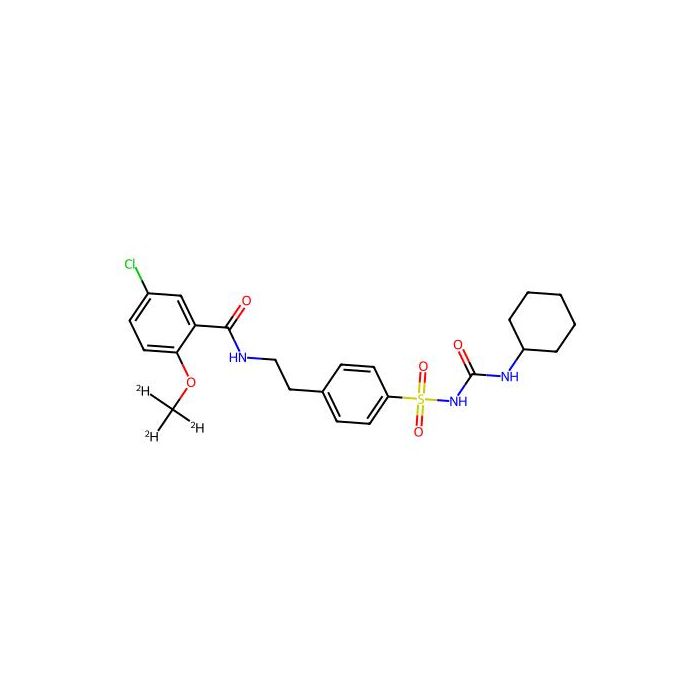
Glyburide-d 3 is the deuterium labeled Glibenclamide. Glibenclamide (Glyburide) is an orally active ATP-sensitive K+ channel (KATP) inhibitor and can be used for the research of diabetes and obesity.Glibenclamide inhibits P-glycoprotein . Glibenclamide directly binds and blocks the SUR1 subunits of KATP and inhibits the cystic fibrosis transmembrane conductance regulator protein (CFTR).Glibenclamide interferes with mitochondrial bioenergetics by inducing changes on membrane ion permeability.Glibenclamide can induce autophagy.
In Vitro
Stable heavy isotopes of hydrogen, carbon, and other elements have been incorporated into drug molecules, largely as tracers for quantitation during the drug development process. Deuteration has gained attention because of its potential to affect the pharmacokinetic and metabolic profiles of drugs. MCE has not independently confirmed the accuracy of these methods. They are for reference only.
Form:Solid
Especificaciones
Especificaciones y pureza
≥98%
Mecanismos bioquímicos y fisiológicos
Glyburide-d 3 is the deuterium labeled Glibenclamide. Glibenclamide (Glyburide) is an orally active ATP-sensitive K+ channel (KATP) inhibitor and can be used for the research of diabetes and obesity. Glibenclamide inhibits P-glycoprotein . Glibenclamid
Condiciones de almacenamiento de almacenamiento
Store at -20°C
Enviado en
Ice chest + Ice pads
Este producto requiere envío en cadena de frío. Los servicios terrestres y otros servicios económicos no están disponibles.
Tipo de acción
INHIBITOR
Pureza
≥98%
Nombres e identificadores
Peso molecular
497.02
Datos avanzados
Certificados (CoA, COO, BSE/TSE y tabla de análisis)
C of A & Other Certificates(BSE/TSE, COO):
Analytical Chart:
Calculadoras de soluciones
Molarity Calculator
Determine the necessary mass, volume, or concentration for preparing a solution.
Dilution Calculator
Determine the dilution needed to prepare a stock solution.
Reconstitution Calculator
Reseñas
Reseñas de cliente
Application Protocols
Use-case: LC–MS/MS internal standard for quantitation of glyburide (illustrative protocol; adjust per lab SOP)
To 100 µL biological or formulation sample, add 10 µL ISTD, then 300 µL MeCN (0.1% FA). Vortex, centrifuge, and transfer supernatant.
Chromatography (example conditions)
Mobile A: H2O + 0.1% FA; Mobile B: MeCN. Gradient to 80–95% B over 5–7 min; flow 0.3–0.5 mL/min; 30–40 °C column oven.
MS/MS
Monitor glyburide MRM transitions and corresponding +3 Da transitions for Glyburide‑d3; optimize CE and DP empirically.
Quantitation
Use peak area ratios (analyte/ISTD) vs calibration curve; verify ion ratio tolerances for identity confirmation.
Notes
Parameters above are general examples for research use and are not specifications. Validate for your instrument, matrix, and regulatory context.
Biological Roles
Biochemical context (parent glyburide; for mechanistic understanding only, not clinical use)
Target class: ATP‑sensitive K+ (KATP) channel modulator via binding to the SUR (sulfonylurea receptor) subunit (e.g., SUR1 in pancreatic β‑cells; SUR2 isoforms in other tissues), leading to channel inhibition.
Molecular pharmacology: interaction occurs at sulfonylurea binding sites; structure–activity relationships highlight the importance of the sulfonylurea linkage, arylsulfonyl moiety, and lipophilic substituents for high‑affinity binding.
Downstream effects (biochemical level): KATP closure depolarizes membranes, influencing Ca2+ influx and exocytotic processes in excitable cells.
Role of deuteration (analytical/biochemical utility)
Isotopic labeling (d3) preserves receptor/transport interactions while enabling mass-spectrometric discrimination from the unlabeled compound; ideal for recovery correction and kinetic studies in complex biological matrices.
Deuteration can slightly shift fragmentation patterns and isotope distributions in MS/MS, assisting in confident identification without altering biological mechanism.
Important notes
This product is supplied strictly for laboratory research and analytical method development. No medical, diagnostic, or in vivo use is intended or implied. Biological interactions described above are provided as general background on the parent compound.
Buffer Applications
Not typically applicable. Glyburide‑d3 is a hydrophobic small-molecule standard and does not function as a buffering agent.
Practical guidance
When preparing aqueous working solutions or calibration standards, use organic co‑solvent systems (e.g., 50–90% acetonitrile or methanol with 0.1% formic acid or ammonium formate) rather than attempting dissolution in neat buffer.
Maintain near‑neutral pH during handling to minimize potential hydrolysis of sulfonylurea/amide functionalities.
Green Alternatives
While Glyburide‑d3 itself is a specialty analytical reagent, you can optimize the surrounding workflow for greener practice by solvent and waste minimization.
Greener solvent choices (relative to common LC–MS solvents)
Acetonitrile vs methanol
MeCN: superior chromatographic performance at lower backpressure; higher toxicity; petro‑derived.
MeOH: renewable routes available; higher viscosity/backpressure; may slightly reduce sensitivity in ESI for some analytes.
DMSO replacement
DMSO is effective but persistent; consider MeCN stock solutions when solubility allows to reduce DMSO carryover.
Mini‑scale and waste reduction
Prepare small aliquots (e.g., 50–200 µL) at validated concentrations to reduce thaw/freeze cycles and disposal volume.
Use micro‑extraction (µSPE, SPME) where compatible to cut organic solvent consumption.
Switching to methanol‑rich mobile phases may require column/temperature adjustments to maintain resolution and run time. Validate retention, peak shape, and MS response when changing solvents.
Pharmaceutical Uses
Formulation/manufacturing context (no therapeutic claims)
Analytical reference/ISTD: Widely used in pharmaceutical development and QC laboratories as a stable‑isotope internal standard for assay of glyburide in drug substance, finished product, and stability studies by LC–MS(/MS).
System suitability and calibration: Supports linearly across relevant ranges; used to verify extraction efficiency, peak identity (via ion ratio), and to monitor instrument performance.
Regulatory/quality considerations (general)
Maintain comprehensive documentation: CoA for each lot, labeling pattern, isotopic enrichment, and storage conditions.
Align with compendial/ICH analytical validation requirements where applicable: accuracy, precision, specificity, linearity, range, robustness, and stability (short‑ and long‑term).
Sample preparation roles
Spike as an internal standard prior to sample work‑up (protein precipitation, LLE, SPE) to normalize recovery.
Employ matrix‑matched calibration or standard‑addition strategies where significant matrix effects are observed.
Notes
This product is intended for research and development or in‑process analytical control; it is not an API, excipient, or clinical diagnostic reagent.
Physical Properties
Item-specific values (specifications)
Appearance: Not specified for this item; refer to CoA/Spec Sheet.
Purity/grade: Not specified for this item; refer to CoA/Spec Sheet.
Molecular weight: Not specified for this item; refer to CoA/Spec Sheet.
Molecular formula: Not specified for this item; refer to CoA/Spec Sheet.
Melting point, boiling point, density, refractive index, UV cutoff, water/peroxide/metal content: Not specified for this item; refer to CoA/Spec Sheet.
General/literature information for the parent (glyburide; for context only)
Physical form: typically a crystalline solid; highly lipophilic.
Solubility profile (literature): poorly soluble in water; soluble in DMSO, DMF, acetonitrile, and to a lesser extent in methanol/ethanol; improved solubility in basic organic media can lead to degradation—avoid strong base.
LogP (literature, parent glyburide): high lipophilicity (reported clogP ~4–5 range).
Ionization: weakly acidic sulfonylurea NH (can deprotonate under strong base), amide largely neutral under physiological pH.
Isotopic effect: deuteration (+3 Da exact mass vs unlabeled) does not materially change bulk physical behavior; chromatographic retention is generally similar, with minimal isotope effect.
Notes for practical handling (general)
Prepare concentrated stocks in anhydrous DMSO, acetonitrile, or methanol to facilitate LC–MS use.
Protect from prolonged light and moisture to limit potential hydrolysis of urea/sulfonylurea motifs. Always confirm item-specific data on the CoA for quantitative parameters.
Quality and Grades
Item-specific quality details
Grade/purity: Not specified for this item; refer to CoA/Spec Sheet.
Stabilizers/antioxidants: Not specified for this item; refer to CoA/Spec Sheet.
Context for isotope-labeled reference materials
Isotope-labeled small molecules such as Glyburide‑d3 are typically produced for quantitative LC–MS(/MS) workflows. Key quality dimensions include:
Isotopic enrichment and labeling site(s) verification by HRMS/NMR.
Chemical purity and residual solvents by GC/LC.
Isotopic purity (D/H ratio and absence of over‑ or under‑labeled species) critical for accurate internal standardization.
Low background contaminants to prevent ion suppression and interferences.
What the grade implies (general guidance)
“Analytical/reference standard grade” (when applicable) emphasizes high chemical purity and well‑characterized isotopic composition; “LC–MS grade” solvents are recommended for preparing solutions to preserve low background.
For trace-quantitation, a well‑documented CoA typically provides: exact mass, isotopic distribution, assay, residual solvent profile, and recommended storage.
User recommendations
Request and review the CoA/Spec Sheet for this lot to verify labeling pattern, assay, and isotopic enrichment prior to method validation.
Prepare fresh calibration/ISTD solutions gravimetrically with verified balances and LC–MS grade solvents; record exact concentrations for auditability.
Reaction and Applications
Primary research applications (isotope-labeled standard)
Internal standard (ISTD) for quantitative LC–MS(/MS) analysis of glyburide in complex matrices (e.g., formulation extracts, in vitro samples). The +3 Da mass shift provides robust coelution and correction for matrix effects, extraction recovery, and ionization variability.
Metabolic studies: tracking of parent drug versus labeled analog to assess extraction efficiency and potential in‑source fragmentation artifacts.
Method development: tuning source/transition parameters using a deuterated analog mitigates carryover quantitation error.
Analytical considerations (general)
Select multiple reaction monitoring (MRM) transitions offset by +3 Da relative to unlabeled glyburide; verify that labeling sites are not prone to H/D exchange under your conditions (consult CoA for labeling pattern).
Co‑elution: confirm by overlaying chromatograms; minor isotope effects on retention are typically negligible but should be checked.
Matrix: spike ISTD prior to extraction (protein precipitation, LLE, or SPE) to normalize recovery.
Chemical reactivity (context)
The sulfonylurea/amide functionalities can undergo hydrolysis under strongly basic or strongly acidic conditions and at elevated temperature; avoid such conditions during sample prep.
Documentation
Record lot numbers and isotopic enrichment for regulated environments; include ISTD details in validation reports per ICH/MHRA guidance (as applicable).
Reaction Conditions
This product is used predominantly as an analytical internal standard rather than a synthetic reagent. Nevertheless, the following practical laboratory conditions are relevant to its preparation and use in analytical workflows.
Stock and working solutions (general guidance)
Stock: dissolve at 0.5–10 mg/mL in anhydrous acetonitrile or DMSO; vortex and, if needed, sonicate mildly. Filter through 0.2 µm PTFE if particulates persist.
Working solutions: dilute stocks with MeCN/H2O or MeOH/H2O containing 0.1% formic acid or ammonium formate/acetate for LC–MS. Prepare freshly or store short‑term at ≤4 °C.
Stability considerations (parent framework)
Avoid prolonged exposure to strong base or strong acid and elevated temperatures; sulfonylurea/amide linkages can hydrolyze under harsh conditions.
Minimize light and moisture exposure; store aliquots at −20 °C to limit freeze–thaw cycles.
Choose MRM transitions offset by +3 Da from the unlabeled parent; optimize collision energies empirically.
Typical mobile phases: water + 0.1% FA (A) and acetonitrile or methanol (B); C18 or phenyl‑hexyl phases provide good retention of sulfonylureas.
Injection solvents should match initial mobile phase organic content to maintain peak shape.
Disclaimer: The above are general laboratory practices, not product specifications. Verify compound‑specific stability and solubility with the CoA/SDS.
Safety and Handling
GHS and hazard classification (item-specific)
Signal word: Not specified for this item; refer to SDS.
Hazard statements (H‑statements): Not specified for this item; refer to SDS.
GHS classification/pictograms: Not specified for this item; refer to SDS.
General laboratory safety guidance (non‑authoritative; consult SDS)
Personal protective equipment: lab coat, safety glasses, and appropriate chemically resistant gloves (e.g., nitrile). Handle powders in a fume hood to minimize inhalation exposure.
Avoid: generating dust/aerosols; contact with skin/eyes; ingestion. Deuterated analogs should be handled with the same caution as their protiated counterparts.
Incompatibilities: strong bases and strong acids may promote hydrolysis of sulfonylurea/amide linkages; strong oxidants generally to be avoided.
First aid (overview): if inhaled, move to fresh air; in case of skin/eye contact, rinse with water for ≥15 min; if ingested, rinse mouth—seek medical attention in all cases. Always defer to SDS for authoritative actions.
Spill response: avoid dusting; gently cover and collect using dampened disposable towels or HEPA‑filtered vacuum; dispose of as hazardous organic solid waste per institutional policy.
Fire safety: use CO2, dry chemical, or foam. Combustion may produce NOx, SOx, HCl/HClO and CO/CO2.
Storage and shipping (from product data)
Storage: Store at −20 °C (tightly sealed, desiccated, light‑protected recommended).
Lipophilic, weakly acidic sulfonylurea; essentially nonionic under neutral conditions; very low aqueous solubility.
Recommended solvents (general/literature for glyburide and its d‑analogs)
Primary: DMSO, acetonitrile (MeCN), methanol. These provide reliable dissolution and LC–MS compatibility.
Secondary: DMF, isopropanol (warming/sonication may be needed).
Aqueous buffers: typically require co‑solvent (≥40–80% MeCN or MeOH) or cyclodextrins/surfactants for appreciable solubility; avoid high pH to prevent hydrolysis.
Practical selection by application
LC–MS internal standard stock: DMSO or MeCN at 0.5–10 mg/mL; dilute into MeCN/H2O (0.1% FA) or MeOH/H2O shortly before use.
Solid‑phase extraction (SPE) workflows: MeOH or MeCN eluents; ISTD spiking in MeCN minimizes matrix precipitation.
Stability considerations: minimize exposure to strong base or prolonged elevated temperature; store aliquots at −20 °C.
MeCN: excellent LC–MS solvent; low viscosity; fast evaporation for calibration curve prep.
MeOH: good protic alternative; may slightly shift retention times vs MeCN.
Tip
Filter final working solutions (0.2 µm PTFE) when feasible to remove particulates; avoid nylon with strong organic solvent mixes.
Storage and Reconstitution
Item-specific conditions (from product data)
Storage: Store at −20 °C.
Shipping: Ice chest + ice pads.
General best practices for this compound class
Protect from light and moisture. Store in tightly closed amber vials with desiccant. Consider inert gas backfill for long‑term stability.
Aliquot upon receipt to avoid repeated freeze–thaw cycles; typical aliquots 50–200 µL for analytical use.
Reconstitution guidance
Solvents: Use anhydrous acetonitrile, DMSO, or methanol to prepare concentrated stock solutions (e.g., 0.5–10 mg/mL). Warm gently (≤40 °C) and/or sonicate briefly if needed; do not overheat.
Working solutions: Dilute with MeCN/H2O or MeOH/H2O (with 0.1% FA or volatile buffer) immediately prior to analysis. Discard working solutions after use or store short‑term at 2–8 °C if stability is verified.
Stability notes
Avoid strong acids/bases and prolonged elevated temperature to minimize hydrolytic degradation of sulfonylurea/amide linkages.
Periodically verify concentration by UV or LC–MS response against fresh standards when used in regulated assays.
Documentation
Retain the CoA/Spec Sheet and record lot number, preparation dates, and storage history for audit trails. Research use only.
Structure and Identity
Isotope-labeled analog of glyburide (glibenclamide), a sulfonylurea small molecule; this product contains three deuterium atoms (d3) for mass spectrometric discrimination.
SKU: G649488
Product name: Glyburide-d3
CAS: 1219803-02-7
Category: Small-molecule/isotope-labeled reference standard (research use only)
Item-specific identifiers
Molecular formula: Not specified for this item; refer to CoA/Spec Sheet.
Molecular weight: Not specified for this item; refer to CoA/Spec Sheet.
SMILES: Not specified for this item; refer to CoA/Spec Sheet.
InChIKey: Not specified for this item; refer to CoA/Spec Sheet.
Structural features (general, based on glyburide literature)
Core functionality: sulfonylurea (–SO2–NH–CO–NH–) linking an arylsulfonyl moiety to a urea nitrogen.
Aromatic systems: a para‑substituted phenyl (attached to sulfonyl group) and a 5‑chloro‑2‑methoxy substituted phenyl connected through an ethylene spacer and an amide linkage.
Additional substituents: cyclohexyl group on the distal urea nitrogen (literature for parent glyburide).
Heteroatoms: multiple O (sulfonyl, carbonyl, methoxy), N (urea/sulfonamide), and one Cl on the anisamide ring.
Isotopic label: three deuterium atoms (²H) incorporated at defined positions (supplier-specific; consult CoA for labeling pattern).
2D structure description (literature)
A para‑sulfonylphenyl ring bears the sulfonylurea, terminating in an N‑cyclohexyl urea; the sulfonyl phenyl is connected via –CH2–CH2– to a second anisamide ring substituted with 5‑Cl and 2‑OMe. The d3 label does not alter connectivity but shifts exact mass for MS workflows.
Synthetic Utility
As a deuterium‑labeled analog, Glyburide‑d3 is not commonly used as a building block for synthesis; however, it provides value in chemical and mechanistic studies.
Utility in research chemistry
Isotope tracing: Verification of analyte identity in complex mixtures and tracking of adsorption/partitioning during sample handling.
Kinetic isotope effect (KIE) assessment: While small for non‑exchangeable C–D positions, deuteration may modestly impact specific fragmentation or degradation pathways; useful in mechanistic degradation studies (e.g., stress testing).
Reference in forced‑degradation mapping: Parallel degradation of unlabeled and d3 analogs helps confirm transformation products by precise mass shifts (+3.0188 Da where labels are retained).
Functional group reactivity context (parent framework)
Contains sulfonylurea and amide functionalities prone to hydrolysis under strong base/acid and heat; aryl chloride is typically inert under mild conditions; methoxy group stable under neutral conditions but cleavable under strong acids.
Analytical derivatization (if attempted)
Derivatization is generally unnecessary for LC–MS; if GC analysis is explored, extensive derivatization would be required due to polarity/thermal lability and is not recommended.
Target Specificity
No antibody/biologic targeting data apply to this small‑molecule isotope standard.
Target, epitope, clone, isotype, and species reactivity: Not applicable to this item.
For biochemical background on the parent compound’s binding (KATP/SUR), refer to the “Biological Roles” section. These are mechanistic insights and not product‑specific targeting attributes.
Preguntas frecuentes
What is the purity of this product?
This product is supplied at ≥98% purity (chemical assay). Lot-specific values are stated on the Certificate of Analysis.
How should this product be stored?
Store at ?20 °C. Freezer storage is required to maintain the specified shelf life.
How is this product shipped?
This product ships in an insulated container with ice pads. Unpack on arrival and transfer it to the storage condition stated above.
What are the CAS number, molecular formula and molecular weight?
The CAS Number is 1219803-02-7, the molecular formula is C23H25D3ClN3O5S, and the molecular weight is 497.02 g/mol.
What documentation is provided?
Available product documentation, including Certificates of Analysis (COA), Safety Data Sheets (SDS), and specification sheets, is shown in the product document area. Document availability and access follow the current site policy.
Utilizamos cookies para garantizar el correcto funcionamiento del sitio web y, cuando esté permitido, para mejorar su experiencia. Puede gestionar sus preferencias en cualquier momento en Configuración. Más información en nuestra Política de Cookies.
¿Quieres que te enviemos un mensaje cuando tengamos descuentos disponibles?
Recordármelo más tarde
¡Gracias! Por favor, revisa tu bandeja de entrada de correo electrónico para confirmar.
Products are supplied to verified businesses, institutions, and qualified professionals for research and development use only. Not for use in humans, animals, diagnosis, or therapy.