Determine the necessary mass, volume, or concentration for preparing a solution.
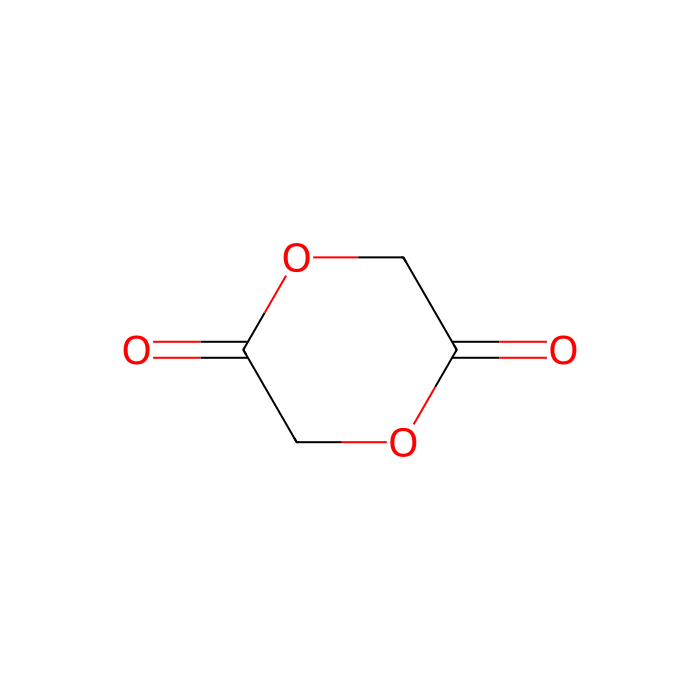
Glycolide is a cyclic dimer of α-hydroxy acid that can be used in the formation of aliphatic polyester. It is synthesized by the dimerization of glycolic acid. It forms a low toxic synthetic biodegradable polymer that can be used in medical applications. It is majorly used in the formation of a highly crystalline poly(glycolide) by ring opening polymerization.
Application:
Glycolide can be used as a monomer in the preparation of poly(lactic-co-glycolide)(PGLA) via copolymerization with lactide monomer. PGLA is further used in the following applications:
Porous PGLA microsphere scaffolds are used in bone repair applications.
Encapsulated PGLA nanoparticles can be used in drug delivery and tissue engineering applications. Polymeric micro/nanoparticles made from PLGA have gained significant interest for their appealing characteristics, including biodegradability, biocompatibility, prolonged drug release, and safeguarding the drug against degradation.
It can also be used to synthesize poly(glycolide-caprolactone)(PGCL) copolymers applicable as bioabsorbable suture materials.
Taxonomy Tree
| Kingdom | Organic compounds |
|---|---|
| Superclass | Organoheterocyclic compounds |
| Clase | Dioxanes |
| Subclass | 1,4-dioxanes |
| Intermediate Tree Nodes | Not available |
| Direct Parent | 1,4-dioxanes |
| Alternative Parents | Dicarboxylic acids and derivatives Lactones Carboxylic acid esters Oxacyclic compounds Organic oxides Hydrocarbon derivatives Carbonyl compounds |
| Molecular Framework | Aliphatic heteromonocyclic compounds |
| Substituents | Dicarboxylic acid or derivatives - Para-dioxane - Lactone - Carboxylic acid ester - Oxacycle - Carboxylic acid derivative - Organic oxygen compound - Organic oxide - Hydrocarbon derivative - Organooxygen compound - Carbonyl group - Aliphatic heteromonocyclic compound |
| Descripción | This compound belongs to the class of organic compounds known as 1,4-dioxanes. These are organic compounds containing 1,4-dioxane, an aliphatic six-member ring with two oxygen atoms in ring positions 1 and 4. |
| External Descriptors | Not available |
Find and download the COA for your product by matching the lot number on the packaging.
| Lot Number | Certificate Type | Fecha | Articulo |
|---|---|---|---|
| Certificate of Analysis | Jun 15, 2026 | G156824 | |
| Certificate of Analysis | Jun 09, 2025 | G156824 | |
| Certificate of Analysis | Apr 24, 2025 | G156824 | |
| Certificate of Analysis | Apr 24, 2025 | G156824 | |
| Certificate of Analysis | Apr 24, 2025 | G156824 | |
| Certificate of Analysis | Apr 24, 2025 | G156824 | |
| Certificate of Analysis | Apr 24, 2025 | G156824 | |
| Certificate of Analysis | Dec 02, 2024 | G156824 | |
| Certificate of Analysis | Dec 02, 2024 | G156824 | |
| Certificate of Analysis | Dec 18, 2023 | G156824 | |
| Certificate of Analysis | Sep 20, 2022 | G156824 | |
| Certificate of Analysis | Sep 20, 2022 | G156824 | |
| Certificate of Analysis | Sep 20, 2022 | G156824 | |
| Certificate of Analysis | Sep 20, 2022 | G156824 | |
| Certificate of Analysis | Sep 20, 2022 | G156824 | |
| Certificate of Analysis | Sep 20, 2022 | G156824 | |
| Certificate of Analysis | Aug 16, 2022 | G156824 | |
| Certificate of Analysis | Aug 16, 2022 | G156824 | |
| Certificate of Analysis | Aug 16, 2022 | G156824 | |
| Certificate of Analysis | May 31, 2022 | G156824 | |
| Certificate of Analysis | May 31, 2022 | G156824 | |
| Certificate of Analysis | May 31, 2022 | G156824 | |
| Certificate of Analysis | May 31, 2022 | G156824 |
| Solubilidad | Soluble in Dimethylformamide |
|---|---|
| Sensibilidad | Moisture & air & heat sensitive |
| Punto de ebullición (°C) | 130℃ |
| Punto de fusión (°C) | 82-86℃ |
| Peso molecular | 116.07 |
| XLogP3 | -0.200 |
| Hydrogen Bond Donor Count | 0 |
| Hydrogen Bond Acceptor Count | 4 |
| Rotatable Bond Count | 0 |
| Exact Mass | 116.011 Da |
| Monoisotopic Mass | 116.011 Da |
| Topological Polar Surface Area | 52.600 Ų |
| Heavy Atom Count | 8 |
| Formal Charge | 0 |
| Complexity | 112.000 |
| Isotope Atom Count | 0 |
| Defined Atom Stereocenter Count | 0 |
| Undefined Atom Stereocenter Count | 0 |
| Defined Bond Stereocenter Count | 0 |
| Undefined Bond Stereocenter Count | 0 |
| The total count of all stereochemical bonds | 0 |
| Covalently-Bonded Unit Count | 1 |
H302:Harmful if swallowed
H319:Causes serious eye irritation
P260:Do not breathe dust/fume/gas/mist/vapors/spray.
P264:Wash hands [and …] thoroughly after handling.
P270:Do not eat, drink or smoke when using this product.
P280:Wear protective gloves/protective clothing/eye protection/face protection.
P321:Specific treatment (see ... on this label).
P330:Rinse mouth.
P363:Wash contaminated clothing before reuse.
P301+P330+P331:IF SWALLOWED: Rinse mouth. Do NOT induce vomiting.
P304+P340:IF INHALED: Remove person to fresh air and keep comfortable for breathing.
P305+P351+P338:IF IN EYES: Rinse cautiously with water for several minutes. Remove contact lenses if present and easy to do - continue rinsing.
P405:Store locked up.
P501:Dispose of contents/container to an approved waste disposal plant.
P264+P265:Wash hands [and …] thoroughly after handling. Do not touch eyes.
P301+P317:IF SWALLOWED: Get medical help.
P305+P354+P338:IF IN EYES: Immediately rinse with water for several minutes. Remove contact lenses if present and easy to do. Continue rinsing.
P317:Get emergency medical help.
P337+P317:If eye irritation persists: Get medical help.
P302+P361+P354:IF ON SKIN: Take off Immediately all contaminated clothing. Immediately rinse with water for several minutes.
P316:Get emergency medical help immediately.